Maintenance for the week of May 4:
• PC/Mac: No maintenance – May 4
• PC/Mac: No maintenance – May 4
Stop saying necro-potence
-
 srfrogg23✭✭✭✭✭
✭✭✭Only thing this thread has proven is the American English has failed as a language. People continuing to debate when we can use proper phonics is a pretty sad state of affairs.
Yes, this is clearly an indication that it's time for someone to push the big red button and put an end to all this madness.
It truly is a sad state of affairs when people don't pronounce words the way a pompous scholar of useless subjects would prefer.0 -
 Arthg✭✭✭✭✭
✭The issue lies with whether suffixes are stress-imposing or not.
"Polis" (from the Greek work meaning city) is a stress-imposing suffix: it requires the previous syllable to be stressed.
All English words ending with "-polis" feature a stressed syllable before it.
As a prefix, "necro" will therefore adapt its pronunciation on whether the suffix is stress-imposing: it'll be pronounced "neck-roe" in "necromancer", "***", etc. but "ne crop" in "necropolis".
So now the question boils down to figuring out whether "potence" is a stress-imposing suffix or not.
In English, "potence" is not a stand-alone word, because of "potency", so arguing it should be pronounced " poe t@nse" ("@ being a schwa, i.e. the sound in the second syllable of, say, mountain") is going to be difficult.
We do have two words with "-potence" as a suffix, though: "omnipotence" and "impotence".
These two words help us solve the issue, because they don't have the same number of syllables - yet in both instances, the preceding syllable is stressed ("omNIp@t@nce", "IMp@t@nce").
The odds are therefore that "-potence" is a stress-imposing suffix.
Ergo: the OP's right: ne-crop-@t@ns, as in "incompetence".
You could also say that potence is a possessive form of potent when combined with a prefix.
"He is omnipotent" describes "him".
"His omnipotence" belongs to "him".
"He is necropotent" may sound nonsensical, but it works in the context of this fake word.
"His Necropotence", again nonsensical outside of fictional situations, but still suggests "he" possesses it.
In that situation, I wouldn't emphasize the "crop" part of the word. It's still two words being jammed together.
And, pronouncing "tence" like "tains" just sounds extra weird. I don't think that's going to catch on.
Not sure I understood what you said about the possessive form, or how that would help infer a defendable pronunciation, but what I meant with the "mountains" example was that the vowel in those syllables ("-tains" and "-tence") is reduced to a schwa (just like the second <a> in "data") - with the caveat of regional accents, some of which will feature no observable vowels on a spectrogram in "-tains", only so-called "vocalic nasals". Bit technical and irrelevant.
The point is that the only words in English that contain "potence", i.e. "impotence" and "omnipotence", feature it as a stress-imposing suffix (stress on the syllable preceding it, "IM-" and "omNI-"), which supports the argument for a "neCROPotence" / "incompetence" pronunciation - and in those words, the two vowels of "-potence" are schwas.
You're putting way too much thought into this. Gotta scale it back some. I'm talking about the "way back when" days of English class.
The subject, verb, adjective, preposition days of English class.
I'm talking about how you modify the words of a sentence to show their relationship to the subject of the sentence. It's either describing the subject, describing what/how the subject is doing it, or if it is a quality that belongs to the subject.
The possessive form of a word illustrates that something belongs to the subject. The same example as before:
"He is omnipotent" describes the subject.
"His omnipotence" describes a quality that the subject owns.
That's what I mean by "possessive form".
As far as why Necropotence should be pronounced Necro-potence. Potence is the possessive modifier of Potent. Potent is not relegated to being only a suffix in the English language so no need to modify the pronunciation of the prefix, "Necro".
I'll start by saying that this is all a mind game, and that I'm not defending tooth and nail any sort of pronunciation.
It's just for the sake of argument, and for the sake of applying well-documented phonological processes to a neologism (the combination of a Greek root, "necro", and a Latin one, "potent", is itself dubious) - for the sake of lulz, no more.
To state that "potence is the possessive modifier of potent" shows that, well, you must have been quite asleep during your English classes, I'm sorry to say.
None of your "explanations" are related to pronunciation, and they're based either on a failure to grasp the grammatical issues at hand (the relationship between "potent" and non-word "potence" has got nothing to do with possessive modifiers, it's a matter of grammatical nature, of derivation), or on a failure to manipulate the metalanguage (perhaps you mean something other than "possessive modifier").
Because of the existence of "potency" (affixations of the root "potent" are indeed extremely interesting), "-potence" ONLY exists as a suffix ("impotence" and "omnipotence"). And in those words, both vowels of "-potence" are reduced to schwas.
Now.
You could also argue the contrary, because of... "prepotence".
This would lead to a *very* interesting discussion (on opaque and transparent derivations), which (un)fortunately has got no place on a video-game forum.
I'll leave it at that, then
Ah, I see. You paid a bunch of money for graduate level language classes and now you have nowhere else to use it outside of a museum or the classroom.
But, you've gotta do something with that information so you might as well impress people on an MMO forum.
Makes sense, I suppose. Far be it from me to interrupt your mind games.
I love words and languages, and playing, mate, no need to get salty - chillax PC/EU. NoCP PvP. sDK Orc IRL. Flawless tamperor. Pro scrub.3 -
 dreddurius✭✭✭Can't go beyond "necro" because I get all warm and fuzzy inside.CAN I HAZ UR STUFF?0
 -
 Bouldercleave✭✭✭✭✭
✭✭✭And to think this made it to 9 pages...
I pronounce it NecWHOGIVESASHIT.
But that's just me.2 -
 Sinthrax✭✭✭✭I don't care. I am going to pronounce it the way I want. I could care less about your proper English. If you know what I said...then so be it. Language is so people can communicate and I would assume you know what is being said with either pronunciation.
I really don't care. I am use to doing what I wanted since I made my own money.Edited by Sinthrax on March 12, 2017 2:09AM1 -
srfrogg23✭✭✭✭✭
✭✭✭The issue lies with whether suffixes are stress-imposing or not.
"Polis" (from the Greek work meaning city) is a stress-imposing suffix: it requires the previous syllable to be stressed.
All English words ending with "-polis" feature a stressed syllable before it.
As a prefix, "necro" will therefore adapt its pronunciation on whether the suffix is stress-imposing: it'll be pronounced "neck-roe" in "necromancer", "***", etc. but "ne crop" in "necropolis".
So now the question boils down to figuring out whether "potence" is a stress-imposing suffix or not.
In English, "potence" is not a stand-alone word, because of "potency", so arguing it should be pronounced " poe t@nse" ("@ being a schwa, i.e. the sound in the second syllable of, say, mountain") is going to be difficult.
We do have two words with "-potence" as a suffix, though: "omnipotence" and "impotence".
These two words help us solve the issue, because they don't have the same number of syllables - yet in both instances, the preceding syllable is stressed ("omNIp@t@nce", "IMp@t@nce").
The odds are therefore that "-potence" is a stress-imposing suffix.
Ergo: the OP's right: ne-crop-@t@ns, as in "incompetence".
You could also say that potence is a possessive form of potent when combined with a prefix.
"He is omnipotent" describes "him".
"His omnipotence" belongs to "him".
"He is necropotent" may sound nonsensical, but it works in the context of this fake word.
"His Necropotence", again nonsensical outside of fictional situations, but still suggests "he" possesses it.
In that situation, I wouldn't emphasize the "crop" part of the word. It's still two words being jammed together.
And, pronouncing "tence" like "tains" just sounds extra weird. I don't think that's going to catch on.
Not sure I understood what you said about the possessive form, or how that would help infer a defendable pronunciation, but what I meant with the "mountains" example was that the vowel in those syllables ("-tains" and "-tence") is reduced to a schwa (just like the second <a> in "data") - with the caveat of regional accents, some of which will feature no observable vowels on a spectrogram in "-tains", only so-called "vocalic nasals". Bit technical and irrelevant.
The point is that the only words in English that contain "potence", i.e. "impotence" and "omnipotence", feature it as a stress-imposing suffix (stress on the syllable preceding it, "IM-" and "omNI-"), which supports the argument for a "neCROPotence" / "incompetence" pronunciation - and in those words, the two vowels of "-potence" are schwas.
You're putting way too much thought into this. Gotta scale it back some. I'm talking about the "way back when" days of English class.
The subject, verb, adjective, preposition days of English class.
I'm talking about how you modify the words of a sentence to show their relationship to the subject of the sentence. It's either describing the subject, describing what/how the subject is doing it, or if it is a quality that belongs to the subject.
The possessive form of a word illustrates that something belongs to the subject. The same example as before:
"He is omnipotent" describes the subject.
"His omnipotence" describes a quality that the subject owns.
That's what I mean by "possessive form".
As far as why Necropotence should be pronounced Necro-potence. Potence is the possessive modifier of Potent. Potent is not relegated to being only a suffix in the English language so no need to modify the pronunciation of the prefix, "Necro".
I'll start by saying that this is all a mind game, and that I'm not defending tooth and nail any sort of pronunciation.
It's just for the sake of argument, and for the sake of applying well-documented phonological processes to a neologism (the combination of a Greek root, "necro", and a Latin one, "potent", is itself dubious) - for the sake of lulz, no more.
To state that "potence is the possessive modifier of potent" shows that, well, you must have been quite asleep during your English classes, I'm sorry to say.
None of your "explanations" are related to pronunciation, and they're based either on a failure to grasp the grammatical issues at hand (the relationship between "potent" and non-word "potence" has got nothing to do with possessive modifiers, it's a matter of grammatical nature, of derivation), or on a failure to manipulate the metalanguage (perhaps you mean something other than "possessive modifier").
Because of the existence of "potency" (affixations of the root "potent" are indeed extremely interesting), "-potence" ONLY exists as a suffix ("impotence" and "omnipotence"). And in those words, both vowels of "-potence" are reduced to schwas.
Now.
You could also argue the contrary, because of... "prepotence".
This would lead to a *very* interesting discussion (on opaque and transparent derivations), which (un)fortunately has got no place on a video-game forum.
I'll leave it at that, then
Ah, I see. You paid a bunch of money for graduate level language classes and now you have nowhere else to use it outside of a museum or the classroom.
But, you've gotta do something with that information so you might as well impress people on an MMO forum.
Makes sense, I suppose. Far be it from me to interrupt your mind games.
I love words and languages, and playing, mate, no need to get salty - chillax
Oh, my bad. Sorry 0
0 -
 Churga_Hral✭✭✭That special feeling you have when people are all wound up about the pronunciation of "necropotence" when they should really be worried about this:
carambapotence0 -
 Yubarius✭✭✭✭how about you stop pronouncing it like incompetence.
say it with me...
Necro - potence
Seriously you people are driving me nutz. You know who you are.
- Yubarius - Magicka NB - Flawless Conqueror
- YubariusX - Magicka Warden - Flawless Conqueror
- Lord Yubarius - Stamina Sorc - Stormproof - Centurion
- 'Rubick the Grand Magus - Magicka Sorc
- Fair Child Tank - Stamina DK
- Jaruko - Magicka Templar
- Selthyn Bavailo - Mag DK
- Bandit-The-Great - Stam Temp
2 -
 Langeston✭✭✭✭✭
✭I agree with the OP. If you think about how the word "Necropolis" (cemetery belonging to an ancient city) is pronounced, it makes sense if "Necropotence" is pronounced nek-róp-o-tense.
Sorry, but I'm not sorry for the thread necro — there has literally never been a more appropriate thread than this one to resurrect.😉3 -
 Cerotonin✭✭✭I agree with the OP. If you think about how the word "Necropolis" (cemetery belonging to an ancient city) is pronounced, it makes sense if "Necropotence" is pronounced nek-róp-o-tense.
Sorry, but I'm not sorry for the thread necro — there has literally never been a more appropriate thread than this one to resurrect.😉
LMAO0 -
 daemonios✭✭✭✭✭
✭✭✭✭✭I agree with the OP. If you think about how the word "Necropolis" (cemetery belonging to an ancient city) is pronounced, it makes sense if "Necropotence" is pronounced nek-róp-o-tense.
Sorry, but I'm not sorry for the thread necro — there has literally never been a more appropriate thread than this one to resurrect.😉
Long dead thread, arise and haunt these forums again and all that. As for your reply, it's cherry-picking at best. There are a number of words in the English language starting with "necro": Necromancer, necrosis, ***, necropolis, etc. Some are pronounced with the tonic on "nec", such as necromancer and necrophilia. Others have the tonic on the following syllable: necropolis, necrosis. But even in words from the same family the pronunciation can change. You say necrosis, but necrotize. Unless you can come up with a phonetic rule that explains where the accent falls in each case, I'd say it's up to oral tradition.Edited by daemonios on June 14, 2020 2:24PM0 -
 Elsonso✭✭✭✭✭
✭✭✭✭✭What I want to know is how they knew about "necromancer potency" and had a word for it (admittedly, misused) before the class even existed.XBox EU/NA:@ElsonsoJannus
PC NA/EU: @Elsonso
PSN NA/EU: @ElsonsoJannus
Total in-game hours: 11321
X/Twitter: ElsonsoJannus0 -
Langeston✭✭✭✭✭
✭I agree with the OP. If you think about how the word "Necropolis" (cemetery belonging to an ancient city) is pronounced, it makes sense if "Necropotence" is pronounced nek-róp-o-tense.
Sorry, but I'm not sorry for the thread necro — there has literally never been a more appropriate thread than this one to resurrect.😉
Long dead thread, arise and haunt these forums again and all that. As for your reply, it's cherry-picking at best. There are a number of words in the English language starting with "necro": Necromancer, necrosis, ***, necropolis, etc. Some are pronounced with the tonic on "nec", such as necromancer and necrophilia. Others have the tonic on the following syllable: necropolis, necrosis. But even in words from the same family the pronunciation can change. You say necrosis, but necrotize. Unless you can come up with a phonetic rule that explains where the accent falls in each case, I'd say it's up to oral tradition.
Wow, you certainly took this a lot more seriously than I did (not difficult I guess, considering I wasn't taking it seriously at all.)
My rationale was fairly simple: a Necropolis is an ancient graveyard, and the Necropotence card in Magic: The Gathering mentions a graveyard. 🤷♂️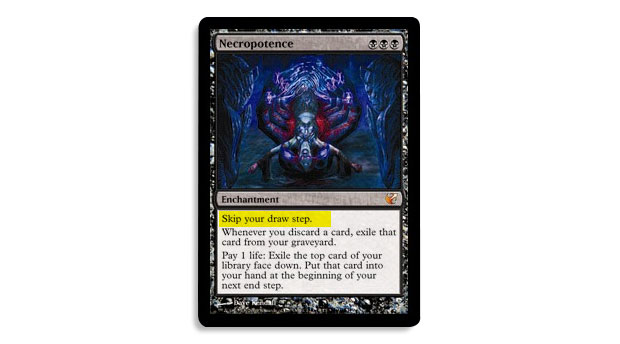
(Yes, I know the Graveyard is just your discard pile — as I said, I wasn't really taking this seriously.)
In any case, I would posit that Necropotence is probably more closely related to "an ancient graveyard" than "cellular injury/death" or [snip]
[Edited to remove Inappropriate Content]Edited by ZOS_ConnorG on June 14, 2020 3:31PM0 -
 ZOS_ConnorGmodGreetings all,
After review we have decided to close this thread down as it is a very old thread. If you wish to continue to discuss this topic you can create another thread so all of the information will be up to date. Thank you for your understanding.0


This discussion has been closed.