Maintenance for the week of January 5:
• PC/Mac: No maintenance – January 5
• NA megaservers for maintenance – January 7, 4:00AM EST (9:00 UTC) - 10:00AM EST (15:00 UTC)
• EU megaservers for maintenance – January 7, 4:00AM EST (9:00 UTC) - 10:00AM EST (15:00 UTC)
• PC/Mac: No maintenance – January 5
• NA megaservers for maintenance – January 7, 4:00AM EST (9:00 UTC) - 10:00AM EST (15:00 UTC)
• EU megaservers for maintenance – January 7, 4:00AM EST (9:00 UTC) - 10:00AM EST (15:00 UTC)
Apologizing to ZOS after being educated from ESO LIVE 8/12
-
 tinythinker✭✭✭✭✭
✭✭✭✭✭
*type*type*type*type*type*type*I pay so i expect a working product.
TOS says no...Edited by tinythinker on August 14, 2016 1:40AM❤Experienced, new, returner?❤ Help keep ESO's community strong ᕙ༼ຈل͜ຈ༽ᕗ -- share what you love about the game, offer constructive feedback, and make friends.ʕ·ᴥ·ʔ
. . . . . . . . . . . . . . . . . . . . . . . . . . . . .
Who are you in Tamriel (whether it's just your character's attitude & style or a full backstory)? - Share your Character's Story! ◔ ⌣ ◔
(And let us know 🔷What Kind of Roleplayer You Are🔷 - even if that only extends to choosing your race)
. . . . . . . . . . . . . . . . . . . . . . . . . . . . .
Support Mudcrab Mode for ESO (\/)!_!(\/) - part joke, part serious, all glorious! You butter be ready for this0 -
 Lysette✭✭✭✭✭
✭✭✭✭✭lordrichter wrote: »TequilaFire wrote: »tinythinker wrote: »Never raged. I see no point in raging on a forum.
However, I did find that segment particularly interesting. I know very little about how bug fixes work, so it was nice to see some insight into the process.
One thing that I will probably say trips ZOS up a lot is how differently a test server works compared to the live server. There's lots of variables that they can't or don't anticipate. For example, I can imagine that it is hard to recreate what happens on a live server in PVP, given that the server and indeed the client has to calculate so many different numbers at any given time.
And then, when they add thousands of lines of new code in with each DLC, that can create some havoc.
Is it an excuse? No. But sometimes things just can't be calculated no matter how much testing goes on. Could this game do with some shine and polishing? Sure could in some areas. But I can only imagine the stress that goes on in their offices.
That's one thing I've asked about and still don't get/never got an answer about.
I understand coding with so many interactive blocks of code can be tricky. I understand testing is hard. I understand bug chasing/squashing is hard. I understand that we each experience the game from different perspectives, have different encounters with performance, and want our own priorities moved to the top of the list. I also get that they say that they can only do so much on the PTS and also that buying more server space for live isn't a silver bullet. I'll grant each point.
Fine. OK. Sure.
But why *not* spend money increasing PTS server space to get it closer (not close, not the same, but closer) to conditions on live? I can only speculate that the bug/performance concerns aren't hitting the bottom line hard enough to justify the expense, but it could potentially save so much time and money spent going back to find and fix things after they hit live.
A live server like this is about 1.5-2 metric tons of hardware - this is not just a few blades in a rack. And it costs quite some amount of money as well. And even if they would use a copy of the live server, they do not have the load which is required to make sure it all will work, when the system comes under production load.
1.5 to 2 metric tons?
I see the problem now they are still running IBM 360s. lmao
/joking
This is really what something like this is - CCP has just ordered the hardware for the new TQ live server - which has to deal with about a similar amount of concurrency - and they said, the new hardware was 1.5 metric tons in weight.
For reference, here is the PC/Mac EU megaserver circa 2014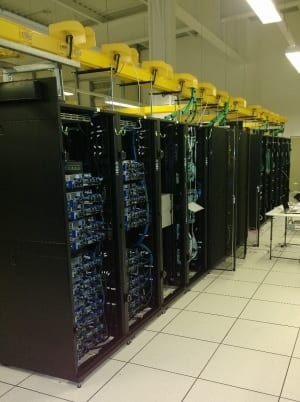
This might weight even more if it is the whole column.0 -
Lysette✭✭✭✭✭
✭✭✭✭✭tinythinker wrote: »tinythinker wrote: »tinythinker wrote: »
So basically if you cause lag your abilities do diddly?There would be a quite simple solution though, and I have suggested in many times - reverse scale the efficiency of spells and attacks with the effort required to resolve the interaction in a zerg - this would make it highly undesireable to form a zerg and things would get better. Meaning the more effort is required to resolve the interaction graph, the less effective spells and attacks coming from the zerg will get. Simple solution, zergs would be highly undesirable, and the lag would be significantly less. Of course this is based on that they have actual interaction graphs and do not just compute it in a brute force way. It has to be computed separately for any interaction group which is large enough to be a zerg.
Yes, this would solve the problem - the role play reasoning would be - if people are too close together, they interfere with each other and are less effective.
It is not a problem to compute all this without lag in a lot of smaller groups, but zergs with AoE spam are a nightmare and create lag.
With this system if I run into them as a proxy det bomber or hit them with siege, those calculations would also be impacted, so my damage to them would be diminished as well then. So would a group next to them, like a group of five enemies who they are swarming over. So, then, they would be shielded in a way, and take anyone interacting with them down the diddly squat rabbit hole? Or could this still work with the graph being Alliance specific? So I can then hit them hard while they fumble about?
Nah, you can compute the center (location) of the interaction group - weighted - and see all those who are in a certain range of this center as effected by the reduction and those outside have normal conditions. This would not effect the siege attack, because it is further away from the zerg. And a weighted center will give a better center than a normal average - and it is as well no extra computation, because the squared distances required to do that are easier to calculate than the actual distance.
So siege would wipe them (heals so weeeak) but if I or my small group ran into them we would get nerfed too. Hmm, well, it would definitely produce an interesting new dynamic. Siege+ranged attacks = upper hand unless the swarm reaches you and sucks you into their nightmare of weak sauce.
As long as you stay enough far away from the center, you would be more effective than those in the group. And I think in such a case people would care for being not too near to each other to not form a zerg and get treated like this - it would really better the situation. Especially because each AoE effect forms an own node and makes the theoretical zerg bigger and less effective.Edited by Lysette on August 14, 2016 1:49AM0 -
vyndral13preub18_ESO✭✭✭✭✭
✭✭✭✭tinythinker wrote: »tinythinker wrote: »tinythinker wrote: »
So basically if you cause lag your abilities do diddly?There would be a quite simple solution though, and I have suggested in many times - reverse scale the efficiency of spells and attacks with the effort required to resolve the interaction in a zerg - this would make it highly undesireable to form a zerg and things would get better. Meaning the more effort is required to resolve the interaction graph, the less effective spells and attacks coming from the zerg will get. Simple solution, zergs would be highly undesirable, and the lag would be significantly less. Of course this is based on that they have actual interaction graphs and do not just compute it in a brute force way. It has to be computed separately for any interaction group which is large enough to be a zerg.
Yes, this would solve the problem - the role play reasoning would be - if people are too close together, they interfere with each other and are less effective.
It is not a problem to compute all this without lag in a lot of smaller groups, but zergs with AoE spam are a nightmare and create lag.
With this system if I run into them as a proxy det bomber or hit them with siege, those calculations would also be impacted, so my damage to them would be diminished as well then. So would a group next to them, like a group of five enemies who they are swarming over. So, then, they would be shielded in a way, and take anyone interacting with them down the diddly squat rabbit hole? Or could this still work with the graph being Alliance specific? So I can then hit them hard while they fumble about?
Nah, you can compute the center (location) of the interaction group - weighted - and see all those who are in a certain range of this center as effected by the reduction and those outside have normal conditions. This would not effect the siege attack, because it is further away from the zerg. And a weighted center will give a better center than a normal average - and it is as well no extra computation, because the squared distances required to do that are easier to calculate than the actual distance.
So siege would wipe them (heals so weeeak) but if I or my small group ran into them we would get nerfed too. Hmm, well, it would definitely produce an interesting new dynamic. Siege+ranged attacks = upper hand unless the swarm reaches you and sucks you into their nightmare of weak sauce.
As long as you stay enough far away from the center, you would be more effective than those in the group.
This could lead to some entertaining trolling.0 -
 whiteshadow711jppreub18_ESO✭✭✭✭✭
✭I dont apologize and let me explain why.
Before on PC, I am now on PS4 NA, that when they had issues with abilities and other things after a major patch/DLC they would have most of the problems fixed about a month to a month and a half when they performed maintenance for the first year and further on.
Now we have to wait for fixes until every next DLC, really??? It wasn't always like it is now. I really see this as a cop out and an excuse that ZOS gave us on the most recent ESO Live. I think Fengrush is right, ZOS doesn't have the manpower like they did the initial year the PC debuted.
Also remember, the ability Shadow Cloak and its morphs were finally fixed when Imperial City dropped. Yes, it was broken all that time and in Beta.Edited by whiteshadow711jppreub18_ESO on August 14, 2016 2:06AMSigned, Kotaro Atani.PS5 NAVR16/ CP 160 Khajiit Nightblade of the Aldmeri Dominion, Guildmaster and Assassin of the Queen's Hand guild on NA PC. PvP Officer in the WOLF guild on NA PS5, and of course Master Thief. Currently 3600 CP out of 3600 CP on NA PS5. Currently 810 CP on NA PC (used for PTS testing purposes only). On PS5 I am also a Master Crafter, all traits done and learned, Jewelry crafting done. all Motifs learned on PS5 except for maybe two-three Motifs. All Companions are Max level as are their Skills.Warrior, Lover, Thief.... Nightblade. Aldmeri Dominion For Life! For the Queen!! Go Dominion or go home ! "I have no hatred for the races of Man, but they are young. Like all children, they are driven by emotion. They lack the wisdom that comes with age. I would sooner place an Altmer infant on the Ruby Throne than surrender Tamriel to their capricious whims. The Altmer, the Bosmer and the Khajiit share the common traits of intelligence, patience and reason. We do not seek riches or plunder. Domination is not our goal, nor is the acclamation of power for its own sake. Today we make our stand. Today we take back the Ruby Throne, which is ours by ancient right and the blessings of the Divines. Stand with us." ―Your Queen Commands, Ayrenn Arana Aldmeri.(All 18 characters are AD only! This one is a AD Loyalist)Member of ESO Since January 29, 2014, started early Access 3/30/14 on PC, currently subbed on NA PS5 and on NA PC. Note- I only use PC for PTS testing purposes, the PS5 is my dedicated Game Platform.Note- for those that don't know how to say Kotaro Atani it's "Ko tar row Ah ta ni" (Ko with a Oh sound, tar which sounds like the sticky black tar stuff, row like rowing a boat, Ah with a AHHHH sound, Ta with a Tahhh sound, Neeee which sounds like knee)"The blowing sands of time wipe clean the footprints of the past...""Moonsugar may be the key to paradise, but it is through a false door...""A perfect society is always elsewhere..."- Unknown book of Khajiiti proverbs.2 -
Lysette✭✭✭✭✭
✭✭✭✭✭vyndral13preub18_ESO wrote: »tinythinker wrote: »tinythinker wrote: »tinythinker wrote: »
So basically if you cause lag your abilities do diddly?There would be a quite simple solution though, and I have suggested in many times - reverse scale the efficiency of spells and attacks with the effort required to resolve the interaction in a zerg - this would make it highly undesireable to form a zerg and things would get better. Meaning the more effort is required to resolve the interaction graph, the less effective spells and attacks coming from the zerg will get. Simple solution, zergs would be highly undesirable, and the lag would be significantly less. Of course this is based on that they have actual interaction graphs and do not just compute it in a brute force way. It has to be computed separately for any interaction group which is large enough to be a zerg.
Yes, this would solve the problem - the role play reasoning would be - if people are too close together, they interfere with each other and are less effective.
It is not a problem to compute all this without lag in a lot of smaller groups, but zergs with AoE spam are a nightmare and create lag.
With this system if I run into them as a proxy det bomber or hit them with siege, those calculations would also be impacted, so my damage to them would be diminished as well then. So would a group next to them, like a group of five enemies who they are swarming over. So, then, they would be shielded in a way, and take anyone interacting with them down the diddly squat rabbit hole? Or could this still work with the graph being Alliance specific? So I can then hit them hard while they fumble about?
Nah, you can compute the center (location) of the interaction group - weighted - and see all those who are in a certain range of this center as effected by the reduction and those outside have normal conditions. This would not effect the siege attack, because it is further away from the zerg. And a weighted center will give a better center than a normal average - and it is as well no extra computation, because the squared distances required to do that are easier to calculate than the actual distance.
So siege would wipe them (heals so weeeak) but if I or my small group ran into them we would get nerfed too. Hmm, well, it would definitely produce an interesting new dynamic. Siege+ranged attacks = upper hand unless the swarm reaches you and sucks you into their nightmare of weak sauce.
As long as you stay enough far away from the center, you would be more effective than those in the group.
This could lead to some entertaining trolling.
It would give ranged players who are agile enough an edge - like archers and mages, who are not in the zerg, but kite it from the far. But my guess is, you would not see large zergs anymore, it would split into many smaller groups, where the reduction effect is bearable. And this is directly bound to server performance, the server performance would go up and less lag - pretty simple.Edited by Lysette on August 14, 2016 1:58AM0 -
tinythinker✭✭✭✭✭
✭✭✭✭✭tinythinker wrote: »tinythinker wrote: »tinythinker wrote: »
So basically if you cause lag your abilities do diddly?There would be a quite simple solution though, and I have suggested in many times - reverse scale the efficiency of spells and attacks with the effort required to resolve the interaction in a zerg - this would make it highly undesireable to form a zerg and things would get better. Meaning the more effort is required to resolve the interaction graph, the less effective spells and attacks coming from the zerg will get. Simple solution, zergs would be highly undesirable, and the lag would be significantly less. Of course this is based on that they have actual interaction graphs and do not just compute it in a brute force way. It has to be computed separately for any interaction group which is large enough to be a zerg.
Yes, this would solve the problem - the role play reasoning would be - if people are too close together, they interfere with each other and are less effective.
It is not a problem to compute all this without lag in a lot of smaller groups, but zergs with AoE spam are a nightmare and create lag.
With this system if I run into them as a proxy det bomber or hit them with siege, those calculations would also be impacted, so my damage to them would be diminished as well then. So would a group next to them, like a group of five enemies who they are swarming over. So, then, they would be shielded in a way, and take anyone interacting with them down the diddly squat rabbit hole? Or could this still work with the graph being Alliance specific? So I can then hit them hard while they fumble about?
Nah, you can compute the center (location) of the interaction group - weighted - and see all those who are in a certain range of this center as effected by the reduction and those outside have normal conditions. This would not effect the siege attack, because it is further away from the zerg. And a weighted center will give a better center than a normal average - and it is as well no extra computation, because the squared distances required to do that are easier to calculate than the actual distance.
So siege would wipe them (heals so weeeak) but if I or my small group ran into them we would get nerfed too. Hmm, well, it would definitely produce an interesting new dynamic. Siege+ranged attacks = upper hand unless the swarm reaches you and sucks you into their nightmare of weak sauce.
As long as you stay enough far away from the center, you would be more effective than those in the group. And I think in such a case people would care for being not too near to each other to not form a zerg and get treated like this - it would really better the situation. Especially because each AoE effect forms an own node and makes the theoretical zerg bigger and less effective.
Well, I mean, zergs would still have effectiveness but it would be greatly diminished *if* people in an opposing faction played the perimeter right. The less tactically aware and more impulsive types, of which there are quite a few in Cyro, would still be run over. Basically again a game of blow up the zerg before it reaches you or you lose, only with a major advantage in blowing them up from range. Lots of caltrops, arrow barrage, blazing spear, negate... Might see Leki's Focus 5 piece bonus getting a workout.❤Experienced, new, returner?❤ Help keep ESO's community strong ᕙ༼ຈل͜ຈ༽ᕗ -- share what you love about the game, offer constructive feedback, and make friends.ʕ·ᴥ·ʔ
. . . . . . . . . . . . . . . . . . . . . . . . . . . . .
Who are you in Tamriel (whether it's just your character's attitude & style or a full backstory)? - Share your Character's Story! ◔ ⌣ ◔
(And let us know 🔷What Kind of Roleplayer You Are🔷 - even if that only extends to choosing your race)
. . . . . . . . . . . . . . . . . . . . . . . . . . . . .
Support Mudcrab Mode for ESO (\/)!_!(\/) - part joke, part serious, all glorious! You butter be ready for this0 -
Lysette✭✭✭✭✭
✭✭✭✭✭tinythinker wrote: »tinythinker wrote: »tinythinker wrote: »tinythinker wrote: »
So basically if you cause lag your abilities do diddly?There would be a quite simple solution though, and I have suggested in many times - reverse scale the efficiency of spells and attacks with the effort required to resolve the interaction in a zerg - this would make it highly undesireable to form a zerg and things would get better. Meaning the more effort is required to resolve the interaction graph, the less effective spells and attacks coming from the zerg will get. Simple solution, zergs would be highly undesirable, and the lag would be significantly less. Of course this is based on that they have actual interaction graphs and do not just compute it in a brute force way. It has to be computed separately for any interaction group which is large enough to be a zerg.
Yes, this would solve the problem - the role play reasoning would be - if people are too close together, they interfere with each other and are less effective.
It is not a problem to compute all this without lag in a lot of smaller groups, but zergs with AoE spam are a nightmare and create lag.
With this system if I run into them as a proxy det bomber or hit them with siege, those calculations would also be impacted, so my damage to them would be diminished as well then. So would a group next to them, like a group of five enemies who they are swarming over. So, then, they would be shielded in a way, and take anyone interacting with them down the diddly squat rabbit hole? Or could this still work with the graph being Alliance specific? So I can then hit them hard while they fumble about?
Nah, you can compute the center (location) of the interaction group - weighted - and see all those who are in a certain range of this center as effected by the reduction and those outside have normal conditions. This would not effect the siege attack, because it is further away from the zerg. And a weighted center will give a better center than a normal average - and it is as well no extra computation, because the squared distances required to do that are easier to calculate than the actual distance.
So siege would wipe them (heals so weeeak) but if I or my small group ran into them we would get nerfed too. Hmm, well, it would definitely produce an interesting new dynamic. Siege+ranged attacks = upper hand unless the swarm reaches you and sucks you into their nightmare of weak sauce.
As long as you stay enough far away from the center, you would be more effective than those in the group. And I think in such a case people would care for being not too near to each other to not form a zerg and get treated like this - it would really better the situation. Especially because each AoE effect forms an own node and makes the theoretical zerg bigger and less effective.
Well, I mean, zergs would still have effectiveness but it would be greatly diminished *if* people in an opposing faction played the perimeter right. The less tactically aware and more impulsive types, of which there are quite a few in Cyro, would still be run over. Basically again a game of blow up the zerg before it reaches you or you lose, only with a major advantage in blowing them up from range. Lots of caltrops, arrow barrage, blazing spear, negate... Might see Leki's Focus 5 piece bonus getting a workout.
Do not forget that I bound this to server performance - if the server performs badly, the zerg will not be effective and they are screwed - they cannot stay densely together and spam AoE anymore, because this would ruin their effectiveness to a point, where they would just be smashed by the enemy - but as their group gets diminished, server performance improves and they get more effective again. This is not a bad solution - gameplay-wise as well as server-performance-wise.
The zerg does not protect them very well anymore - healing is effected as well - less healing, less damage done - this is not where you want to be in a battle - and this is what is the desired effect - that large zergs are undesirable.Edited by Lysette on August 14, 2016 2:13AM0 -
vyndral13preub18_ESO✭✭✭✭✭
✭✭✭✭vyndral13preub18_ESO wrote: »tinythinker wrote: »tinythinker wrote: »tinythinker wrote: »
So basically if you cause lag your abilities do diddly?There would be a quite simple solution though, and I have suggested in many times - reverse scale the efficiency of spells and attacks with the effort required to resolve the interaction in a zerg - this would make it highly undesireable to form a zerg and things would get better. Meaning the more effort is required to resolve the interaction graph, the less effective spells and attacks coming from the zerg will get. Simple solution, zergs would be highly undesirable, and the lag would be significantly less. Of course this is based on that they have actual interaction graphs and do not just compute it in a brute force way. It has to be computed separately for any interaction group which is large enough to be a zerg.
Yes, this would solve the problem - the role play reasoning would be - if people are too close together, they interfere with each other and are less effective.
It is not a problem to compute all this without lag in a lot of smaller groups, but zergs with AoE spam are a nightmare and create lag.
With this system if I run into them as a proxy det bomber or hit them with siege, those calculations would also be impacted, so my damage to them would be diminished as well then. So would a group next to them, like a group of five enemies who they are swarming over. So, then, they would be shielded in a way, and take anyone interacting with them down the diddly squat rabbit hole? Or could this still work with the graph being Alliance specific? So I can then hit them hard while they fumble about?
Nah, you can compute the center (location) of the interaction group - weighted - and see all those who are in a certain range of this center as effected by the reduction and those outside have normal conditions. This would not effect the siege attack, because it is further away from the zerg. And a weighted center will give a better center than a normal average - and it is as well no extra computation, because the squared distances required to do that are easier to calculate than the actual distance.
So siege would wipe them (heals so weeeak) but if I or my small group ran into them we would get nerfed too. Hmm, well, it would definitely produce an interesting new dynamic. Siege+ranged attacks = upper hand unless the swarm reaches you and sucks you into their nightmare of weak sauce.
As long as you stay enough far away from the center, you would be more effective than those in the group.
This could lead to some entertaining trolling.
It would give ranged players who are agile enough an edge - like archers and mages, who are not in the zerg, but kite it from the far. But my guess is, you would not see large zergs anymore, it would split into many smaller groups, where the reduction effect is bearable. And this is directly bound to server performance, the server performance would go up and less lag - pretty simple.
I get what your saying. Doesnt really answer the trolling. Heck annoy a guild on your own side and they could follow you around all night crippling your ability to fight.
Or another faction from a different campaign wants to come help they cause? They load up their characters in your faction amd follow you around all night.
And that even leaves out the much more entertaining, hey lets wait until the falcon 5 over there engage that enemy at the flag and then chage in there not attacking. We will suprise wipe them as a joke as their combat effectiveness tanks!
I guess my problem with this idea is part of the fun a mass pvp is planning. You cant plan for 10 people on your own side running over the hill behind you and crippling your ability to fight. That isnt fun. And it is even less fun when you start to consider how many people would find this amusing to do on purpose.0 -
tinythinker✭✭✭✭✭
✭✭✭✭✭tinythinker wrote: »tinythinker wrote: »tinythinker wrote: »tinythinker wrote: »
So basically if you cause lag your abilities do diddly?There would be a quite simple solution though, and I have suggested in many times - reverse scale the efficiency of spells and attacks with the effort required to resolve the interaction in a zerg - this would make it highly undesireable to form a zerg and things would get better. Meaning the more effort is required to resolve the interaction graph, the less effective spells and attacks coming from the zerg will get. Simple solution, zergs would be highly undesirable, and the lag would be significantly less. Of course this is based on that they have actual interaction graphs and do not just compute it in a brute force way. It has to be computed separately for any interaction group which is large enough to be a zerg.
Yes, this would solve the problem - the role play reasoning would be - if people are too close together, they interfere with each other and are less effective.
It is not a problem to compute all this without lag in a lot of smaller groups, but zergs with AoE spam are a nightmare and create lag.
With this system if I run into them as a proxy det bomber or hit them with siege, those calculations would also be impacted, so my damage to them would be diminished as well then. So would a group next to them, like a group of five enemies who they are swarming over. So, then, they would be shielded in a way, and take anyone interacting with them down the diddly squat rabbit hole? Or could this still work with the graph being Alliance specific? So I can then hit them hard while they fumble about?
Nah, you can compute the center (location) of the interaction group - weighted - and see all those who are in a certain range of this center as effected by the reduction and those outside have normal conditions. This would not effect the siege attack, because it is further away from the zerg. And a weighted center will give a better center than a normal average - and it is as well no extra computation, because the squared distances required to do that are easier to calculate than the actual distance.
So siege would wipe them (heals so weeeak) but if I or my small group ran into them we would get nerfed too. Hmm, well, it would definitely produce an interesting new dynamic. Siege+ranged attacks = upper hand unless the swarm reaches you and sucks you into their nightmare of weak sauce.
As long as you stay enough far away from the center, you would be more effective than those in the group. And I think in such a case people would care for being not too near to each other to not form a zerg and get treated like this - it would really better the situation. Especially because each AoE effect forms an own node and makes the theoretical zerg bigger and less effective.
Well, I mean, zergs would still have effectiveness but it would be greatly diminished *if* people in an opposing faction played the perimeter right. The less tactically aware and more impulsive types, of which there are quite a few in Cyro, would still be run over. Basically again a game of blow up the zerg before it reaches you or you lose, only with a major advantage in blowing them up from range. Lots of caltrops, arrow barrage, blazing spear, negate... Might see Leki's Focus 5 piece bonus getting a workout.
Do not forget that I bound this to server performance - if the server performs badly, the zerg will not be effective and they are screwed - they cannot stay densely together and spam AoE anymore, because this would ruin their effectiveness to a point, where they would just be smashed by the enemy - but as their group gets diminished, server performance improves and they get more effective again. This is not a bad solution - gameplay-wise as well as server-performance-wise.
The zerg does not protect them very well anymore - healing is effected as well - less healing, less damage done - this is not where you want to be in a battle - and this is what is the desired effect - that large zergs are undesirable.
Future entry in the Dev Tracker:
"We are aware of the issue where lag causes everyone's abilities in Cyrodiil to be reduced in effectiveness, not just those in large localized groups..." ❤Experienced, new, returner?❤ Help keep ESO's community strong ᕙ༼ຈل͜ຈ༽ᕗ -- share what you love about the game, offer constructive feedback, and make friends.ʕ·ᴥ·ʔ
. . . . . . . . . . . . . . . . . . . . . . . . . . . . .
Who are you in Tamriel (whether it's just your character's attitude & style or a full backstory)? - Share your Character's Story! ◔ ⌣ ◔
(And let us know 🔷What Kind of Roleplayer You Are🔷 - even if that only extends to choosing your race)
. . . . . . . . . . . . . . . . . . . . . . . . . . . . .
Support Mudcrab Mode for ESO (\/)!_!(\/) - part joke, part serious, all glorious! You butter be ready for this0 -
Lysette✭✭✭✭✭
✭✭✭✭✭vyndral13preub18_ESO wrote: »vyndral13preub18_ESO wrote: »tinythinker wrote: »tinythinker wrote: »tinythinker wrote: »
So basically if you cause lag your abilities do diddly?There would be a quite simple solution though, and I have suggested in many times - reverse scale the efficiency of spells and attacks with the effort required to resolve the interaction in a zerg - this would make it highly undesireable to form a zerg and things would get better. Meaning the more effort is required to resolve the interaction graph, the less effective spells and attacks coming from the zerg will get. Simple solution, zergs would be highly undesirable, and the lag would be significantly less. Of course this is based on that they have actual interaction graphs and do not just compute it in a brute force way. It has to be computed separately for any interaction group which is large enough to be a zerg.
Yes, this would solve the problem - the role play reasoning would be - if people are too close together, they interfere with each other and are less effective.
It is not a problem to compute all this without lag in a lot of smaller groups, but zergs with AoE spam are a nightmare and create lag.
With this system if I run into them as a proxy det bomber or hit them with siege, those calculations would also be impacted, so my damage to them would be diminished as well then. So would a group next to them, like a group of five enemies who they are swarming over. So, then, they would be shielded in a way, and take anyone interacting with them down the diddly squat rabbit hole? Or could this still work with the graph being Alliance specific? So I can then hit them hard while they fumble about?
Nah, you can compute the center (location) of the interaction group - weighted - and see all those who are in a certain range of this center as effected by the reduction and those outside have normal conditions. This would not effect the siege attack, because it is further away from the zerg. And a weighted center will give a better center than a normal average - and it is as well no extra computation, because the squared distances required to do that are easier to calculate than the actual distance.
So siege would wipe them (heals so weeeak) but if I or my small group ran into them we would get nerfed too. Hmm, well, it would definitely produce an interesting new dynamic. Siege+ranged attacks = upper hand unless the swarm reaches you and sucks you into their nightmare of weak sauce.
As long as you stay enough far away from the center, you would be more effective than those in the group.
This could lead to some entertaining trolling.
It would give ranged players who are agile enough an edge - like archers and mages, who are not in the zerg, but kite it from the far. But my guess is, you would not see large zergs anymore, it would split into many smaller groups, where the reduction effect is bearable. And this is directly bound to server performance, the server performance would go up and less lag - pretty simple.
I get what your saying. Doesnt really answer the trolling. Heck annoy a guild on your own side and they could follow you around all night crippling your ability to fight.
Or another faction from a different campaign wants to come help they cause? They load up their characters in your faction amd follow you around all night.
And that even leaves out the much more entertaining, hey lets wait until the falcon 5 over there engage that enemy at the flag and then chage in there not attacking. We will suprise wipe them as a joke as their combat effectiveness tanks!
I guess my problem with this idea is part of the fun a mass pvp is planning. You cant plan for 10 people on your own side running over the hill behind you and crippling your ability to fight. That isnt fun. And it is even less fun when you start to consider how many people would find this amusing to do on purpose.
Well, you have to see how it scales - it is not a linear scale, but it scales in a factorial way with the number of nodes in the graph (any AoE is an own node with this) - smaller groups are not effected much, but it is extremely inefficient to be in a larger group. A group of 10 will not have a lot of reduction at all, but a larger group will not be effective anymore.
And to the trolling - I give a computer scientist's answer - this was not a requirement, to solve this, and so the presented solution solves only what was asked for - reduce lag in Cyrrodil in a simple way, which does not require to make larger changes in the combat system itself.
You might know the computer scientist's joke - how to corral a herd of sheeps efficiently?- well, make a fence around yourself and declare yourself to be "outside" - efficient, but useless for practical purposes Edited by Lysette on August 14, 2016 2:34AM0 -
 UltimaJoe777✭✭✭✭✭
✭✭✭This poll is bugged. Fix it, Zenimax!
...Oh wait, I need to provide details on how to replicate it Guildmaster of Power With Numbers in PS4 NA Server's Aldmeri Dominion.
Proud Founder of the Yaysay cult! DOWN WITH THE NAYSAY CULT!! #ToxicRemedy0 -
vyndral13preub18_ESO✭✭✭✭✭
✭✭✭✭UltimaJoe777 wrote: »This poll is bugged. Fix it, Zenimax!
...Oh wait, I need to provide details on how to replicate it
Just dont test it on the live servers, that could get you banned. Even though they say some bugs only happen on the live server...
Oh heck be as vague possible. Then Just ignore the ticket so they can close it as completed in 4 days.1 -
 Thealteregoroman✭✭✭✭✭
✭UltimaJoe777 wrote: »This poll is bugged. Fix it, Zenimax!
...Oh wait, I need to provide details on how to replicate it
Stop that! lol****Master Healer...****0 -
Lysette✭✭✭✭✭
✭✭✭✭✭Ah, there was this question what I mean by "interaction group'" - I mean with it the directed graph which includes all interactions between nodes (which can be players and AoE effects). "directed graph" is a certain type of graph in graph theory. To get more of an idea what that is https://en.wikipedia.org/wiki/Graph_theory0 -
 nimander99✭✭✭✭✭
✭✭You assumed programming a three dimensional game with millions of lines of code connecting hundreds of thousands of people from around the world on various forms of media was easy?
Now you apologize for forum rage because you assumed someone could walk into the office and sweep up a mess like an underpaid janitor... Mang...
Well, at least folks have been edified.Edited by nimander99 on August 14, 2016 3:12AMI AM UPDATING MY PRIVACY POLICY
PAWS (Positively Against Wrip-off Stuff) - Say No to Crown Crates!
∽∽∽ 2 years of Elder Scrolls Online ∼∼∼
"Give us money" = Box sales & monthly sub fees,
"moar!" = £10 palomino horse,
"MOAR!" = Switch to B2P, launch cash shop,
"MOAR!!" = Charge for DLC that subs had already paid for,
"MOAR!!!" = Experience scrolls and riding lessons,
"MOARR!!!" = Vampire/werewolf bites,
"MOAARRR!!!" = CS exclusive motifs,
"MOOAARRR!!!" = Crown crates,
"MOOOAAARRR!!!" = 'Chapter's' bought separately from ESO+,
"MOOOOAAAARRRR!!!!" = ???
Male, Dunmer, VR16, Templar, Aldmeri Dominion, Master Crafter & all Traits, CP4500 -
Lysette✭✭✭✭✭
✭✭✭✭✭nimander99 wrote: »You assumed programming a three dimensional game with millions of lines of code connecting hundreds of thousands of people from around the world on various forms of media was easy?
Now you apologize for forum rage because you assumed someone could walk into the office and sweep up a mess like an underpaid janitor... Mang...
Well, at least folks have been edified.
It is actually even 4-dimensional - due to the phasing technology 1
1 -
nimander99✭✭✭✭✭
✭✭nimander99 wrote: »You assumed programming a three dimensional game with millions of lines of code connecting hundreds of thousands of people from around the world on various forms of media was easy?
Now you apologize for forum rage because you assumed someone could walk into the office and sweep up a mess like an underpaid janitor... Mang...
Well, at least folks have been edified.
It is actually even 4-dimensional - due to the phasing technology
LOL! I didn't want to confuse people. But I sit corrected I AM UPDATING MY PRIVACY POLICY
PAWS (Positively Against Wrip-off Stuff) - Say No to Crown Crates!
∽∽∽ 2 years of Elder Scrolls Online ∼∼∼
"Give us money" = Box sales & monthly sub fees,
"moar!" = £10 palomino horse,
"MOAR!" = Switch to B2P, launch cash shop,
"MOAR!!" = Charge for DLC that subs had already paid for,
"MOAR!!!" = Experience scrolls and riding lessons,
"MOARR!!!" = Vampire/werewolf bites,
"MOAARRR!!!" = CS exclusive motifs,
"MOOAARRR!!!" = Crown crates,
"MOOOAAARRR!!!" = 'Chapter's' bought separately from ESO+,
"MOOOOAAAARRRR!!!!" = ???
Male, Dunmer, VR16, Templar, Aldmeri Dominion, Master Crafter & all Traits, CP4500 -
 yodased✭✭✭✭✭
✭✭✭✭✭Almost three years, some bugs from beta still exist
Keep making all the excuses you want
ZOS meeting 101.
Dev: man we got this punch list of bugs.
Boss: how much revenue will we lose if we don't fix it?
Finance: Maybe 2%
Boss: How many people bought the new dlc?
Sales: 750k
Boss: make a new dlc
Dev: but the bugs, I can fix them given a team and enough time.
Boss: you are fired, to junior dev: Make a new dlc.
It's also why they don't fix pvp, if everyone stopped pvp obviously the cost benefit says that's ok.
So today I've seen an accountant for ZOS on the forums elsewhere and now a ZOS board member who attends their meetings and discussions.
Funny, these apparent ZOS could be you or me!
clever, but obvious troll is obvious. It was an example man, just calm it.Tl;dr really weigh the fun you have in game vs the business practices you are supporting.0 -
 NBrookus✭✭✭✭✭
✭✭✭✭Almost three years, some bugs from beta still exist
Keep making all the excuses you want
ZOS meeting 101.
Dev: man we got this punch list of bugs.
Boss: how much revenue will we lose if we don't fix it?
Finance: Maybe 2%
Boss: How many people bought the new dlc?
Sales: 750k
Boss: make a new dlc
Dev: but the bugs, I can fix them given a team and enough time.
Boss: you are fired, to junior dev: Make a new dlc.
It's also why they don't fix pvp, if everyone stopped pvp obviously the cost benefit says that's ok.
I honestly had numerous conversations like that with management as a lead developer. There DOES have to be a balance between fixing/refactoring and making changes customers can see and appreciate.
I have a lot of sympathy in the "this is complicated" department, but when I hear things like how it'll take months to change loot tables, I wonder what kind of totally borked architecture this game is built on.
0 -
 Leon119✭✭✭✭As i have no idea what fixing bugs or programming a game requires i didnt say anything rude about ZOS concering the fact that bug fixes arent instant.
I do not however apologise for some design directions they went with that are just baffling to me. Still didnt insult them but expressed my dislike at them0 -
Lysette✭✭✭✭✭
✭✭✭✭✭Almost three years, some bugs from beta still exist
Keep making all the excuses you want
ZOS meeting 101.
Dev: man we got this punch list of bugs.
Boss: how much revenue will we lose if we don't fix it?
Finance: Maybe 2%
Boss: How many people bought the new dlc?
Sales: 750k
Boss: make a new dlc
Dev: but the bugs, I can fix them given a team and enough time.
Boss: you are fired, to junior dev: Make a new dlc.
It's also why they don't fix pvp, if everyone stopped pvp obviously the cost benefit says that's ok.
I honestly had numerous conversations like that with management as a lead developer. There DOES have to be a balance between fixing/refactoring and making changes customers can see and appreciate.
I have a lot of sympathy in the "this is complicated" department, but when I hear things like how it'll take months to change loot tables, I wonder what kind of totally borked architecture this game is built on.
I came to this idea a couple of times already - latest in the last live show - these guys are actually afraid of touching core systems - this tells a lot about the "legacy code" and what it might be like. In my company these guys would not have a future, I could not have people around, who are afraid to approach problems and find solutions.Edited by Lysette on August 14, 2016 3:43AM1 -
 Izaki✭✭✭✭✭
✭✭@ Izaki #PCEU
#FrenchKiss #GoneFor2YearsAndMyGuildDoesn'tRaidAnymore
#MoreDPSthanYou
#Stamblade0 -
yodased✭✭✭✭✭
✭✭✭✭✭Almost three years, some bugs from beta still exist
Keep making all the excuses you want
ZOS meeting 101.
Dev: man we got this punch list of bugs.
Boss: how much revenue will we lose if we don't fix it?
Finance: Maybe 2%
Boss: How many people bought the new dlc?
Sales: 750k
Boss: make a new dlc
Dev: but the bugs, I can fix them given a team and enough time.
Boss: you are fired, to junior dev: Make a new dlc.
It's also why they don't fix pvp, if everyone stopped pvp obviously the cost benefit says that's ok.
I honestly had numerous conversations like that with management as a lead developer. There DOES have to be a balance between fixing/refactoring and making changes customers can see and appreciate.
I have a lot of sympathy in the "this is complicated" department, but when I hear things like how it'll take months to change loot tables, I wonder what kind of totally borked architecture this game is built on.
I came to this idea a couple of times already - latest in the last live show - these guys are actually afraid of touching core systems - this tells a lot about the "legacy code" and what it might be like. In my company these guys would not have a future, I could not have people around, who are afraid to approach problems and find solutions.
Almost like there isn't a private test environemnt for them to bork trying to fix thingsTl;dr really weigh the fun you have in game vs the business practices you are supporting.0 -
 C0wrex✭✭✭✭Never did vent out in the forums because despite all the bugs and problems, I always had fun with ESO
+ I have high hopes for Zenimax to improve the game in the days to come! "We are not now that strength which in old days moved earth and heaven, that which we are, we are; One equal temper of heroic hearts, made weak by time and fate, but strong in will, to strive, to seek and not to yield."
-Tennyson, Ulysses0 -
Wreuntzylla✭✭✭✭✭
✭✭How long ago did modular coding and inter-dependency tables come into existence?
I don't begrudge the time it takes to fix. I don't see why they release code that PTS testers identified as bugged... ZoS QA aside, player QA exists...0 -
Burning_Talons✭✭✭✭✭Don't care zenimax maybe if you didn't rush these broken patches pass PTS you wouldnt have to worry about adding more1
-
 Vipstaakki✭✭✭✭✭
✭Finally you horribly people get it. Whining doesn't help you get anything fixed.1 -
 Stovahkiin✭✭✭✭✭
✭✭Not necessarily true :P if you don't make a fuss about anything then Zeni is going to think it isn't much of a problem and therefore doesn't need to be fixed.Beware the battle cattle, but don't *fear* the battle cattle!0 -
 tryia3b14a_ESO✭✭✭I know how difficult bug tracking and fixing can be - however, if I run into a bug within the first few minutes of playing the game, then I assume that QA has not done their job properly. Furthermore, when armor sets have shields, which cut into the head and the hips of a character, and they do not see that - then they have definitely not done their job - things like that should never pass QA and given an "ok".
And another thing - we are not talking here about the difficulty to find a bug within a few days and fix it - they cannot fix it in months or even years - and that is just a bad joke.
As someone who once spent 5 years in different levels of QA at different game companies, I guarantee you that QA both saw and reported the really easy to see obvious issue. Then a dev or producer took that report and either said "don't care" or put it in the pile of "maybe we'll get around to this."
I guess I feel defensive of QA because they WANT the bugs to get fixed. If it were up to the QA team, way too much money would probably be spent polishing out every little tiny bit of clipping and every unsmooth animation transition...
Unfortunately, there's someone higher up than QA deciding the cost to fix vs the cost to let the bug go through.
In short, please don't blame QA. They're the hardest working, most underpaid, under appreciated people in game development, and everyone blames them for everything.4