Maintenance for the week of August 24:
• PC/Mac: No maintenance – August 24
• PC/Mac: No maintenance – August 24
Three-Sided Deathmatch
-
 Moonspawn✭✭✭✭Let us assume the matchmaking system is bound by two main rules:
First) It uses the average MMR of the entire team.Unless someone can come up with an alternative, the best explanation we have for how BG matchmaking works is that it uses the average MMR of the entire team. First it tries to make as many people of the same MMR as possible into one game. When it fails, it tries to make teams as equal MMR-wise as possible.
So, two results of Elo are:
1) if number of players is big, it can successfully pick 16 players of the same MMR A+-a (like, 1500+-100 for example). It is possible in big MOBA games.
2) if number of players is not that big, it can pick any players to make groups look equal. Balancer can pick 6 "1500 MMR" players, one "200 MMR" player and one "2800 MMR" player, so team will be balanced at 1500. Another team can have all "1500 MMR" players.
You usually see result 2, I suppose, because from my feeling, there are not many players in PvP. If so, it is hard to make two equal groups out of equal players, so it picks some overskilled players and team them with low MMR players, and another team can have the same situation, that is why you usually see 2-4 players with positive KD and some damage, big score, and all other players are constantly dead, 0 damage, 0 score.
It is very rough estimation, and it will not be true in many cases, but you can estimate, that average winrate of you team is near 50%. If your winrate is 80%, winrates of 6 other players are 45 55 45 55 45 55, then winrate of last player should be close to 20% Once again, it is very rough estimation.
Second) The MMR is based on wins and losses.According to ZOS, the MMR is based on wins and losses.
Source:
www.pcgamesn.com/the-elder-scrolls-online/mmr-battlegrounds-interview
ESO dev lifts lid on the MMO's MMR system saying "it's nothing new"
After huge battleground changes recently hit the Elder Scrolls Online recently, players have become obsessed with MMR and how it all works.
Updated: Nov 1, 2024
The Elder Scrolls Online
PvP has received a renewed focus in the Elder Scrolls Online thanks to the most recent update which completely overhauled the game's battlegrounds. Instead of the traditional version found previously in the Tamrielic game which consisted of three teams facing off against each other, things have become simplified and streamlined. Now, it's just your team versus another one, and as a result of this new playing field fans are looking at the MMO's matchmaking rating system and wondering what effects it has and how to navigate it.
We recently got the chance to speak to Elder Scrolls Online PvP designer Brian Wheeler about all the big changes hitting the MMORPG right now. One query that came up relates to the community's current obsession with MMR, especially looking at how one goes up or down in rank against other players, and where the current system came from.
"What's funny is it's nothing new. We've had that. We've had that MMR system in since update 20," Wheeler laughs. "When we launched battlegrounds with Morrowind, we had a pretty basic MMR that was based on your win and loss, and that's it. What we explored after that was looking at Elo and TrueSkill and various things like that, because what it's supposed to do is take into account your expected win rate or not, which is basically the MMR of your enemies."
"So let's say we're in a group and the system gets the MMR average of our group and then it goes, what's the group? What's the enemy's MMR, what's their ranking and their average?" he continues. "If theirs is higher than yours and you lose, then you don't take as big of a hit. But if you win, you get a bigger gain. The reverse goes for the other team. If they were fighting us and we're lower and we win, they're going to take a bigger hit because they lost to a crappier team."
"The only calculation change we had to make was whether it's looking at two other teams or just one other team in terms of are you going to win, or are you not going to win," he says. "The calculations have always been based on win/loss, and it's been very interesting seeing how much more people are getting interested in that because as a PvP and gamer nerd, I like looking at that stuff."
That said, there's a limit to how much the developer will share - as it might become open to abuse if the full MMR calculations ever became known. "We do have some help definitions that explain a little bit how it functions but as with many things in the game, we're not going to tell you the exact calculations," he lets us know. "That's the secret in the sauce that we have across the board for the entire game."
If you'd like to check out what's new in this latest update which completely changed how battlegrounds work in ESO, head over to the full patch notes to get the lowdown.
If the first two rules are still in effect, what could possibly be going wrong?
First thing that comes to mind is that it may be expanding too much, as described by @Stamicka :A lot of MMR systems start narrow to match players as close to skill levels as possible. Then if no matching players are found it’ll expand and expand until it’s basically covering all people queued just to get them in a match.Edited by Moonspawn on July 11, 2026 10:11PMCan you help solve any of the FOUR critical flaws of two-sided BGs ?
Looking for feedback on How to fix the 3-sided objective modes0 -
NxJoeyD✭✭✭✭[*] Build matchups and class imbalance are a thing
All of that but this more than anything.
The entirety of core combat mechanics are below poor. The simply truth of it is that, as far as the PvP portion of this game goes, the Devs didn't do a good job; they didn't deliver a quality product that players feel broadly compelled to engage with; hence the population decline.
I've said this same thing so many times in other threads. Sure, there are some "band aid" ideas that Bethesda could apply to try and reduce "some" of the pain points of BGs .. but .. the reality is that so long as the Devs continue to ignore feedback and simply deploy updates that break combat mechanical balance in PvP then no amount of MMR is going to "solve" the problem; it's, at best, only going to reduce it slightly .. and even then.
There is far too much randomness in PvP combat and that was only made worse with Subclassing. They have to fix the logic behind core combat otherwise we will always have threads like this.
BG outcomes aren't as much about skill checks anymore as they are down to the randomness of which skill and combat mechanics are going to present in a particular match. You can't MMR that.0 -
Haki_7✭✭✭
First thing that comes to mind is that it may be expanding too much, as described by @Stamicka :A lot of MMR systems start narrow to match players as close to skill levels as possible. Then if no matching players are found it’ll expand and expand until it’s basically covering all people queued just to get them in a match.
But the alternative would be never expanding enough to create matches.0 -
Haki_7✭✭✭@Solantris wrote:
If the first two rules are still in effect, what could possibly be going wrong? What additional rule could be applied to this system to make it appear completely random?
Different game modes measure different skills- Deathmatch primarily rewards combat dominance and good micro decisionmaking
- Objective modes primarily reward macro decisionmaking. Different modes have different balance, but still
- A player can have a high win rate in objective modes entirely through avoidance, which doesn't translate into combat performance in Deathmatch. A win in one environment is not directly comparable to a win in another.
- Randomness of mode select means a player can reach the same rating through completely different skill expression depending on RNG
There is one rule that may account for what you're talking about. It makes sense in theory, and may already be in effect:
Third) Every character has five different matchmaking ratings, one for each of the game modes.Edited by Haki_7 on July 13, 2026 9:24AM0 -
 Solantris✭✭✭
Third) Every character has five different matchmaking ratings, one for each of the game modes.
We can test this through battleboard. Filter by game mode and check your average queue times.
(I borrowed a friends data since I dont have enough recorded matches)
8v8 games
DM, 16 games, avg queue 2:31, 75%
CTR, 8 games, avg queue 4:22, 88%
Chaos, 30 games, avg queue 6:44, 70%
Crazy, 14 games, avg queue 4:12, 79%
Dom, 7 games, avg queue 2:27, 43%
4v4 games
DM, 28 games, avg queue 4:43, 79%
Crazy, 17 games, avg queue 4:18, 71%
Dom, 27 games, 2:27, 89%
If game modes did have their own mmr based on win rate, you'd expect to see modes with a higher winrate consistently having a longer average queue time. From what I can see, that isnt the case.Edited by Solantris on July 13, 2026 7:13PM0 -
Moonspawn✭✭✭✭@Solantris wrote:
If the first two rules are still in effect, what could possibly be going wrong? What additional rule could be applied to this system to make it appear completely random?
Different game modes measure different skills- Deathmatch primarily rewards combat dominance and good micro decisionmaking
- Objective modes primarily reward macro decisionmaking. Different modes have different balance, but still
- A player can have a high win rate in objective modes entirely through avoidance, which doesn't translate into combat performance in Deathmatch. A win in one environment is not directly comparable to a win in another.
- Randomness of mode select means a player can reach the same rating through completely different skill expression depending on RNG
There is one rule that may account for what you're talking about. It makes sense in theory, and may already be in effect:
Third) Every character has five different matchmaking ratings, one for each of the game modes.
It does make sense in theory. In practice it would only render the matchmaking even more erratic, because the vast majority of high (damage/KDR) players rarely compete for the objectives, so they could be anywhere on the MMR ladder.Edited by Moonspawn on July 14, 2026 9:22PMCan you help solve any of the FOUR critical flaws of two-sided BGs ?
Looking for feedback on How to fix the 3-sided objective modes0 -
NxJoeyD✭✭✭✭In a magical world where the players who dislike the objective modes have their own Deathmatch queue, would a separate MMR for each of the five game modes help to make them all competitive?
The short answer is no, not right now.
With the extreme degree of imbalance we have given that we're in the middle of a major class refresh project there is ZERO way that any MMR or any "matchmaking-wannabe-like-system" could ever deliver "competitively" made teams.
Unfortunately, there's no way to do that, unless, maybe, one were to consider grouping Subclassed players, Werewolf players, & DK players all as one "pool" and then separately grouping all other players into a different pool to matchmake.
There is zero chance of that because that would be a huge demand on the server and a long time to design and implement; and also because the population, at least on PC, is too small to ever have that work. I play on both PC NA and XB NA and I could wait forever to get a BG queue to proc on PC but, on average, I only wait a couple of minutes on XB for a BG queue; and that's consistently. I'm never sitting and waiting for a BG on XB.
Now, this tells us that more players on console play ESO than do on PC. Why that is a trend, that's anyone's guess and I think we all have our theories.
But as for any sort of "balancing" MMR, no, put that on the back burner until at least after the class refreshes are done because this is a waste of time otherwise. It's simply not possible right now with how disheveled everything is.Edited by NxJoeyD on July 14, 2026 11:21PM0 -
Moonspawn✭✭✭✭In a magical world where the players who dislike the objective modes have their own Deathmatch queue, would a separate MMR for each of the five game modes help to make them all competitive?
The short answer is no, not right now.
With the extreme degree of imbalance we have given that we're in the middle of a major class refresh project there is ZERO way that any MMR or any "matchmaking-wannabe-like-system" could ever deliver "competitively" made teams.
Unfortunately, there's no way to do that, unless, maybe, one were to consider grouping Subclassed players, Werewolf players, & DK players all as one "pool" and then separately grouping all other players into a different pool to matchmake.
There is zero chance of that because that would be a huge demand on the server and a long time to design and implement; and also because the population, at least on PC, is too small to ever have that work. I play on both PC NA and XB NA and I could wait forever to get a BG queue to proc on PC but, on average, I only wait a couple of minutes on XB for a BG queue; and that's consistently. I'm never sitting and waiting for a BG on XB.
Now, this tells us that more players on console play ESO than do on PC. Why that is a trend, that's anyone's guess and I think we all have our theories.
But as for any sort of "balancing" MMR, no, put that on the back burner until at least after the class refreshes are done because this is a waste of time otherwise. It's simply not possible right now with how disheveled everything is.
I'd say it's impossible to make the objective modes competitive without having a separate MMR for each one. @NxJoeyD , @Solantris do you see any sense in using the same MMR for both Deathmach and Domination?Can you help solve any of the FOUR critical flaws of two-sided BGs ?
Looking for feedback on How to fix the 3-sided objective modes0 -
Solantris✭✭✭Objective modes are more similar to each other than they are to deathmatch, by a large margin. DM is an outlier0
-
Moonspawn✭✭✭✭Can you help solve any of the FOUR critical flaws of two-sided BGs ?
Looking for feedback on How to fix the 3-sided objective modes0 -
Moonspawn✭✭✭✭
Perhaps ZOS can answer if there is a separate MMR for each of the game modes?
I'm adding this question to the others.
Hopefully, they’ll all be answered someday. In the meantime:Please examine the following 8v8 Deathmatch: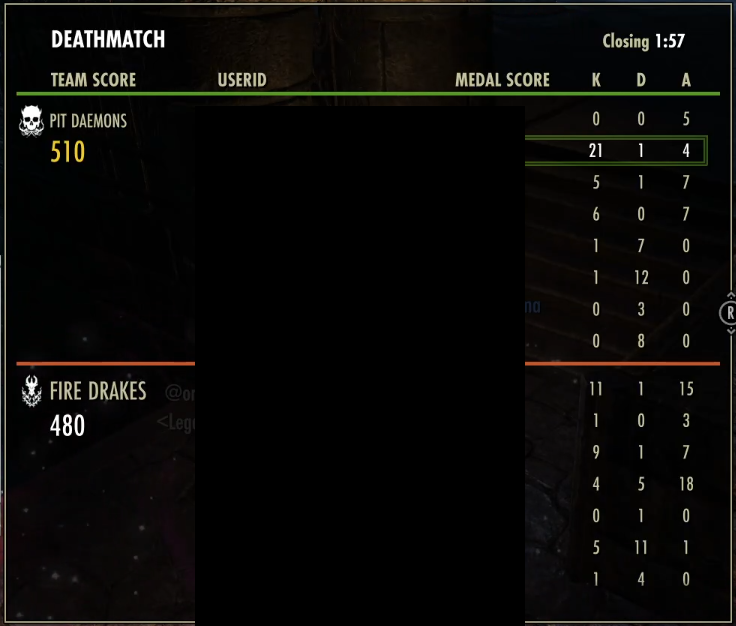
There's something odd about this scoreboard. The numbers don't add up.
One of the players from Orange quit after dying eleven times, never to be seen again.Can you help solve any of the FOUR critical flaws of two-sided BGs ?
Looking for feedback on How to fix the 3-sided objective modes0 -
Moonspawn✭✭✭✭
Perhaps ZOS can answer if there is a separate MMR for each of the game modes?
I'm adding this question to the others.
Hopefully, they’ll all be answered someday. In the meantime:Please examine the following 8v8 Deathmatch:
There's something odd about this scoreboard. The numbers don't add up.
One of the players from Orange quit after dying eleven times, never to be seen again.
I see. Business as usual
@Solantris what do you think of this match?
And as always, Green-2 was once again awed by how the critical flaws of 2-sided ruin even the matches that could have been fun for everyone.
By every metric, it was highly competitive.
But the competition boiled down to who avoided pvpers better and farmed newcomers faster.Can you help solve any of the FOUR critical flaws of two-sided BGs ?
Looking for feedback on How to fix the 3-sided objective modes0 -
Moonspawn✭✭✭✭
@NxJoeyD I'm sure ZOS could use help locating these map crevices and all the other places players use to cheese chaosballs.And as far as 3 team BGs go, I will say this Chaosball event is dog water! The maps are awful for this. The existing 3 team maps are fine for Relic or Domination / Crazy King but not CB! .. having someone grab the ball on Quarry and then duck into a map crevice, using it to avoid damage because the attacks won’t register through the gap in the wood is nobody’s idea of good combat. ..
That's a good idea. I'll see what I can do.
Sooner or later, someone will have to do it.
Is it just me, or are people not cheesing chaosballs like they used to?
Not cheesing like they used to?
They weren't cheesing at all, so I was only able to capture a few spots. I've been going over my screenshots trying to find them. Here's one: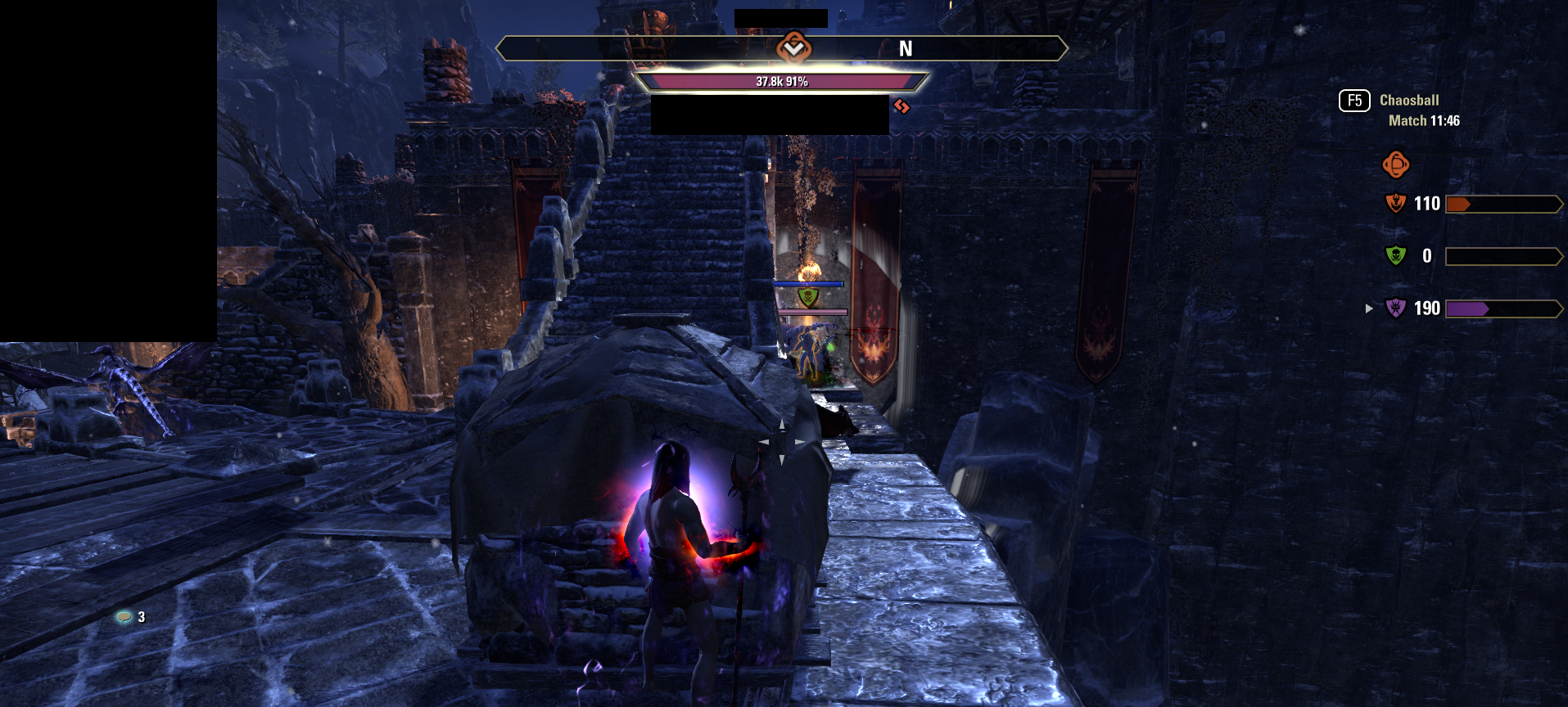
What if you had started sooner?Can you help solve any of the FOUR critical flaws of two-sided BGs ?
Looking for feedback on How to fix the 3-sided objective modes0 -
Moonspawn✭✭✭✭
Is this another spot?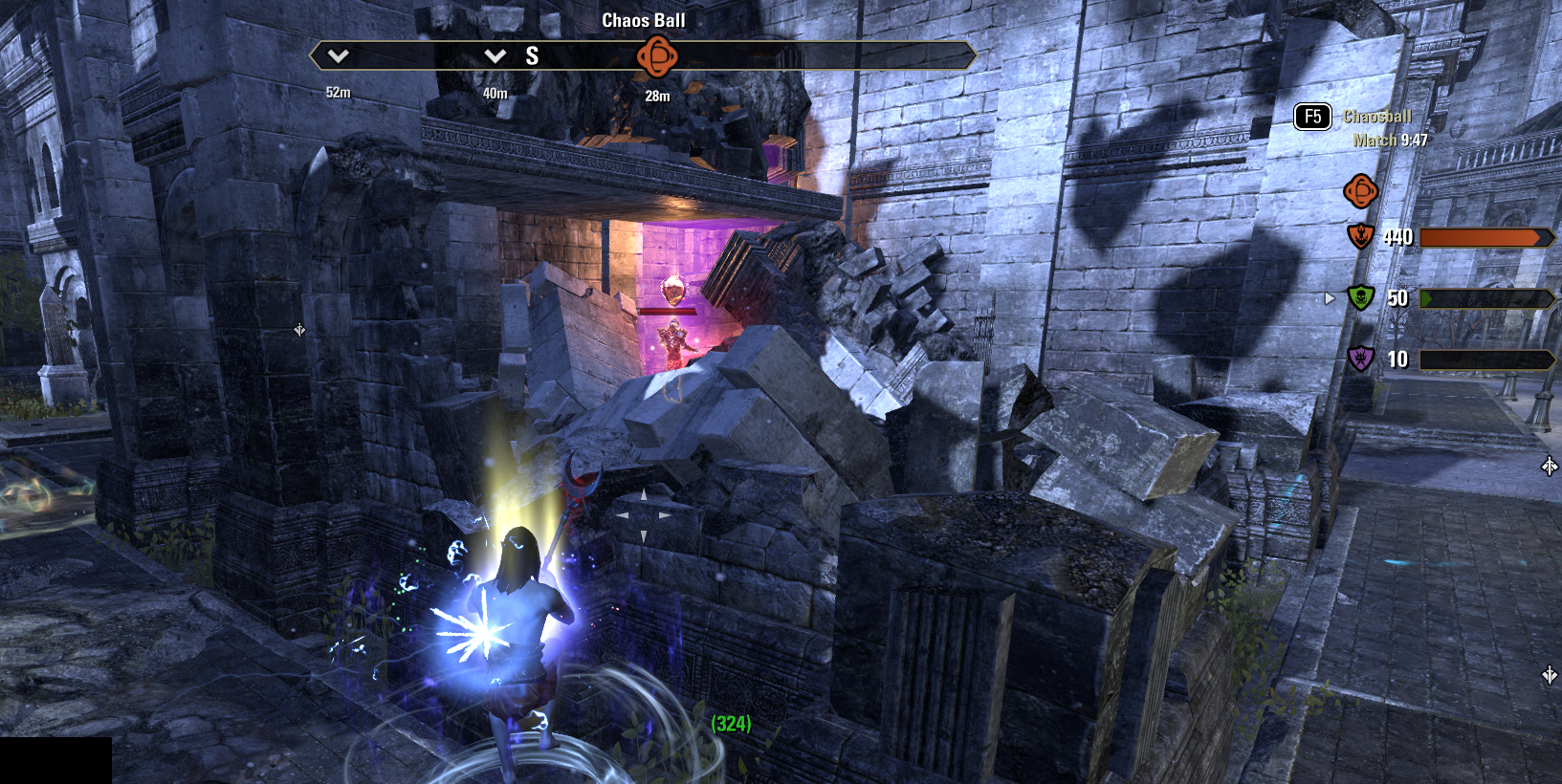
I think so. Some spots are definetely more problematic than others.Can you help solve any of the FOUR critical flaws of two-sided BGs ?
Looking for feedback on How to fix the 3-sided objective modes0 -
Moonspawn✭✭✭✭Front page has been updated with the questions only Zenimax can answer.
There was also the question about the rarity of lopsided matches in 3-sided, when compared to 2-sided.
But is that a question directed at ZOS, or at everyone?Can you help solve any of the FOUR critical flaws of two-sided BGs ?
Looking for feedback on How to fix the 3-sided objective modes0 -
 Maitsukas✭✭✭✭✭
✭✭✭Going back to what the main conversation topic of what this thread should have been (which has deviated from since the start), 4v4v4 will be permanently back with Update 51: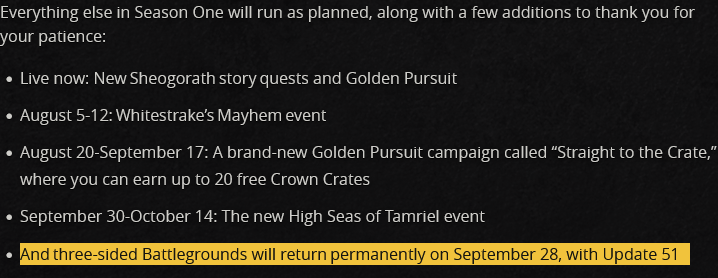 Edited by Maitsukas on July 30, 2026 2:43PMPC-EU @maitsukas
Posting the Infinite Archive and Imperial City Weekly Vendor updates.
Also trying out new Main Quests, Companions, ToT decks, Events and Styles on PTS.4 -
 Bguk✭✭✭✭Good news everyone! The posts can stop and new ones complaining about 3 sided being unfair/unbalanced/no chance of winning/etc. can start on September 28!
And three-sided Battlegrounds will return permanently on September 28, with Update 51
https://www.elderscrollsonline.com/en-us/news/post/702135 -
 Personofsecrets✭✭✭✭✭
✭✭✭✭It doesnt matter if there are two teams or three, ESO PvP is bad.
- Classes are not balanced
- There is little to no in-game build transparency
- Cheesy play is not just encouraged, but needed
- Matchmaking is not balanced
EDO PvP wad built in a way that makes spankings the likely outcome.Rest in Peace:
The Dragonknight
2014-2025
This commemoration is for the class that has constantly been plundered and dismantled by designers for no obvious reason while other classes continue to have coherent skill lines and feel both powerful and cool.4 -
 HatchetHaro✭✭✭✭✭
✭✭Good news everyone! The posts can stop and new ones complaining about 3 sided being unfair/unbalanced/no chance of winning/etc. can start on September 28!
And three-sided Battlegrounds will return permanently on September 28, with Update 51
https://www.elderscrollsonline.com/en-us/news/post/70213
It will still reduce the number of players dissatisfied with the BG outcomes. Coming out of a BG with second place is still great.
3-sided BGs also take a lot of the edge off of simple skill and gear gaps, and grants many opportunities for teams to get ahead through strategy. You can, using good strategy, even sneak in a first place win against a team that is stomping the match.
As someone who has played loads of BGs since its launch and through the 2-team phase, 3-team BGs are vastly superior.Best Argonian NA and I will fight anyone for it
20 Argonians
7x IR, 7x GH, 8x TTT, 5x GS, 7x DB, 3x PB, 4x SBS, 1x MM, 1x US, 2x CB, 1x Unchained2 -
Bguk✭✭✭✭HatchetHaro wrote: »Good news everyone! The posts can stop and new ones complaining about 3 sided being unfair/unbalanced/no chance of winning/etc. can start on September 28!
And three-sided Battlegrounds will return permanently on September 28, with Update 51
https://www.elderscrollsonline.com/en-us/news/post/70213
It will still reduce the number of players dissatisfied with the BG outcomes. Coming out of a BG with second place is still great.
3-sided BGs also take a lot of the edge off of simple skill and gear gaps, and grants many opportunities for teams to get ahead through strategy. You can, using good strategy, even sneak in a first place win against a team that is stomping the match.
As someone who has played loads of BGs since its launch and through the 2-team phase, 3-team BGs are vastly superior.
I agree 100%. Except this thread started as a request to bring back 3-sided, quote below. This thread should die excpet we got more random screenshots that are irrelevant seeing 3-sided is coming.Two-sided Battlegrounds are too difficult to balance. Three-sided Deathmatch is not. Please add it as a permanent option for solo players.
0 -
 Necrotech_Master✭✭✭✭✭
✭✭✭✭✭the matchmaking and low population are usually why lopsided matches happen in 2 sided
3 team BGs are not immune to poor matchmaking and lopsided matches either, in fact it usually feels worse to me when in a 3 team and your just getting double teamed by both enemy teams who refuse to fight each other (which i saw a lot of before they switched to 2 team BGs)
like personofsecrets said, a lot of it comes down to poorly balanced pvp in general, the only really balanced pvp this game has had so far in recent times is vengeance cyro (even when they enabled procs last week it was more balanced than any other pvp ive done in a long time here)plays PC/NA
handle @Necrotech_Master
active player since april 2014
i have my main house (grand topal hideaway) listed in the housing tours, it has multiple target dummies, scribing altar, and grandmaster stations (fully filled out with current game), as well as almost every antiquity furnishing on display to preview them
in progress: acquiring mundus stones (currently only have the thief)
feel free to stop by and use the facilities3 -
Haki_7✭✭✭@Darkmage1337 wrote:I currently believe the best solution for BGs would be this:
3-sided (solo or grouped), unranked, and top-menu option.
2-sided (solo or grouped), ranked, and bottom-menu option.
I enjoy both variations and all maps/modes in each of them.
BUT, I believe the best/most-fun was with the 3-sided format.
Both formats can coexist with the ESO BG PvP community.
It is simple. Competitive-play? 2-sided. Casual-play? 3-sided.
So, remove the current casual 2-sided and bring back 3-sided.
Which one is the current casual 2-sided? 8v8?@Avran_Sylt wrote:@Moonspawn
Regarding the 4 flaws of 2-sided:`
1. What has changed about positioning and target selection? You still want to try and focus down on those that seem like they take more damage than the rest, CC healers, layer burst, rushdown squishies or backline archers while being sure to be mindful of where you're at so as to not get swarmed and focused (unless built for it).
I've been thinking for a while now that the first flaw should be rewritten.
''1. Since you can't use one team against another anymore, it's difficult for BG regulars to engage each other without discarding everything they know about positioning and target selection.''
Rewritten how?
And why?
The description of the first flaw makes it seem like the possibility of being sandwiched is the only factor that facilitates fights between BG regulars. The part about the target order going from 1-4, instead of 1-8, is just as important, but it's hidden at the bottom of the spoiler tab.
The first flaw (rigidity of target order) is also influenced by the third, which encourages BG regulars to spawncamp and pushes them to ''fight'' on opposite ends of the map.
I'm not sure how to write all that in the description. Any suggestions?
One option would be leaving the whole explanation inside the spoiler tab:
''1. Since you can't use one team against another anymore, it's difficult for BG regulars to engage each other without discarding everything they know about positioning and target selection.''
[snip]
Edited by ZOS_CouchTato on August 19, 2026 3:07PM0 -
Haki_7✭✭✭@Maitsukas wrote:4v4v4 will be permanently back with Update 51:
I wish this was true 😢
Crazy King, 100% guaranteed to win. They couldn't reach the flags. Third flaw: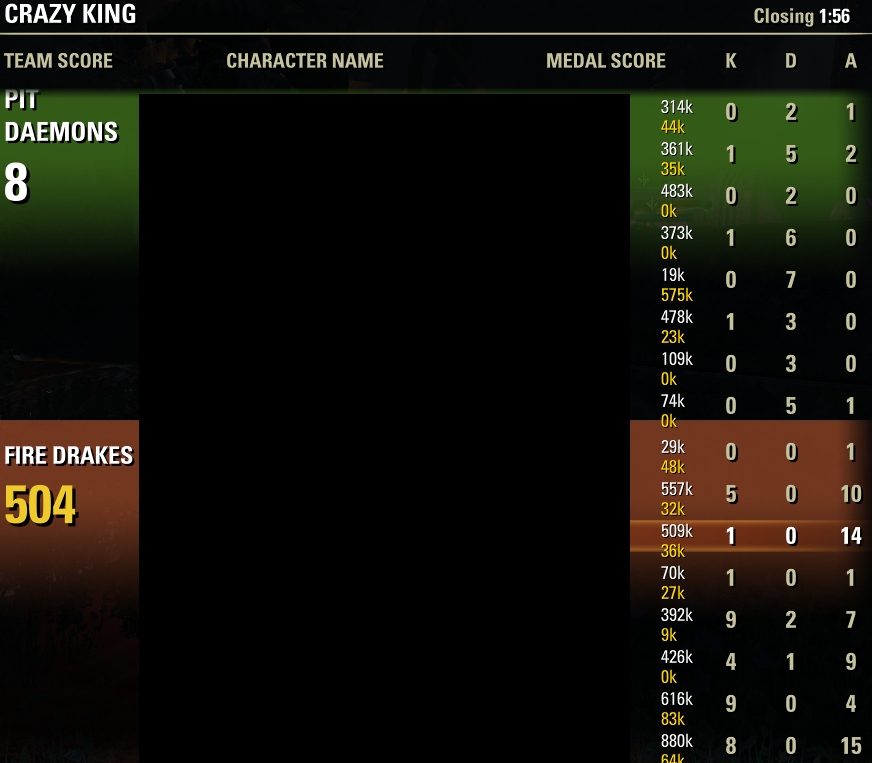
Chaosball 1 & 2, 100% guaranteed to win. Soul gazing sessions with ball carriers: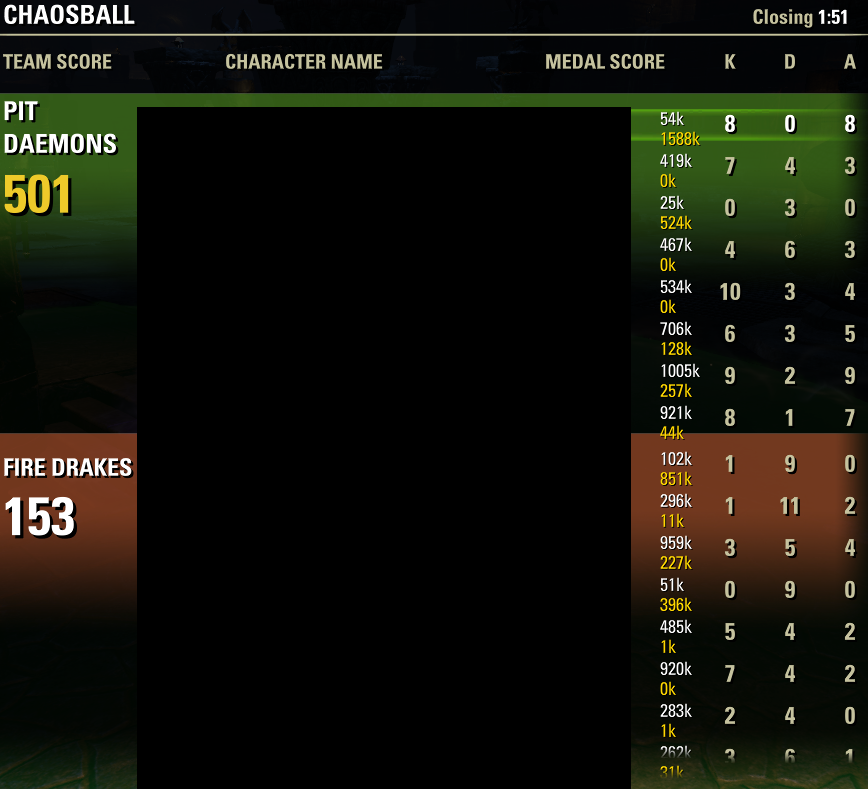
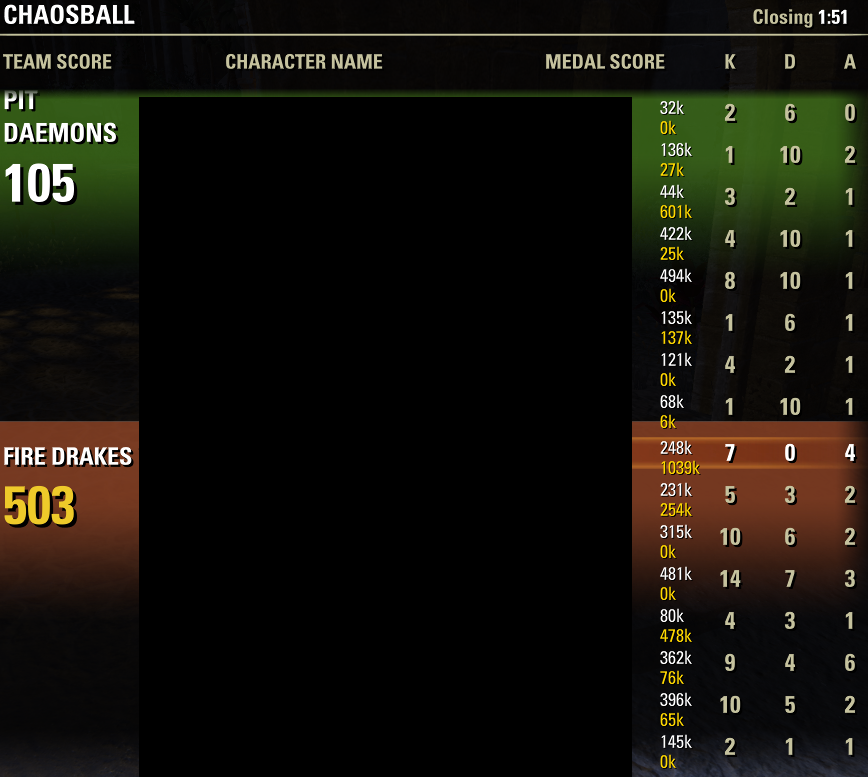
Relic, 100% guaranteed to win. Promptly giving up after losing one relic. Fourth flaw: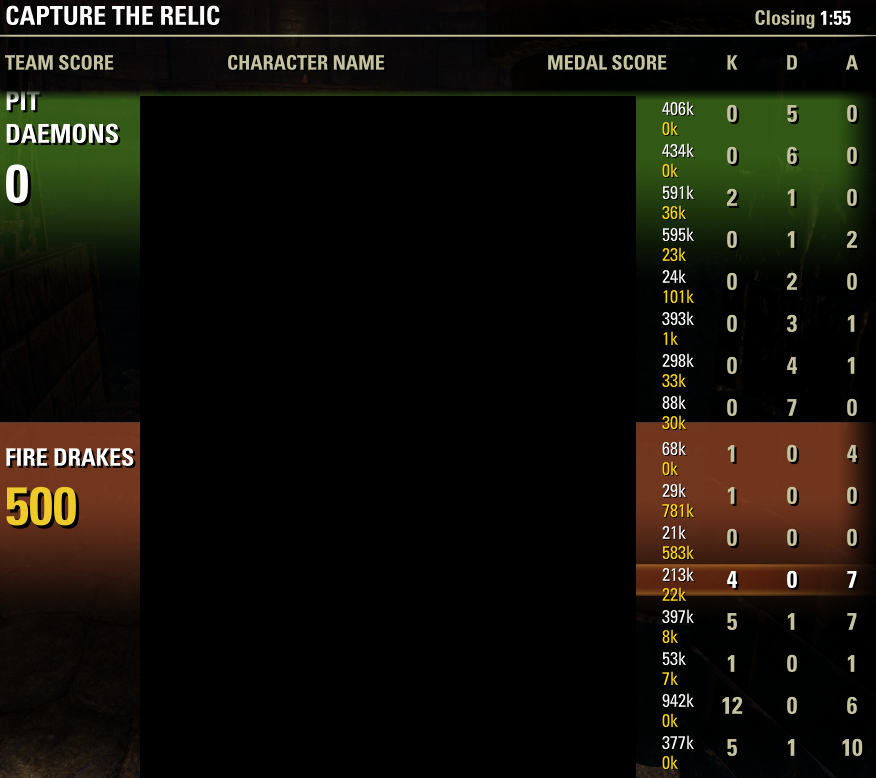
Destruction of Battlegrounds Chapter 238: Waiting 18 minutes for a lopsided match (Solo 8v8 PC/NA)
Deathmatch 1 & 2, 100% guaranteed to win: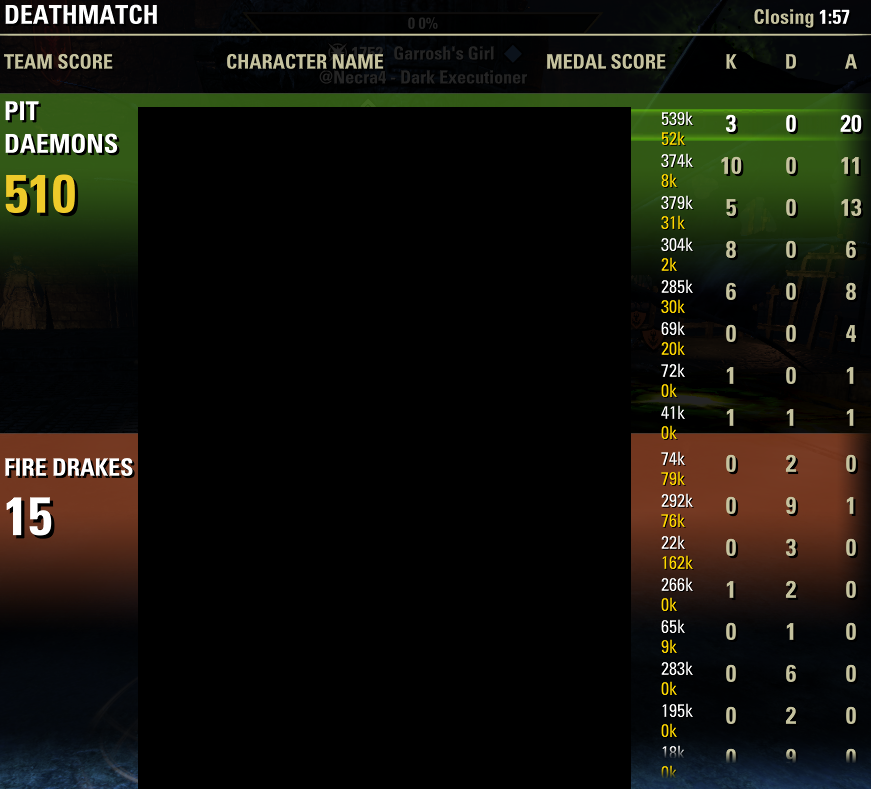
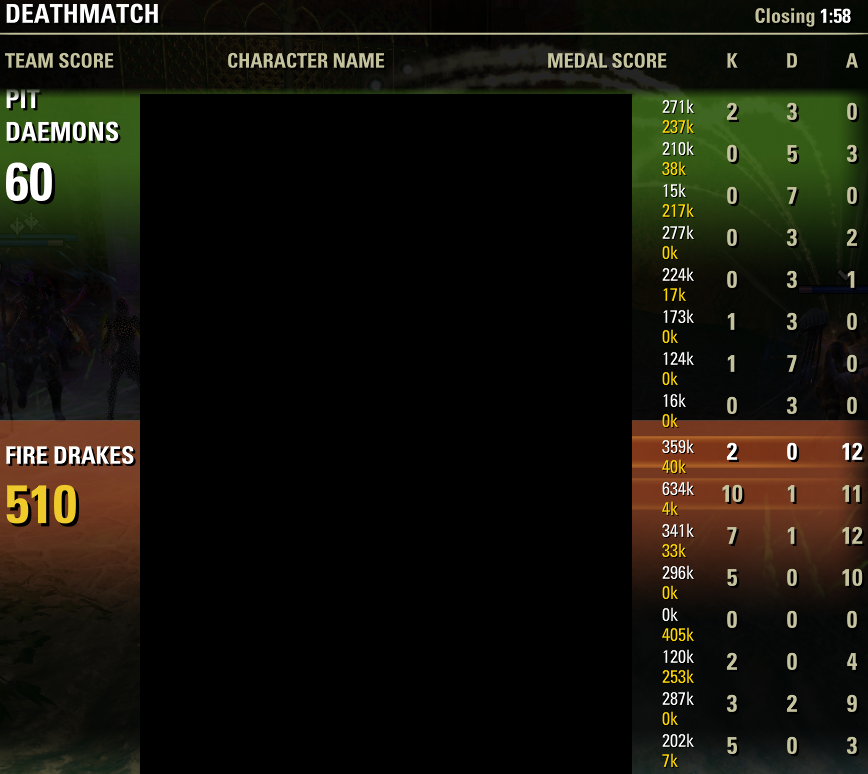
Domination, 100% guaranteed to lose: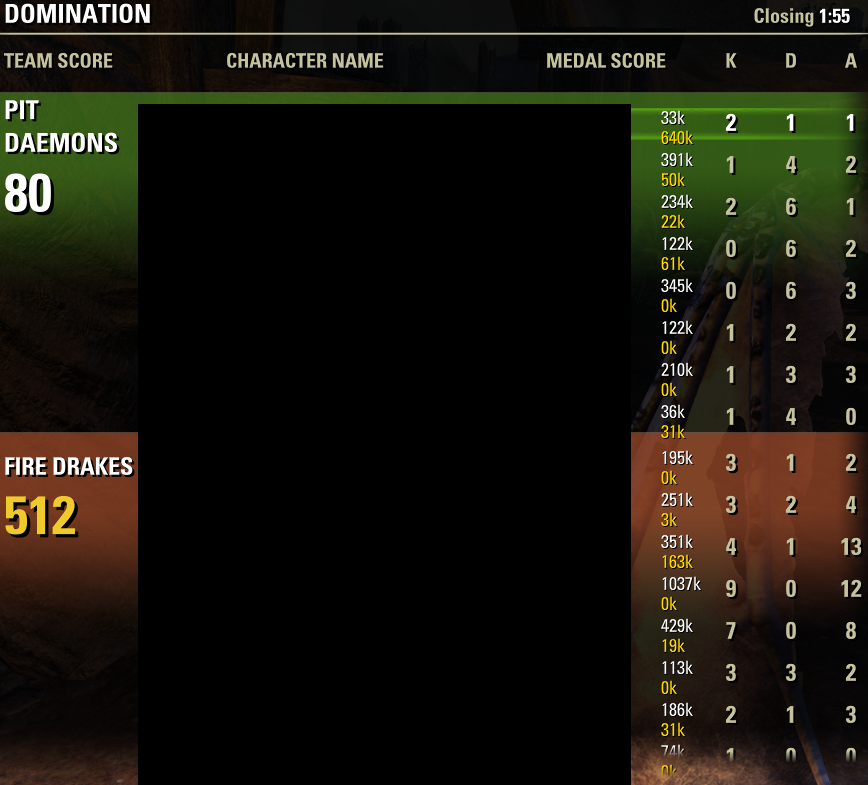 0
0 -
Moonspawn✭✭✭✭@Bguk wrote:Good news everyone! The posts can stop and new ones complaining about 3 sided being unfair/unbalanced/no chance of winning/etc. can start on September 28!
And three-sided Battlegrounds will return permanently on September 28, with Update 51
https://www.elderscrollsonline.com/en-us/news/post/70213
When the 3-sided format comes back, will its game-breaking problems still be there?Can you help solve any of the FOUR critical flaws of two-sided BGs ?
Looking for feedback on How to fix the 3-sided objective modes0 -
Haki_7✭✭✭@Personofsecrets wrote:It doesnt matter if there are two teams or three, ESO PvP is bad.
- Classes are not balanced
- There is little to no in-game build transparency
- Cheesy play is not just encouraged, but needed
- Matchmaking is not balanced
ESO PvP wad built in a way that makes spankings the likely outcome.
Right, but why is the rate of completely lopsided matches so much higher in 8v8, when compared to 4v4v4? Aren't they using the same matchmaking?
[snip]Edited by ZOS_CouchTato on August 19, 2026 3:07PM0 -
Personofsecrets✭✭✭✭✭
✭✭✭✭@Personofsecrets wrote:It doesnt matter if there are two teams or three, ESO PvP is bad.
- Classes are not balanced
- There is little to no in-game build transparency
- Cheesy play is not just encouraged, but needed
- Matchmaking is not balanced
ESO PvP wad built in a way that makes spankings the likely outcome.
Right, but why is the rate of completely lopsided matches so much higher in 8v8, when compared to 4v4v4? Aren't they using the same matchmaking?
The matchmaking could be the same. Maybe that's part of the problem? I don't have any insider information about the system, so I just have to think that matchmaking doesn't work.
We can look at both teams before a game starts and intuit how the teams could be better balanced. If a system can't use a statistic to do that same thing, then it's a bad system that doesn't work. But we all know that the system is bad and there is nothing to do about it. It's like any neglected system that needs updating.
I can't even bring myself to care too much about 2 team versus 3 team. PvP in ESO is inherently broken. It's an inherently bad experience. If the design team won't do anything about class abilities or sets that are too powerful, then of course they won't try to figure out what team to put a specific player on.
From the very beginning, ranked PvP arena should have just been 1v1 duels. Instead we got the system that has morphed into the failure that exists today.Rest in Peace:
The Dragonknight
2014-2025
This commemoration is for the class that has constantly been plundered and dismantled by designers for no obvious reason while other classes continue to have coherent skill lines and feel both powerful and cool.1 -
Moonspawn✭✭✭✭Front page has been updated with the questions only Zenimax can answer.
There was also the question about the rarity of lopsided matches in 3-sided, when compared to 2-sided.
But is that a question directed at ZOS, or at everyone?
Everyone. No way to know where the answer may come from.
I ask because I was keeping that section for questions that can really only be answered by ZOS.Can you help solve any of the FOUR critical flaws of two-sided BGs ?
Looking for feedback on How to fix the 3-sided objective modes0

 https://youtu.be/6AMulv-eFD0