Maintenance for the week of August 24:
• PC/Mac: No maintenance – August 24
• PC/Mac: No maintenance – August 24
Three-Sided Deathmatch
-
 Darkmage1337✭✭✭✭✭
✭@Darkmage1337 wrote:I currently believe the best solution for BGs would be this:
3-sided (solo or grouped), unranked, and top-menu option.
2-sided (solo or grouped), ranked, and bottom-menu option.
I enjoy both variations and all maps/modes in each of them.
BUT, I believe the best/most-fun was with the 3-sided format.
Both formats can coexist with the ESO BG PvP community.
It is simple. Competitive-play? 2-sided. Casual-play? 3-sided.
So, remove the current casual 2-sided and bring back 3-sided.
Which one is the current casual 2-sided? 8v8?@Avran_Sylt wrote:@Moonspawn
Regarding the 4 flaws of 2-sided:`
1. What has changed about positioning and target selection? You still want to try and focus down on those that seem like they take more damage than the rest, CC healers, layer burst, rushdown squishies or backline archers while being sure to be mindful of where you're at so as to not get swarmed and focused (unless built for it).
I've been thinking for a while now that the first flaw should be rewritten.
''1. Since you can't use one team against another anymore, it's difficult for BG regulars to engage each other without discarding everything they know about positioning and target selection.''
Rewritten how?
And why?
The description of the first flaw makes it seem like the possibility of being sandwiched is the only factor that facilitates fights between BG regulars. The part about the target order going from 1-4, instead of 1-8, is just as important, but it's hidden at the bottom of the spoiler tab.
Deathmatch 1 and 2, inevitable victories: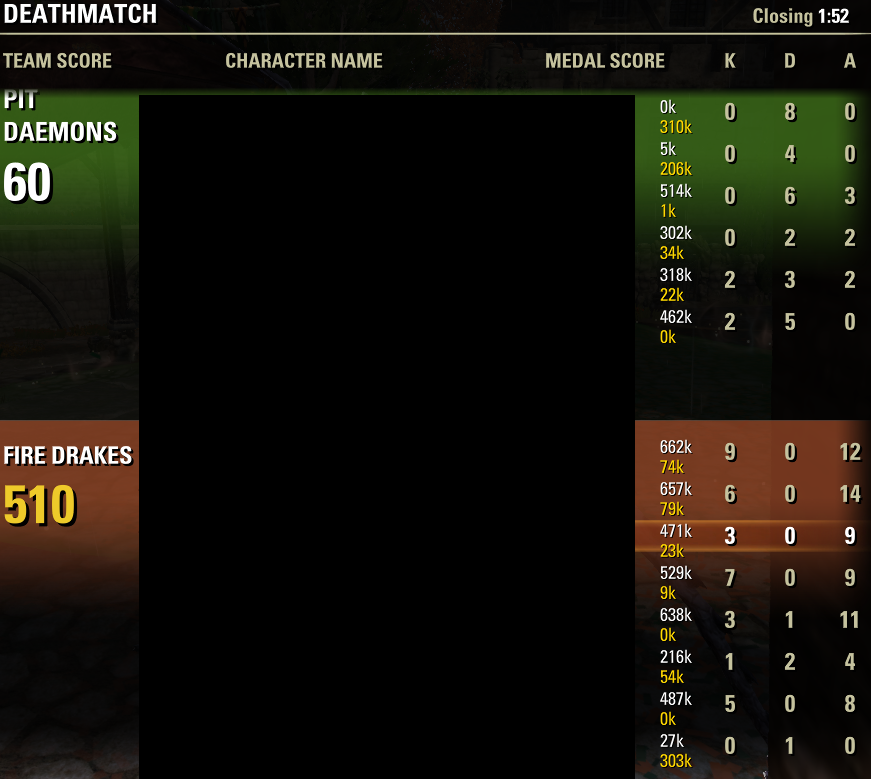
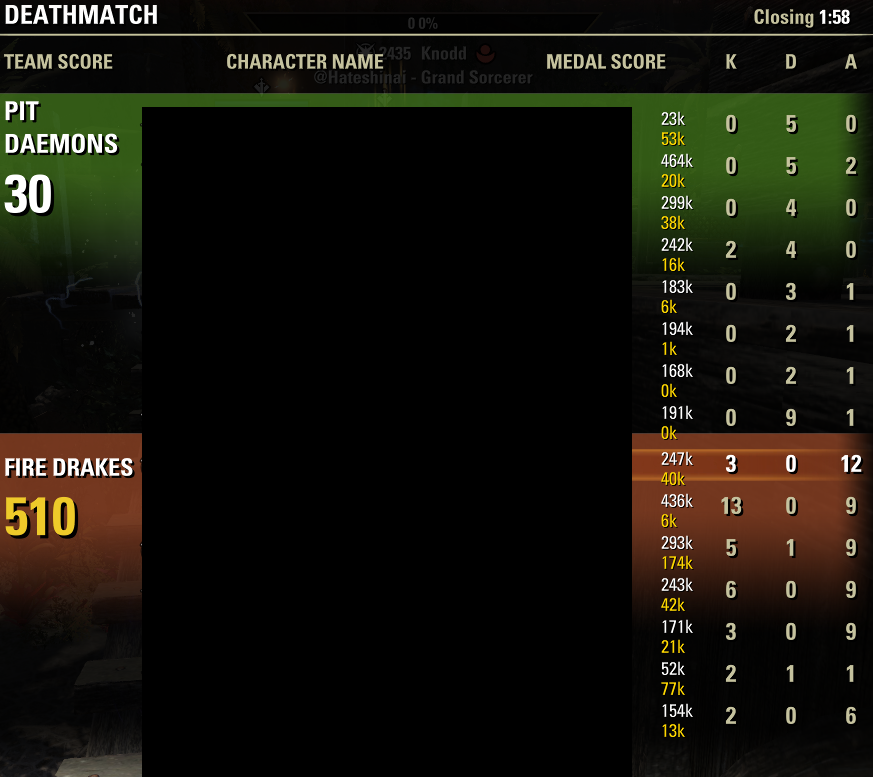
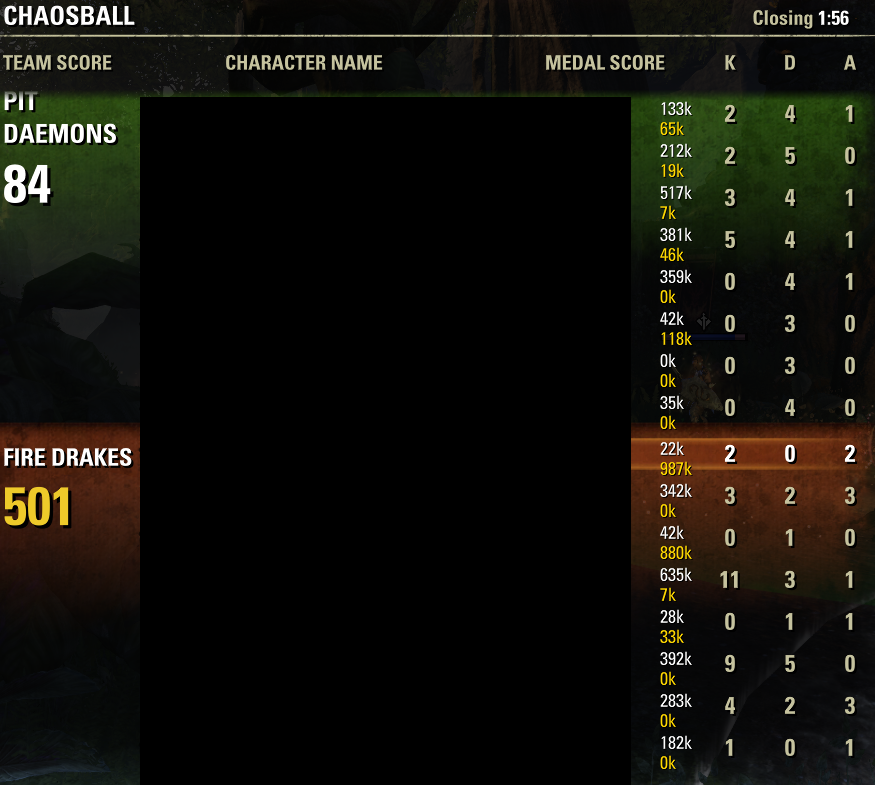
Chaosball 1 and 2, inevitable victories: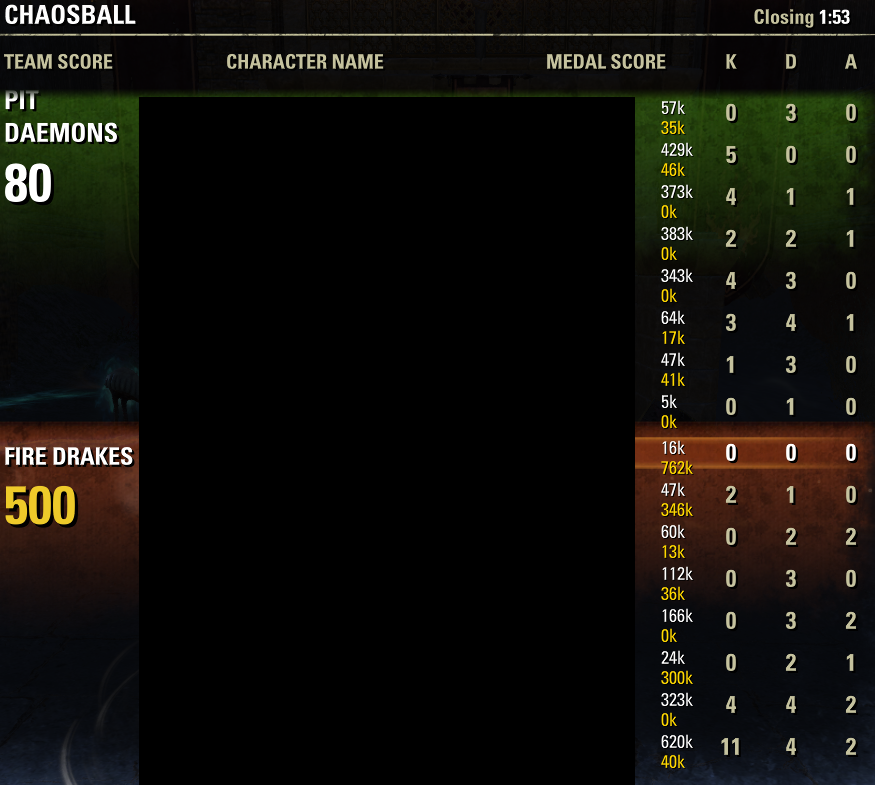
Crazy King, inevitable victory. Opponents collected 75 deaths: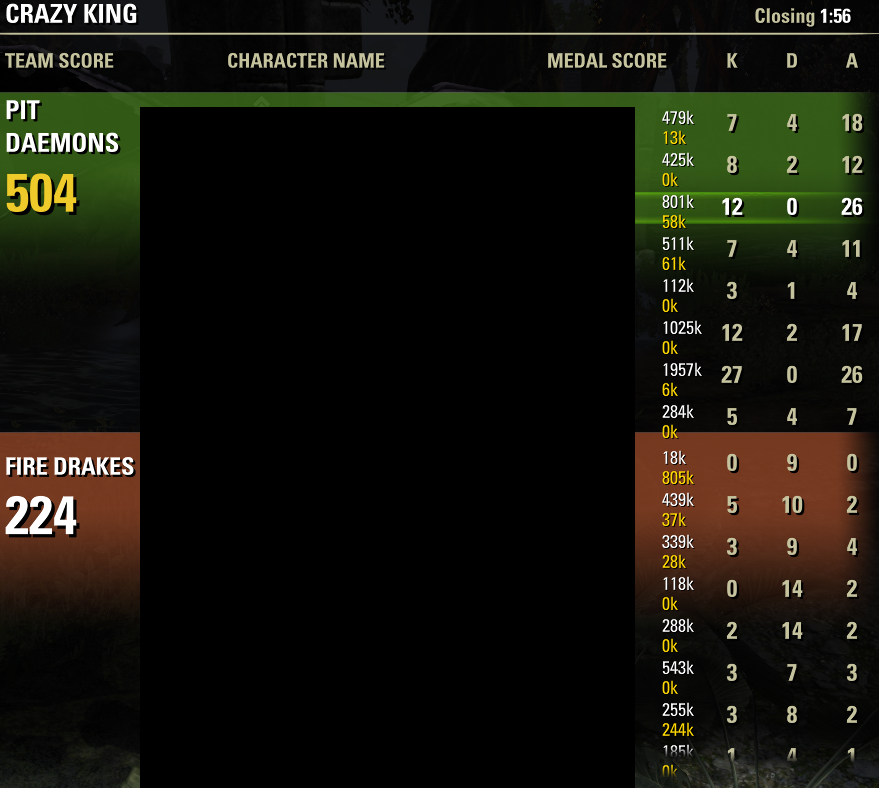
Destruction of Battlegrounds Chapter 213: Waiting 25 minutes for a lopsided match (Solo 8v8 PC/EU)
Relic, inevitable victory. Promptly throwing the towel after losing one relic. Fourth critical flaw of 2-sided: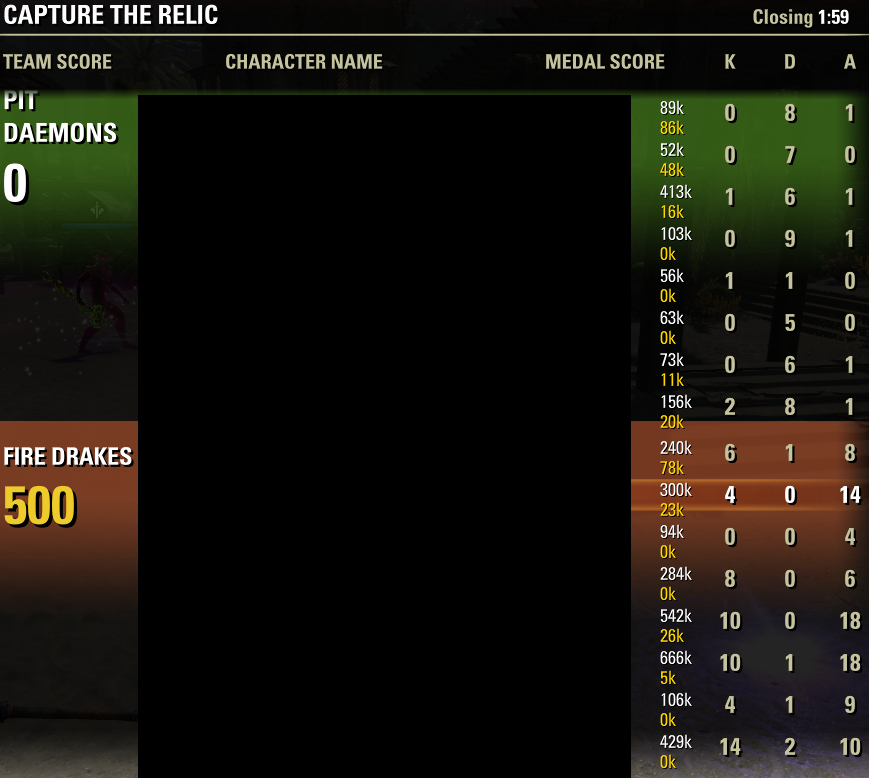
Domination, inevitable defeat. We could barely reach the flags, let alone capture them: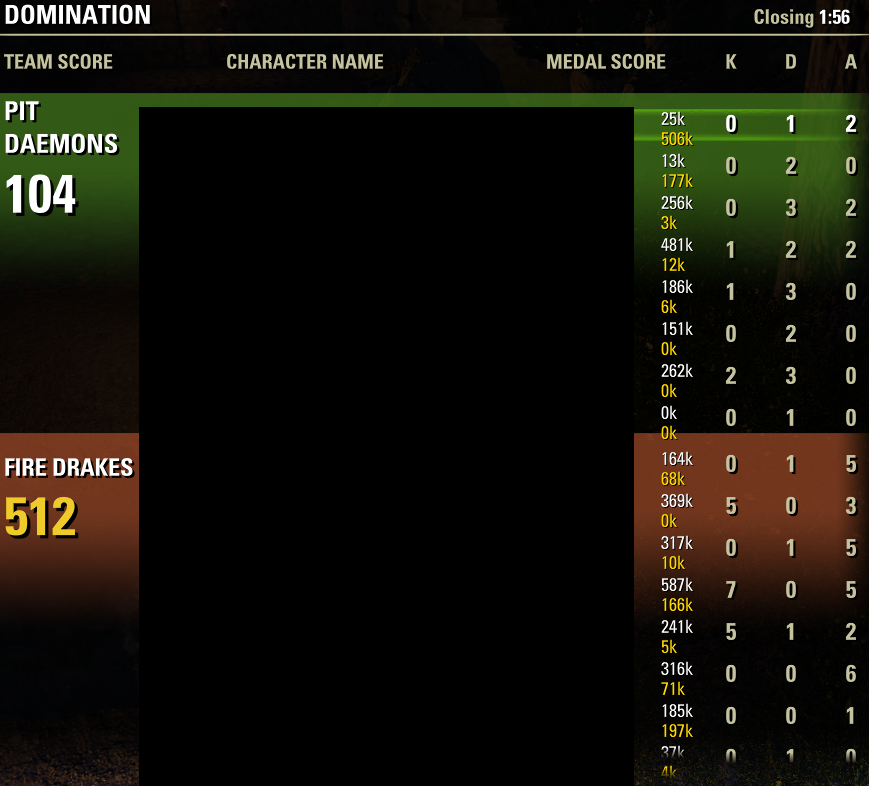
Ranked battlegrounds should only be 4v4.
Ranked 4v4v4 has awful validity due to being 3-sided.
4v4v4 should be unranked-only, and always should be.
4v4v4 and 8v8 should be casual, with both unranked.
If 4v4v4 and 8v8 are too much, then they can alternate weeks.ESO Platform/Region: PC/NA. ESO ID: @Darkmage1337GM of Absolute Virtue. Co-GM of Absolute Vice. 8-time Former Emperor, out of 13 characters. 3 Templars, 3 Sorcerers, 2 Nightblades, 2 Dragonknights, 1 Warden. 1 Necromancer, and 1 Arcanist. The Ebonheart Pact: The Dark-Mage (Former Emperor), The Undying Nightshade, The Moonlit-Knight, The Killionaire (Former Emperor), Swims-Among-Slaughterfish (Former Emperor), The Undead Mage, and The Dark-Warlock. The Aldmeri Dominion: The Dawn-Bringer (Former Empress), The Ironwood Kid (Former Emperor), and The Storm-Sword. The Daggerfall Covenant: The Storm-Shield (Former Empress), The Savage-Beast, and The Burning-Crusader CP: 1,999.8 -
 Moonspawn✭✭✭✭
Are you referring to the situation below?@L_Nici wrote:Its pretty easy to see what kind is better by the number of players taking part.
We had two 3 sided BG Events this year and both times you instantly got into one, never waited more than one minute on a BG that did not consist of the same 16 people just mixed differently. To be fair the Domination one was better as people did not exploit Shattered Path yet, still I had more fun with the 3 sided relic hunt too than I ever did with any 2 sided BG. 2 sided BGs get decided by which team wipes first, because then it just gets camped at spawn.
One thing I noticed about the relic event was how often every team ended up holding each other's relics without being able to deliver. Didn't that used to be extremely rare?
That's the one. I remember taking a bunch of pictures the first few times it happened. I'll see if I can find them.
How is that coming along? If possible, I'd like to update the relic suggestion with those pictures. Replacing the image I drew in Paint with something familiar should make it much easier for people to understand.Can you help solve any of the FOUR critical flaws of two-sided BGs ?
Looking for feedback on How to fix the 3-sided objective modes0 -
Moonspawn✭✭✭✭
Are you referring to the situation below?@L_Nici wrote:Its pretty easy to see what kind is better by the number of players taking part.
We had two 3 sided BG Events this year and both times you instantly got into one, never waited more than one minute on a BG that did not consist of the same 16 people just mixed differently. To be fair the Domination one was better as people did not exploit Shattered Path yet, still I had more fun with the 3 sided relic hunt too than I ever did with any 2 sided BG. 2 sided BGs get decided by which team wipes first, because then it just gets camped at spawn.
One thing I noticed about the relic event was how often every team ended up holding each other's relics without being able to deliver. Didn't that used to be extremely rare?
That's the one. I remember taking a bunch of pictures the first few times it happened. I'll see if I can find them.
How is that coming along? If possible, I'd like to update the relic suggestion with those pictures. Replacing the image I drew in Paint with something familiar should make it much easier for people to understand.
In my opinion, 3-sided Capture the Relic only works when this happens: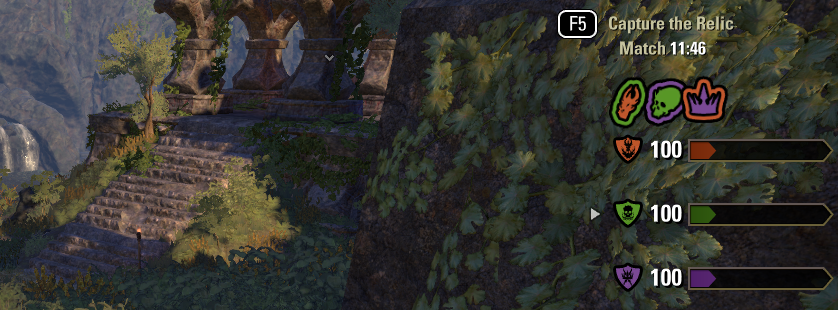
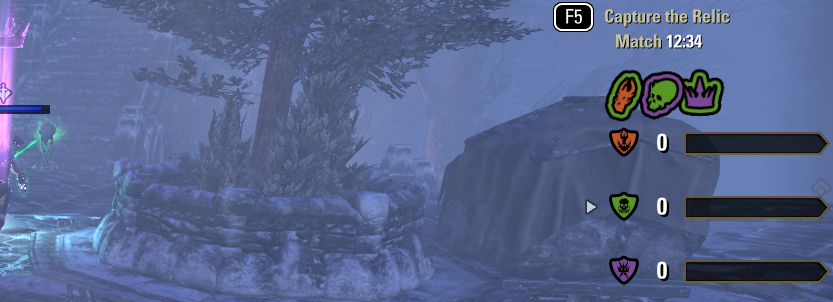
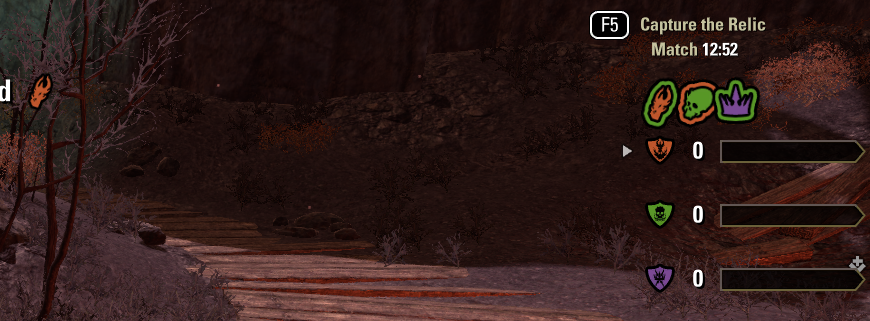
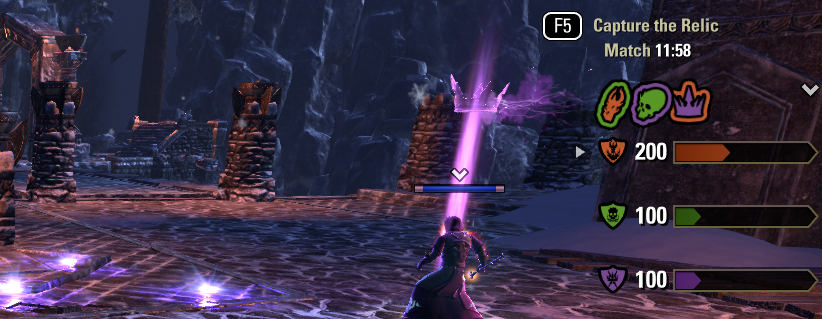
EDIT: It would be more accurate to say that each and every time any of these problems arises, everything goes to hell.Edited by Moonspawn on June 22, 2026 8:24AMCan you help solve any of the FOUR critical flaws of two-sided BGs ?
Looking for feedback on How to fix the 3-sided objective modes0 -
 Weesacs✭✭✭✭✭Just give us the option for 4x4 and 4x4x4 full time. I sign up to both. They just need to fix the MMR.Breton Templar
PS5 - EU - DC2 -
 moo_2021✭✭✭✭✭3 teams is a lot better. 2-sided was nice at first but people just give up now after the first wipe.
Not if you just ask them.
Had this a while ago - less than a minute into the game, I found myself standing alone, struggling to stay alive, barely able to hurt any opponent. An apparently skilled teammate died next to me and didn't come back, then I realized they all ran out of lives.
It was 1 vs 4, zero chance of winning. So I gave up my lives, went back to base and told my team we just need tactics - stay close to base, identify the healer and end him as fast as we can.
Then everyone followed. Found the healer, couldn't really kill him, but he panicked and ran because his teammates didn't come to his rescue, except they were the ones who needed him, not the other way around. As soon as he was separated, we turned back, wiped his team, won that round, then the third round. One of my best games in 5 years.
There was nothing special about the tactic. Everyone knew it. All it needed was someone to say it loud, letting them know we're still a team, and we are not giving up.Edited by moo_2021 on June 23, 2026 8:20PM0 -
Weesacs✭✭✭✭✭
How would you fix the MMR?@Weesacs wrote:Just give us the option for 4x4 and 4x4x4 full time. I sign up to both. They just need to fix the MMR.
Im sure it isn't that difficult to implement an algorithm that makes the game fairer and more competitive.
Honest question, before a match starts and you look at the teams, can you pretty much predict who is going to win? I can.
Now this isn't based on some magic formula, I'm just looking at the names of the players who I previously went up against, looked at the classes they are playing and then make an assumption. And as I said, that assumption is pretty much on the money most of the time. This is solely based on experience.
We can easily have a system that can save statistics like damage done, damage taken, healing done, games won, games lost, kills for, kills against, class sign up etc and taking all that information, balance the teams appropriately.
Too many times we see things like:- 2 or more healers on the one team and the other team have none.
- 3 or 4 very good experienced players against noobs and one experienced player; the experienced good player seems to inflate the noob teams overall MMR which is ridiculous.
- 3 v 4. Absolute silly addition. The extra buff doesnt even nearly cover the lack of a player.
- Lack of balancing of the two meta crutch classes between the teams i.e. DKs and Werewolfs. In one of my recent games, myself (who plays a subclassing Templar) went up against 3 werewolves and a DK. Our team didnt have either. How the hell is that fair?
- Good experienced players jumping on an alt they never use and getting treated like a low MMR player. That isnt right. A good experienced player on a main will always make an alt work so should be the same across all their classes.
- There shouldnt be an MMR reset. Why should there be? I see it multiple times were a good experienced player who has been away for the game on months on end coming back and destroying again. Why? Because their skill and knowledge doesnt really disappear so their MMR should stick with them.
Thats just a few examples of where MMR is lacking and where it can be improved. If this was the case then the games would be much better, regardless whether its 4v4 or 4v4v4.
Oh and one other thing, to make solo queue TDM work better, as Ive mentioned numerous times, the players within each team should be rotated after each round to make each round more balanced and fairer. They do this in WoW arena and it works. There is no need to get scores of 500-0 and 500-0 across two rounds. Play three rounds, switch the teams about after each round, and I can guarantee that the results would look better at the end of the game.
Breton Templar
PS5 - EU - DC1 -
Moonspawn✭✭✭✭Before we discuss the MMR, any word from ZOS regarding the questions that have come up so far?
Questions plural? There's more than one?Can you help solve any of the FOUR critical flaws of two-sided BGs ?
Looking for feedback on How to fix the 3-sided objective modes0 -
Moonspawn✭✭✭✭
The first question was about the MMR resetting in 3-sided, and how it changed in update 44
The second was about queue times
No answer yet. I'll add these questions to the first page to make sure they are not forgotten.Can you help solve any of the FOUR critical flaws of two-sided BGs ?
Looking for feedback on How to fix the 3-sided objective modes0 -
Moonspawn✭✭✭✭
How would you fix the MMR?@Weesacs wrote:Just give us the option for 4x4 and 4x4x4 full time. I sign up to both. They just need to fix the MMR.
Im sure it isn't that difficult to implement an algorithm that makes the game fairer and more competitive.
Honest question, before a match starts and you look at the teams, can you pretty much predict who is going to win? I can.
Now this isn't based on some magic formula, I'm just looking at the names of the players who I previously went up against, looked at the classes they are playing and then make an assumption. And as I said, that assumption is pretty much on the money most of the time. This is solely based on experience.
We can easily have a system that can save statistics like damage done, damage taken, healing done, games won, games lost, kills for, kills against, class sign up etc and taking all that information, balance the teams appropriately.
Too many times we see things like:- 2 or more healers on the one team and the other team have none.
- 3 or 4 very good experienced players against noobs and one experienced player; the experienced good player seems to inflate the noob teams overall MMR which is ridiculous.
- 3 v 4. Absolute silly addition. The extra buff doesnt even nearly cover the lack of a player.
- Lack of balancing of the two meta crutch classes between the teams i.e. DKs and Werewolfs. In one of my recent games, myself (who plays a subclassing Templar) went up against 3 werewolves and a DK. Our team didnt have either. How the hell is that fair?
- Good experienced players jumping on an alt they never use and getting treated like a low MMR player. That isnt right. A good experienced player on a main will always make an alt work so should be the same across all their classes.
- There shouldnt be an MMR reset. Why should there be? I see it multiple times were a good experienced player who has been away for the game on months on end coming back and destroying again. Why? Because their skill and knowledge doesnt really disappear so their MMR should stick with them.
Thats just a few examples of where MMR is lacking and where it can be improved. If this was the case then the games would be much better, regardless whether its 4v4 or 4v4v4.
Oh and one other thing, to make solo queue TDM work better, as Ive mentioned numerous times, the players within each team should be rotated after each round to make each round more balanced and fairer. They do this in WoW arena and it works. There is no need to get scores of 500-0 and 500-0 across two rounds. Play three rounds, switch the teams about after each round, and I can guarantee that the results would look better at the end of the game.
Please examine the following 8v8 Deathmatch: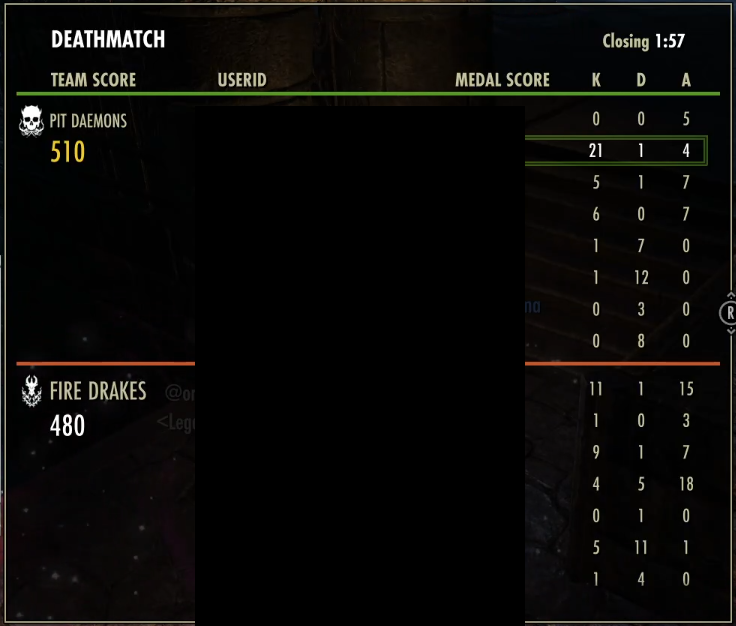
Since the teams were evenly matched, the pvpers on both sides had no choice but to go after the same targets over and over again. They all knew that whoever dared deviate from that would have been zerged down.
Is it possible to persuade any of these players, pvper or not, to enjoy this horrible situation?Can you help solve any of the FOUR critical flaws of two-sided BGs ?
Looking for feedback on How to fix the 3-sided objective modes0 -
DestroyerPewnack✭✭✭✭✭In my view, the issue is not 2-sided versus 3-sided that's causing the lopsided problem. It's the fact that MMR is reset every month, forcing the newbies and the sweats to end up in the same lobbies.
Make MMR last for the entire season, (or better yet, permanent per character,) and let people play against players they can handle.1 -
Haki_7✭✭✭The information is getting all spread out. @Moonspawn It would be nice if everything we've seen about the matchmaking was brought together into a single post: The article, impda's explanation, the comparison between queue times, ZOS' statements about MMR, and anything else I may be forgetting.
[snip]Edited by ZOS_CouchTato on August 19, 2026 3:04PM0 -
Moonspawn✭✭✭✭
Are you referring to the situation below?@L_Nici wrote:Its pretty easy to see what kind is better by the number of players taking part.
We had two 3 sided BG Events this year and both times you instantly got into one, never waited more than one minute on a BG that did not consist of the same 16 people just mixed differently. To be fair the Domination one was better as people did not exploit Shattered Path yet, still I had more fun with the 3 sided relic hunt too than I ever did with any 2 sided BG. 2 sided BGs get decided by which team wipes first, because then it just gets camped at spawn.
One thing I noticed about the relic event was how often every team ended up holding each other's relics without being able to deliver. Didn't that used to be extremely rare?
That's the one. I remember taking a bunch of pictures the first few times it happened. I'll see if I can find them.
How is that coming along? If possible, I'd like to update the relic suggestion with those pictures. Replacing the image I drew in Paint with something familiar should make it much easier for people to understand.
In my opinion, 3-sided Capture the Relic only works when this happens:
The changes necessary to eliminate the game-breaking problems of 3-sided capture the relic have been updated with these screenshots. The suggestion should be much easier to understand now.Edited by Moonspawn on June 30, 2026 1:07PMCan you help solve any of the FOUR critical flaws of two-sided BGs ?
Looking for feedback on How to fix the 3-sided objective modes0 -
Moonspawn✭✭✭✭@Demonwolff wrote:What is the meaning of ''zero damage ball carries'' and ''base jumping''?
Zero Damage ball carries are where the ball bugs out and fails to damage the carrier at all. Base jumping is where the Ball Carrier is able to "magically" return to their spawn. I didn't mention the one where the ball disappears and you cant see the person carrying it lol
In the hundreds of matches I played during the 3-sided chaosball event, I never once saw this happen. Did you?
Hundreds of matches in the span of 7 days? How did you manage that?Can you help solve any of the FOUR critical flaws of two-sided BGs ?
Looking for feedback on How to fix the 3-sided objective modes0 -
Moonspawn✭✭✭✭Front page has been updated with the questions only Zenimax can answer.
Now, regarding @imPDA 's explanation:If this system works as described, it does 2 things:
1) it tries to make as many people of the same MMR as possible into one game
2) it tries to make teams as equal MMR-wise as possible
So, two results of Elo are:
1) if number of players is big, it can successfully pick 16 players of the same MMR A+-a (like, 1500+-100 for example). It is possible in big MOBA games.
2) if number of players is not that big, it can pick any players to make groups look equal. Balancer can pick 6 "1500 MMR" players, one "200 MMR" player and one "2800 MMR" player, so team will be balanced at 1500. Another team can have all "1500 MMR" players.
You usually see result 2, I suppose, because from my feeling, there are not many players in PvP. If so, it is hard to make two equal groups out of equal players, so it picks some overskilled players and team them with low MMR players, and another team can have the same situation, that is why you usually see 2-4 players with positive KD and some damage, big score, and all other players are constantly dead, 0 damage, 0 score.
It is very rough estimation, and it will not be true in many cases, but you can estimate, that average winrate of you team is near 50%. If your winrate is 80%, winrates of 6 other players are 45 55 45 55 45 55, then winrate of last player should be close to 20% Once again, it is very rough estimation.
Is there any other way for any matchmaking system to function?Edited by Moonspawn on July 4, 2026 1:33PMCan you help solve any of the FOUR critical flaws of two-sided BGs ?
Looking for feedback on How to fix the 3-sided objective modes0 -
Moonspawn✭✭✭✭
Maybe it was shadow patched somewhere along the way?@Demonwolff wrote:What is the meaning of ''zero damage ball carries'' and ''base jumping''?
Zero Damage ball carries are where the ball bugs out and fails to damage the carrier at all. Base jumping is where the Ball Carrier is able to "magically" return to their spawn. I didn't mention the one where the ball disappears and you cant see the person carrying it lol
In the hundreds of matches I played during the 3-sided chaosball event, I never once saw this happen. Did you?
Can you help solve any of the FOUR critical flaws of two-sided BGs ?
Looking for feedback on How to fix the 3-sided objective modes0 -
 Solantris✭✭✭I'm with impda option 2 generally. But I have a slightly different perspective on this problem as a game designer myself.
I'll be frank, the algorithm itself has never been the real problem with balancing BGs. There's a lot of player debate on this topic lately, but its a symptom, not the cause. The real issue is that ESO lacks the systems and constraints that usually underpin how an mmr algorithm actually works.
To put it succinctly, our current BG ecosystem does not present a consistent definition of success for an algorithm to measure. As a result, any single MMR algorithm will struggle to produce a reliable estimate of player skill, because a win means different things.
Deathmatch primarily rewards combat dominance. Domination primarily rewards space control and speed. Crazy King primarily rewards rotations and timing. CTR and ball boy primarily reward movement, escorting and survival. In most of them, any kind of prolonged fight is directly detrimental to the objective, and each of them asks players to optimise for something completely different.
Somebody with a high win rate at domination probably does perform equally well in crazy king, but that means absolutely nothing in a deathmatch context. Because in ESO, the design of our objective modes does not fundamentally require combat for effectiveness. Mechanically, we can often bypass combat and still be really effective.
In games like MOBAs, macro decisions (map rotations, objectives, vision) are constrained by combat competency (micro decisions). If you lose every fight, you will generally lose map control. Avoiding fights will put you at an objective disadvantage, but so will fighting uneccesarily: they're designed in harmony, interdependent. But In ESO, our objective mechanics are much kess dependent on combat performance, and the most efficient thing can often be to slap on some running shoes and avoid combat completely. Objective sucess does not follow or require combat sucess. Meaning, from an algorithmic perspective, two players can have identical win rates while possessing incredibly different actual combat ability. The wins are not comparable.
This is especially the case with deathmatch. It meassures something substantially different from the other modes, but has the same impact on a winrate.
Largely, most of us believe our current mmr algorithm has something to do with win rate, given public comments. In most games this is often one of the most reliable indicators, because a win is comparable to other wins. But in ESO, it's just not.
Regardless of implementation, an MMR algorithm fundamentally asks 'on average, which players consistently outperform others?' The problem we have is that BG wins don't represent consistent or comparable performance. Sometimes it reflects combat dominance, sometimes objective play, sometimes rotation or escorting, sometimes building like a brick and holding block on an objective.
When the definition of success changes from match to match, a single rating just cant converge on a single measure of skill. And thats why the mmr system feels so chaotic and unbalanced to players. Mathematically, I imagine it actually is creating a balanced match on paper: it's just that the data it bases that decision on doesnt actually mean anything specific in our context.
I'm not wading too far into the 3 team debate, but I will say from my perspective, its not mechanically any less imbalanced than 2 teams. Nothing really changed under the hood from a balance perspective. I do think it *feels* better to players, and that does have meaning. But thats largely the impact of increased variables and the way that feels to players, not because its fundamentally any more balanced from a mechanical perspective
Tldr: MMR systems estimate skill from outcomes. For that to be meaningful, outcomes need to reflect reasonable performance consistency. Our bg modes reward different things, meaning our wins represent different things, and thus, we have no consistency. Regardless of the actual formula used, this means our mmr systems struggle to mathematically represent meaningful player brackets
Edited by Solantris on July 6, 2026 6:32PM2 -
moo_2021✭✭✭✭✭Tldr: MMR systems estimate skill from outcomes. For that to be meaningful, outcomes need to reflect reasonable performance consistency. Our bg modes reward different things, meaning our wins represent different things, and thus, we have no consistency. Regardless of the actual formula used, this means our mmr systems struggle to mathematically represent meaningful player brackets
It doesn't have to measure wins. A simple K/A/D based ranking with total healing output for healers should be more than enough to fix the game.
Teams would always be unfair and there would always be members who don't go after objectives. As long as the combat performances of both teams are similar, they can have meaningful and impactful gameplay. It's what matters most.Edited by moo_2021 on July 7, 2026 12:09PM0 -
 Ace_SiN✭✭✭✭Readding 3 way PvP is irrelevant to the issue. First, there will never be a system that is perfect and there were plenty of stompings happening in the original BG design. Regardless, the core issue with ESO BGs has ALWAYS been the content itself and maps. The game modes primarily promote "stand your ground" tactics so either your team has a meta healer and high damage aoe builds (with enough personal defense) or your team is collectively on the lesser end of the meta and get smashed. This is why currently having more DKs on your team is a good sign of steamrolling the other.
BGs should promote constant movement and outplay potential without head on blob collisions being the sole way of play.
For example, Capture the Flag is the most balanced Game Mode of any. If done well, there's much less of a damage or defense check to grab the flag and score it. Even if my team is trash, if they can just hold on a bit and be a good enough distraction then we can potentially win. However, one key problem with ESO's capture the relic is how long it takes to grab it so you can sometimes end in a loop where you can't kill the 1 or 2 guarding it or sneak and grab it because there's plenty of time to be countered by the enemy. There shouldnt be such a long channel time. Take a page from New World's CTF. Short channel and disabling of speed boosts so the enemy can still react/defend.
The other game modes are just blob matches that are math checks. There's no built in mechanics that allows a losing team to catch up or outplay to make up the gear/player difference. You either collectively have the gear/skill on your side or you get smoked without a chance.
Lastly, the other issue here is the length of the BGs. They should be sped up. Getting squashed is unavoidable. There is no way to have perfectly balanced pug BGs. However, there should be checks within the system or content design should be in a way that creates a mercy rule (like controlling multiple flags should boost gains after x amount of time).King of Beasts1 -
Solantris✭✭✭
It doesn't have to measure wins. A simple K/A/D based ranking with total healing output for healers should be more than enough to fix the game.
Teams would always be unfair and there would always be members who don't go after objectives. As long as the combat performances of both teams are similar, they can have meaningful and impactful gameplay. It's what matters most.
Fundamentally disagree. This doesn't address the lack of underlying systems and it isnt suited to a game with such diverse playstyles. It would be no more of a consistent measure of sucess in our current environment than win loss currently is.
This definition of meaningful and impactful gameplay is narrow, systemically. Players optimise for what is rewarded and this would would reward ignoring team-mates or group play in favour of single target burst windows to optimise one's own KDA
And whats more, this would be especially punishing to good support players. The better the support, the worse they'd perform, because healing output doesnt equal support quality.
The better a support player is, the more effective they are at enabling pressure, creating opportunities, controlling space, and generally creating favourable conditions. Healing is part of that toolkit, but not all of it. How much self-healing do they enable? How much damage? How much pressure do they alleviate? How much heals, how much sustain? How many buffs? Debuffs? Interrupts? Stuns? Setup? Shields? Peel? Body block? Disruption? None of that is captured. The more they actually provided, the lower their pure healing output would be, and the more theyd be punished.
This system would mathematically reward bird / remembrance spammers over optimised, experienced, active supports.
Its not as easy as just saying kda + heals is a measure of good combat performance. Very few successful competitive games base MMR primarily or exclusively on KDA. In most games its an estimation of the probability a player increases their team's chance of winning a game with a fixed objective, under relatively constrained conditions.
We dont have constrained conditions.Edited by Solantris on July 7, 2026 3:35PM0 -
Solantris✭✭✭For the record. If there's no ability to change on the horizon, and we had to have exactly what we have with no structural changes...
My vote is for 3 team objectives, 2 team deathmatch, with a separate dm queue and mmr (even if it is just the current jank system)Edited by Solantris on July 7, 2026 3:48PM0 -
Moonspawn✭✭✭✭1) Unless someone can come up with an alternative, the best explanation we have for how BG matchmaking works is that it uses the average MMR of the entire team.First it tries to make as many people of the same MMR as possible into one game
When it fails, it tries to make teams as equal MMR-wise as possible
So, two results of Elo are:
1) if number of players is big, it can successfully pick 16 players of the same MMR A+-a (like, 1500+-100 for example). It is possible in big MOBA games.
2) if number of players is not that big, it can pick any players to make groups look equal. Balancer can pick 6 "1500 MMR" players, one "200 MMR" player and one "2800 MMR" player, so team will be balanced at 1500. Another team can have all "1500 MMR" players.
You usually see result 2, I suppose, because from my feeling, there are not many players in PvP. If so, it is hard to make two equal groups out of equal players, so it picks some overskilled players and team them with low MMR players, and another team can have the same situation, that is why you usually see 2-4 players with positive KD and some damage, big score, and all other players are constantly dead, 0 damage, 0 score.
It is very rough estimation, and it will not be true in many cases, but you can estimate, that average winrate of you team is near 50%. If your winrate is 80%, winrates of 6 other players are 45 55 45 55 45 55, then winrate of last player should be close to 20% Once again, it is very rough estimation.
2) According to ZOS, the MMR is based on wins and losses.Source:
www.pcgamesn.com/the-elder-scrolls-online/mmr-battlegrounds-interview
ESO dev lifts lid on the MMO's MMR system saying "it's nothing new"
After huge battleground changes recently hit the Elder Scrolls Online recently, players have become obsessed with MMR and how it all works.
Updated: Nov 1, 2024
The Elder Scrolls Online
PvP has received a renewed focus in the Elder Scrolls Online thanks to the most recent update which completely overhauled the game's battlegrounds. Instead of the traditional version found previously in the Tamrielic game which consisted of three teams facing off against each other, things have become simplified and streamlined. Now, it's just your team versus another one, and as a result of this new playing field fans are looking at the MMO's matchmaking rating system and wondering what effects it has and how to navigate it.
We recently got the chance to speak to Elder Scrolls Online PvP designer Brian Wheeler about all the big changes hitting the MMORPG right now. One query that came up relates to the community's current obsession with MMR, especially looking at how one goes up or down in rank against other players, and where the current system came from.
"What's funny is it's nothing new. We've had that. We've had that MMR system in since update 20," Wheeler laughs. "When we launched battlegrounds with Morrowind, we had a pretty basic MMR that was based on your win and loss, and that's it. What we explored after that was looking at Elo and TrueSkill and various things like that, because what it's supposed to do is take into account your expected win rate or not, which is basically the MMR of your enemies."
"So let's say we're in a group and the system gets the MMR average of our group and then it goes, what's the group? What's the enemy's MMR, what's their ranking and their average?" he continues. "If theirs is higher than yours and you lose, then you don't take as big of a hit. But if you win, you get a bigger gain. The reverse goes for the other team. If they were fighting us and we're lower and we win, they're going to take a bigger hit because they lost to a crappier team."
"The only calculation change we had to make was whether it's looking at two other teams or just one other team in terms of are you going to win, or are you not going to win," he says. "The calculations have always been based on win/loss, and it's been very interesting seeing how much more people are getting interested in that because as a PvP and gamer nerd, I like looking at that stuff."
That said, there's a limit to how much the developer will share - as it might become open to abuse if the full MMR calculations ever became known. "We do have some help definitions that explain a little bit how it functions but as with many things in the game, we're not going to tell you the exact calculations," he lets us know. "That's the secret in the sauce that we have across the board for the entire game."
If you'd like to check out what's new in this latest update which completely changed how battlegrounds work in ESO, head over to the full patch notes to get the lowdown.
Why, then, does the matchmaking seem so random?Edited by Moonspawn on July 8, 2026 10:25AMCan you help solve any of the FOUR critical flaws of two-sided BGs ?
Looking for feedback on How to fix the 3-sided objective modes0 -
Artisian0001✭✭✭✭✭1) Unless someone can come up with an alternative, the best explanation we have for how BG matchmaking works is that it uses the average MMR of the entire team.First it tries to make as many people of the same MMR as possible into one game
When it fails, it tries to make teams as equal MMR-wise as possible
So, two results of Elo are:
1) if number of players is big, it can successfully pick 16 players of the same MMR A+-a (like, 1500+-100 for example). It is possible in big MOBA games.
2) if number of players is not that big, it can pick any players to make groups look equal. Balancer can pick 6 "1500 MMR" players, one "200 MMR" player and one "2800 MMR" player, so team will be balanced at 1500. Another team can have all "1500 MMR" players.
You usually see result 2, I suppose, because from my feeling, there are not many players in PvP. If so, it is hard to make two equal groups out of equal players, so it picks some overskilled players and team them with low MMR players, and another team can have the same situation, that is why you usually see 2-4 players with positive KD and some damage, big score, and all other players are constantly dead, 0 damage, 0 score.
It is very rough estimation, and it will not be true in many cases, but you can estimate, that average winrate of you team is near 50%. If your winrate is 80%, winrates of 6 other players are 45 55 45 55 45 55, then winrate of last player should be close to 20% Once again, it is very rough estimation.
2) According to ZOS, the MMR is based on wins and losses.Source:
www.pcgamesn.com/the-elder-scrolls-online/mmr-battlegrounds-interview
ESO dev lifts lid on the MMO's MMR system saying "it's nothing new"
After huge battleground changes recently hit the Elder Scrolls Online recently, players have become obsessed with MMR and how it all works.
Updated: Nov 1, 2024
The Elder Scrolls Online
PvP has received a renewed focus in the Elder Scrolls Online thanks to the most recent update which completely overhauled the game's battlegrounds. Instead of the traditional version found previously in the Tamrielic game which consisted of three teams facing off against each other, things have become simplified and streamlined. Now, it's just your team versus another one, and as a result of this new playing field fans are looking at the MMO's matchmaking rating system and wondering what effects it has and how to navigate it.
We recently got the chance to speak to Elder Scrolls Online PvP designer Brian Wheeler about all the big changes hitting the MMORPG right now. One query that came up relates to the community's current obsession with MMR, especially looking at how one goes up or down in rank against other players, and where the current system came from.
"What's funny is it's nothing new. We've had that. We've had that MMR system in since update 20," Wheeler laughs. "When we launched battlegrounds with Morrowind, we had a pretty basic MMR that was based on your win and loss, and that's it. What we explored after that was looking at Elo and TrueSkill and various things like that, because what it's supposed to do is take into account your expected win rate or not, which is basically the MMR of your enemies."
"So let's say we're in a group and the system gets the MMR average of our group and then it goes, what's the group? What's the enemy's MMR, what's their ranking and their average?" he continues. "If theirs is higher than yours and you lose, then you don't take as big of a hit. But if you win, you get a bigger gain. The reverse goes for the other team. If they were fighting us and we're lower and we win, they're going to take a bigger hit because they lost to a crappier team."
"The only calculation change we had to make was whether it's looking at two other teams or just one other team in terms of are you going to win, or are you not going to win," he says. "The calculations have always been based on win/loss, and it's been very interesting seeing how much more people are getting interested in that because as a PvP and gamer nerd, I like looking at that stuff."
That said, there's a limit to how much the developer will share - as it might become open to abuse if the full MMR calculations ever became known. "We do have some help definitions that explain a little bit how it functions but as with many things in the game, we're not going to tell you the exact calculations," he lets us know. "That's the secret in the sauce that we have across the board for the entire game."
If you'd like to check out what's new in this latest update which completely changed how battlegrounds work in ESO, head over to the full patch notes to get the lowdown.
Why, then, does the matchmaking seem so random?
There is a ZERO percent change. ZERO. That MMR is based on win/loss. How do I know? I specifically went in game with friends, not on a new character, on a BRAND NEW ACCOUNT, with the express intent to lose every match. After around 30-40 matches, even though we had 1 win in the entire history of the 40 or so games we played, we were matched up against the same players we always saw in high MMR. I don't know what MMR they use, but they aren't truthful about it. I don't know why, I don't know if the range they use is just way too high, but it is not based on W/L at all. We should have been in the depths of the lowest MMR, not the highest.0 -
Solantris✭✭✭1)
Why, then, does the matchmaking seem so random?
Because whatever matchmaking systems that can exist are fed randomised datasets. Randomised roles, randomised players, randomised game modes. There's no constraints, meaning, no constants, meaning, no ability to measure anything accurately0 -
Haki_7✭✭✭1) Unless someone can come up with an alternative, the best explanation we have for how BG matchmaking works is that it uses the average MMR of the entire team.First it tries to make as many people of the same MMR as possible into one game
When it fails, it tries to make teams as equal MMR-wise as possible
So, two results of Elo are:
1) if number of players is big, it can successfully pick 16 players of the same MMR A+-a (like, 1500+-100 for example). It is possible in big MOBA games.
2) if number of players is not that big, it can pick any players to make groups look equal. Balancer can pick 6 "1500 MMR" players, one "200 MMR" player and one "2800 MMR" player, so team will be balanced at 1500. Another team can have all "1500 MMR" players.
You usually see result 2, I suppose, because from my feeling, there are not many players in PvP. If so, it is hard to make two equal groups out of equal players, so it picks some overskilled players and team them with low MMR players, and another team can have the same situation, that is why you usually see 2-4 players with positive KD and some damage, big score, and all other players are constantly dead, 0 damage, 0 score.
It is very rough estimation, and it will not be true in many cases, but you can estimate, that average winrate of you team is near 50%. If your winrate is 80%, winrates of 6 other players are 45 55 45 55 45 55, then winrate of last player should be close to 20% Once again, it is very rough estimation.
2) According to ZOS, the MMR is based on wins and losses.Source:
www.pcgamesn.com/the-elder-scrolls-online/mmr-battlegrounds-interview
ESO dev lifts lid on the MMO's MMR system saying "it's nothing new"
After huge battleground changes recently hit the Elder Scrolls Online recently, players have become obsessed with MMR and how it all works.
Updated: Nov 1, 2024
The Elder Scrolls Online
PvP has received a renewed focus in the Elder Scrolls Online thanks to the most recent update which completely overhauled the game's battlegrounds. Instead of the traditional version found previously in the Tamrielic game which consisted of three teams facing off against each other, things have become simplified and streamlined. Now, it's just your team versus another one, and as a result of this new playing field fans are looking at the MMO's matchmaking rating system and wondering what effects it has and how to navigate it.
We recently got the chance to speak to Elder Scrolls Online PvP designer Brian Wheeler about all the big changes hitting the MMORPG right now. One query that came up relates to the community's current obsession with MMR, especially looking at how one goes up or down in rank against other players, and where the current system came from.
"What's funny is it's nothing new. We've had that. We've had that MMR system in since update 20," Wheeler laughs. "When we launched battlegrounds with Morrowind, we had a pretty basic MMR that was based on your win and loss, and that's it. What we explored after that was looking at Elo and TrueSkill and various things like that, because what it's supposed to do is take into account your expected win rate or not, which is basically the MMR of your enemies."
"So let's say we're in a group and the system gets the MMR average of our group and then it goes, what's the group? What's the enemy's MMR, what's their ranking and their average?" he continues. "If theirs is higher than yours and you lose, then you don't take as big of a hit. But if you win, you get a bigger gain. The reverse goes for the other team. If they were fighting us and we're lower and we win, they're going to take a bigger hit because they lost to a crappier team."
"The only calculation change we had to make was whether it's looking at two other teams or just one other team in terms of are you going to win, or are you not going to win," he says. "The calculations have always been based on win/loss, and it's been very interesting seeing how much more people are getting interested in that because as a PvP and gamer nerd, I like looking at that stuff."
That said, there's a limit to how much the developer will share - as it might become open to abuse if the full MMR calculations ever became known. "We do have some help definitions that explain a little bit how it functions but as with many things in the game, we're not going to tell you the exact calculations," he lets us know. "That's the secret in the sauce that we have across the board for the entire game."
If you'd like to check out what's new in this latest update which completely changed how battlegrounds work in ESO, head over to the full patch notes to get the lowdown.
Why, then, does the matchmaking seem so random?
I think a better question would be: How can a matchmaking system with these two characteristics be made to appear completely random?
Edited by Haki_7 on July 9, 2026 10:11AM0 -
Moonspawn✭✭✭✭1) Unless someone can come up with an alternative, the best explanation we have for how BG matchmaking works is that it uses the average MMR of the entire team.First it tries to make as many people of the same MMR as possible into one game
When it fails, it tries to make teams as equal MMR-wise as possible
So, two results of Elo are:
1) if number of players is big, it can successfully pick 16 players of the same MMR A+-a (like, 1500+-100 for example). It is possible in big MOBA games.
2) if number of players is not that big, it can pick any players to make groups look equal. Balancer can pick 6 "1500 MMR" players, one "200 MMR" player and one "2800 MMR" player, so team will be balanced at 1500. Another team can have all "1500 MMR" players.
You usually see result 2, I suppose, because from my feeling, there are not many players in PvP. If so, it is hard to make two equal groups out of equal players, so it picks some overskilled players and team them with low MMR players, and another team can have the same situation, that is why you usually see 2-4 players with positive KD and some damage, big score, and all other players are constantly dead, 0 damage, 0 score.
It is very rough estimation, and it will not be true in many cases, but you can estimate, that average winrate of you team is near 50%. If your winrate is 80%, winrates of 6 other players are 45 55 45 55 45 55, then winrate of last player should be close to 20% Once again, it is very rough estimation.
2) According to ZOS, the MMR is based on wins and losses.Source:
www.pcgamesn.com/the-elder-scrolls-online/mmr-battlegrounds-interview
ESO dev lifts lid on the MMO's MMR system saying "it's nothing new"
After huge battleground changes recently hit the Elder Scrolls Online recently, players have become obsessed with MMR and how it all works.
Updated: Nov 1, 2024
The Elder Scrolls Online
PvP has received a renewed focus in the Elder Scrolls Online thanks to the most recent update which completely overhauled the game's battlegrounds. Instead of the traditional version found previously in the Tamrielic game which consisted of three teams facing off against each other, things have become simplified and streamlined. Now, it's just your team versus another one, and as a result of this new playing field fans are looking at the MMO's matchmaking rating system and wondering what effects it has and how to navigate it.
We recently got the chance to speak to Elder Scrolls Online PvP designer Brian Wheeler about all the big changes hitting the MMORPG right now. One query that came up relates to the community's current obsession with MMR, especially looking at how one goes up or down in rank against other players, and where the current system came from.
"What's funny is it's nothing new. We've had that. We've had that MMR system in since update 20," Wheeler laughs. "When we launched battlegrounds with Morrowind, we had a pretty basic MMR that was based on your win and loss, and that's it. What we explored after that was looking at Elo and TrueSkill and various things like that, because what it's supposed to do is take into account your expected win rate or not, which is basically the MMR of your enemies."
"So let's say we're in a group and the system gets the MMR average of our group and then it goes, what's the group? What's the enemy's MMR, what's their ranking and their average?" he continues. "If theirs is higher than yours and you lose, then you don't take as big of a hit. But if you win, you get a bigger gain. The reverse goes for the other team. If they were fighting us and we're lower and we win, they're going to take a bigger hit because they lost to a crappier team."
"The only calculation change we had to make was whether it's looking at two other teams or just one other team in terms of are you going to win, or are you not going to win," he says. "The calculations have always been based on win/loss, and it's been very interesting seeing how much more people are getting interested in that because as a PvP and gamer nerd, I like looking at that stuff."
That said, there's a limit to how much the developer will share - as it might become open to abuse if the full MMR calculations ever became known. "We do have some help definitions that explain a little bit how it functions but as with many things in the game, we're not going to tell you the exact calculations," he lets us know. "That's the secret in the sauce that we have across the board for the entire game."
If you'd like to check out what's new in this latest update which completely changed how battlegrounds work in ESO, head over to the full patch notes to get the lowdown.
Why, then, does the matchmaking seem so random?
I think a better question would be: How can a matchmaking system with these two characteristics be made to appear completely random?
I don't understand the question.Can you help solve any of the FOUR critical flaws of two-sided BGs ?
Looking for feedback on How to fix the 3-sided objective modes0 -
Moonspawn✭✭✭✭
Pumping out non-repeatable content ad infinitum may no longer be viable.Can you help solve any of the FOUR critical flaws of two-sided BGs ?
Looking for feedback on How to fix the 3-sided objective modes0 -
Haki_7✭✭✭Let us assume the matchmaking system is bound by two main rules:
First) It uses the average MMR of the entire team.Unless someone can come up with an alternative, the best explanation we have for how BG matchmaking works is that it uses the average MMR of the entire team. First it tries to make as many people of the same MMR as possible into one game. When it fails, it tries to make teams as equal MMR-wise as possible.
So, two results of Elo are:
1) if number of players is big, it can successfully pick 16 players of the same MMR A+-a (like, 1500+-100 for example). It is possible in big MOBA games.
2) if number of players is not that big, it can pick any players to make groups look equal. Balancer can pick 6 "1500 MMR" players, one "200 MMR" player and one "2800 MMR" player, so team will be balanced at 1500. Another team can have all "1500 MMR" players.
You usually see result 2, I suppose, because from my feeling, there are not many players in PvP. If so, it is hard to make two equal groups out of equal players, so it picks some overskilled players and team them with low MMR players, and another team can have the same situation, that is why you usually see 2-4 players with positive KD and some damage, big score, and all other players are constantly dead, 0 damage, 0 score.
It is very rough estimation, and it will not be true in many cases, but you can estimate, that average winrate of you team is near 50%. If your winrate is 80%, winrates of 6 other players are 45 55 45 55 45 55, then winrate of last player should be close to 20% Once again, it is very rough estimation.
Second) The MMR is based on wins and losses.According to ZOS, the MMR is based on wins and losses.
Source:
www.pcgamesn.com/the-elder-scrolls-online/mmr-battlegrounds-interview
ESO dev lifts lid on the MMO's MMR system saying "it's nothing new"
After huge battleground changes recently hit the Elder Scrolls Online recently, players have become obsessed with MMR and how it all works.
Updated: Nov 1, 2024
The Elder Scrolls Online
PvP has received a renewed focus in the Elder Scrolls Online thanks to the most recent update which completely overhauled the game's battlegrounds. Instead of the traditional version found previously in the Tamrielic game which consisted of three teams facing off against each other, things have become simplified and streamlined. Now, it's just your team versus another one, and as a result of this new playing field fans are looking at the MMO's matchmaking rating system and wondering what effects it has and how to navigate it.
We recently got the chance to speak to Elder Scrolls Online PvP designer Brian Wheeler about all the big changes hitting the MMORPG right now. One query that came up relates to the community's current obsession with MMR, especially looking at how one goes up or down in rank against other players, and where the current system came from.
"What's funny is it's nothing new. We've had that. We've had that MMR system in since update 20," Wheeler laughs. "When we launched battlegrounds with Morrowind, we had a pretty basic MMR that was based on your win and loss, and that's it. What we explored after that was looking at Elo and TrueSkill and various things like that, because what it's supposed to do is take into account your expected win rate or not, which is basically the MMR of your enemies."
"So let's say we're in a group and the system gets the MMR average of our group and then it goes, what's the group? What's the enemy's MMR, what's their ranking and their average?" he continues. "If theirs is higher than yours and you lose, then you don't take as big of a hit. But if you win, you get a bigger gain. The reverse goes for the other team. If they were fighting us and we're lower and we win, they're going to take a bigger hit because they lost to a crappier team."
"The only calculation change we had to make was whether it's looking at two other teams or just one other team in terms of are you going to win, or are you not going to win," he says. "The calculations have always been based on win/loss, and it's been very interesting seeing how much more people are getting interested in that because as a PvP and gamer nerd, I like looking at that stuff."
That said, there's a limit to how much the developer will share - as it might become open to abuse if the full MMR calculations ever became known. "We do have some help definitions that explain a little bit how it functions but as with many things in the game, we're not going to tell you the exact calculations," he lets us know. "That's the secret in the sauce that we have across the board for the entire game."
If you'd like to check out what's new in this latest update which completely changed how battlegrounds work in ESO, head over to the full patch notes to get the lowdown.
If the first two rules are still in effect, what could possibly be going wrong? What additional rule could be applied to this system to make it appear completely random?0 -
Solantris✭✭✭
If the first two rules are still in effect, what could possibly be going wrong? What additional rule could be applied to this system to make it appear completely random?
No rule needs to be applied to this system to make it appear random. It appears random because winrate itself is impacted too much by randomness
Any MMR system based on winrate relies on the assumption that a win in one match is directly comparable to a win in another. Games achieve this by controlling objectives, roles and implementing strong player constraints, leaving skill as the dominant influence on win condition. It's the thing that's different game to game, therefore, you can measure it.
But in ESO, lots of things are different game to game. Lots of things influence win conditions.
Teams are highly inconsistent- Unlike many competitive games, ESO does not have fixed roles or controlled team compositions
- A single support player can completely change the outcome of a match
- Two teams with the same average MMR can have very different levels of synergy, composition, and experience
- The objective-to-deathmatch player split is a Venn diagram, not a circle. Players often optimize for their definition of their success.
Individual players can have massively disproportionate impacts on outcomes- Fluctuating game balance means individual players can blowout matches (See: pulse ganking).
- ESO has a high amount of skill variance in one match compared to most competitive games (See: 10year veterans matched with first time BG goers)
- Low-interaction objective mechanics often allow individual players to create enormous value without necessarily demonstrating combat skill or even requiring impact from their team (See: guy with running shoes).
- Build matchups and class imbalance are a thing
Different game modes measure different skills- Deathmatch primarily rewards combat dominance and good micro decisionmaking
- Objective modes primarily reward macro decisionmaking. Different modes have different balance, but still
- A player can have a high win rate in objective modes entirely through avoidance, which doesn't translate into combat performance in Deathmatch. A win in one environment is not directly comparable to a win in another.
- Randomness of mode select means a player can reach the same rating through completely different skill expression depending on RNG
Population and sample size skew matchmaking- MMR systems are more accurate the more data they have. They require a large number of games to converge toward a reliable estimate.
- Resets reduce the amount of information the system has available, but are sadly necessary due to the tiny population.
- The system must pull from smaller pools of players with wider experience differences to keep queues functioning at all
This ecosystem means teams could be perfectly balanced on paper using these two rules, while still feeling completely random to players. The wins that created a rating were achieved through different conditions, behaviours, teams, roles, builds and skill sets.
If the conditions that determine a win are largely undefined, then the outcome is effectively random. Winrate doesn't currently reflect a level of true pattern or consistency... it mostly reflects how lucky somebody has gotten. Thus, the system can feel entirely random, while not being.
edit to add, I'm not saying player skill doesn't matter to winrate at all, or that it's totally random. I'm just saying that it has too many uncontrolled variables to isolate individual skill well.Edited by Solantris on July 11, 2026 3:17PM2
 https://youtu.be/o2lyZgaXiOQ