Maintenance for the week of September 7:
• PC/Mac: No maintenance – September 7
• PC/Mac: No maintenance – September 7
Huge Layoffs at Zenimax, a lot of ESO devs impacted
-
 Pixiepumpkin✭✭✭✭✭
✭✭✭Pixiepumpkin wrote: »
Incorrect.
1. Revenue is ultimately consolidated up to the parent.This is standard for subsidiaries in the gaming industry.
2. Subsidiaries operate with some autonomy daily, but are not financially independent. Revenue, profit/loss, expenses are consolidated into Microsofts financials.
3. This is usually the case for any subsidiary or "department" within a company, nothing new here.
4. When Zenimax was privately held, they did have shareholders. Microsoft aquired Zenimax I think in 2021 for 8+ billion. Zenimax answers to higherups at MS, who do have shareholders. So shareholders do have a claim to Zenimax through proxy.
This isn’t exactly true.
As a Corporate CFO for nearly 2 decades I can tell you that’s absolutely not correct and, in fact, illegal.
Business entity is a concept that states that each company is its own, separate, entity; and must be treated that way for finance & accounting purposes, even (and especially) with wholly owned subsidiaries.
This means that if a person pays for an ESO+ so subscription or Crowns, the money for those purchases must go to the company which provided the goods or services; in this case, Bethesda.
Now, companies can (and sometimes do) setup agreements that enable a sharing of a portion of revenue or profits in exchange for debt or equity, but, if any such agreement exists it has to be disclosed.
In this case, ZoS nor Microsoft can’t just “funnel” monies from Bethesda up into their own bank accounts simply because they own them. That would constitute “cooking” the books.
Either ZoS or Microsoft could charge Bethesda things like “management fees” as a back door way to transfer SOME of the revenue from Bethesda upward, but, even then, the agreements for any such management fees would have to be disclosed, and, those fees couldn’t constitute all or the lions share of Bethesda’s revenue; otherwise Bethesda wouldn’t be able to pass a certified financial audit, and that’s important because whilst neither ZoS nor Bethesda are publicly traded companies, Microsoft is, and as part of their legally required consolidated financial statements must audit their subsidiaries.
Now Microsoft can manage or otherwise direct & dictate to both ZoS & Bethesda; they absolutely have a right to do that. But, whether or not any Microsoft shareholder has any legal claim to equity within either ZoS or Bethesda would be dependent upon how the companies were acquired. One does not simply “inherit” equity in a subsidiary simply by holding stock in the parent. In fact, many mergers o & acquisitions are structured to prevent that very thing.
So, the long & short, no, neither ZoS nor Microsoft can’t simply pillage or otherwise funnel revenue from Bethesda upward as they see fit. There’s laws and rules that govern revenue recognition.
Yes, Bethesa has to record the revenu in their books, but in the end most of the profit belongs to Microsoft. MS must include 100% of Bethesdas revenu in offical reports.
Edited by Pixiepumpkin on July 11, 2026 10:46PM"a fool and his money are soon parted"- Defense of the Government of the Church of England c. 15873 -
 moo_2021✭✭✭✭✭ToddIngram wrote: »All AI models have to have humans to train them and check their work. AI doesn't create things. It just scavenges examples from around the internet and recombines them. Without humans AI can't do anything. People need to wake up to this reality and fast.
Isn't that just how many people work?
You could argue it can't do anything serious unsurpervised, but who could be possibly thinking in several security models when they review a piece of code line by line, or evaluating impact on CPU caching for performance critical work, or geneating 20 visual variants of the same armor, putting them into 10 different environments and letting you pick the most ideal one?
With enough improvements on models, basic context and rules, which unlike a learning person, are being done every hour and and able to impact the whole world with each iteration, I have no doubt I'll be out of job permanently at some point.1 -
 KrazyKaren874Soul ShrivenDanteTheDeviant wrote: »DanteTheDeviant wrote: »DanteTheDeviant wrote: »Just one of an endless list of reasons to hate the AI, data centers, Nvidia, Microslop, and the rest of the corrupt corporations and politicians currently in office, running the US and the global economy into the ground with the AI bubble. Really sad to see all of this...
As I've been been doing and will continue to do, I will buy NOTHING from microslop, I will not use Windows 11, I will not touch Xbox, and now I won't do ESO+. These companies are bleeding money for the imaginary AI stock values, and it's all going to crash soon enough.
So, if you too are tired of seeing awesome game companies bought up by single corporations like Microsoft, and then being slowly driven into the ground to extract profits, until the next big thing comes along (in this case AI), and then firing all the awesome devs who put their heart and soul into what they do, THEN PROTEST WITH YOUR MONEY, AND VOTE IN THE MIDTERM ELECTIONS TO REMOVE THE CURRENT ADMINISTRATION THAT HAS ENABLED ALL OF THIS!
Leave politics out of this. The current and past administrations have nothing to do with MS layoffs. Try blaming the MS executives who make 100 million or more a year for this. They are the ones spending billions on AI that will implode on them.
What's happening with the global economy, and ESO, is political. I'm sorry you don't want to hear it, but it needs to be said. Please look up what anti-trust laws are, read about Microsoft's acquisition of gaming studios, Microsoft's push for AI in everything they make, and take a few minutes to read up on the AI bubble, then come back and we can have a good faith discussion if you still disagree.
No. Political statements are against the policy.
It does not need to be said and this is not the place to speaking your political opinions.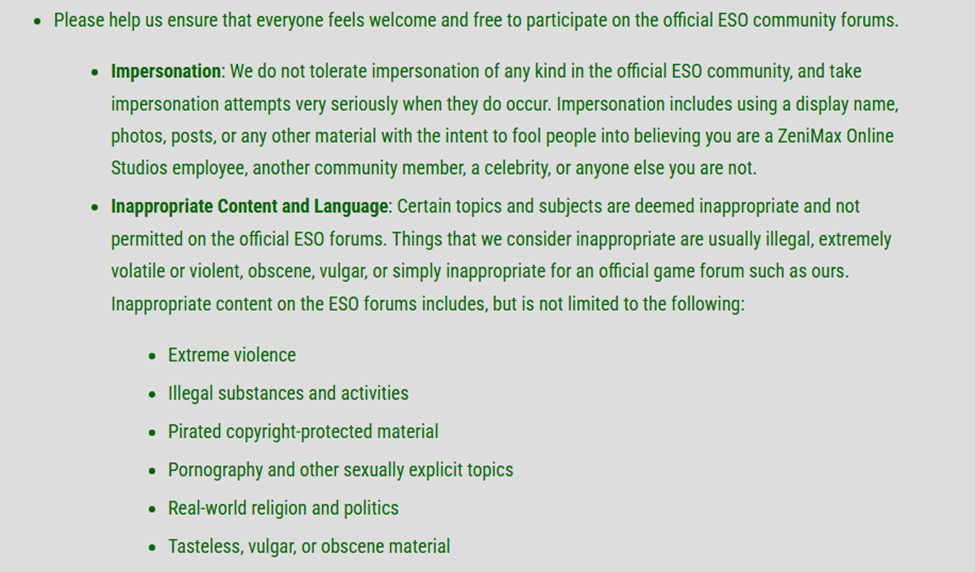
Perhaps reviewing what is and is not subject to anti-trust would be a good exercise for you. Perhaps.
I genuinely do not care about the censorship rules right now. Everything is falling apart, and now not even our escape in ESO is safe, or the creatives/devs/community moderators who made the game what it was. And don't worry, I've already gotten warned by the mods, they hear you loud in clear, no discussions of the cause of what's happening today because that's "political". I'm so sick of everything being labeled "political" and any real discussion on any real forum in any real community being shutdown. THIS IS WHY THE WORLD IS THE WAY IT IS, NO ONE IS ALLOWED TO TALK ABOUT THE CAUSE OF ANYTHING, JUST THOUGHTS AND BEST WISHES
People who expect to get respect from me soon learn they have to give me respect at the same time in order for their expectations to be met. Just say'n.
More people need to learn this lesson about how respect works.1 -
NxJoeyD✭✭✭✭Pixiepumpkin wrote: »Pixiepumpkin wrote: »
Incorrect.
1. Revenue is ultimately consolidated up to the parent.This is standard for subsidiaries in the gaming industry.
2. Subsidiaries operate with some autonomy daily, but are not financially independent. Revenue, profit/loss, expenses are consolidated into Microsofts financials.
3. This is usually the case for any subsidiary or "department" within a company, nothing new here.
4. When Zenimax was privately held, they did have shareholders. Microsoft aquired Zenimax I think in 2021 for 8+ billion. Zenimax answers to higherups at MS, who do have shareholders. So shareholders do have a claim to Zenimax through proxy.
This isn’t exactly true.
As a Corporate CFO for nearly 2 decades I can tell you that’s absolutely not correct and, in fact, illegal.
Business entity is a concept that states that each company is its own, separate, entity; and must be treated that way for finance & accounting purposes, even (and especially) with wholly owned subsidiaries.
This means that if a person pays for an ESO+ so subscription or Crowns, the money for those purchases must go to the company which provided the goods or services; in this case, Bethesda.
Now, companies can (and sometimes do) setup agreements that enable a sharing of a portion of revenue or profits in exchange for debt or equity, but, if any such agreement exists it has to be disclosed.
In this case, ZoS nor Microsoft can’t just “funnel” monies from Bethesda up into their own bank accounts simply because they own them. That would constitute “cooking” the books.
Either ZoS or Microsoft could charge Bethesda things like “management fees” as a back door way to transfer SOME of the revenue from Bethesda upward, but, even then, the agreements for any such management fees would have to be disclosed, and, those fees couldn’t constitute all or the lions share of Bethesda’s revenue; otherwise Bethesda wouldn’t be able to pass a certified financial audit, and that’s important because whilst neither ZoS nor Bethesda are publicly traded companies, Microsoft is, and as part of their legally required consolidated financial statements must audit their subsidiaries.
Now Microsoft can manage or otherwise direct & dictate to both ZoS & Bethesda; they absolutely have a right to do that. But, whether or not any Microsoft shareholder has any legal claim to equity within either ZoS or Bethesda would be dependent upon how the companies were acquired. One does not simply “inherit” equity in a subsidiary simply by holding stock in the parent. In fact, many mergers o & acquisitions are structured to prevent that very thing.
So, the long & short, no, neither ZoS nor Microsoft can’t simply pillage or otherwise funnel revenue from Bethesda upward as they see fit. There’s laws and rules that govern revenue recognition.
Yes, Bethesa has to record the revenu in their books, but in the end most of the profit belongs to Microsoft. MS must include 100% of Bethesdas revenu in offical reports.
Yes & No. Microsoft has to include Bethesda & Zenimax revenues on their "Consolidated" financial statements .. Those consolidated reports are NOT the same thing as "taking money from Bethesda and just putting into Microsoft".
Despite Bethesda & Zenimax being recorded in & among financial reports WITH Microsoft does not mean that Bethesda's revenues belong to Microsoft or that Microsoft has access to them or can just take them at will; those subsidiaries ARE financially independent.
When someone says that "Revenues are consolidated up to the parent" it's important to clarify that's only in Consolidated reporting. Don't mislead people into thinking that Bethesda's revenue just goes and gets taken upward toward Microsoft who uses it however they see fit because that's not the case.
Reporting revenue from a subsidiary on a consolidated financial statement does NOT mean that those revenues or profits from that subsidiary belong to the parent.4 -
Pixiepumpkin✭✭✭✭✭
✭✭✭Pixiepumpkin wrote: »Pixiepumpkin wrote: »
Incorrect.
1. Revenue is ultimately consolidated up to the parent.This is standard for subsidiaries in the gaming industry.
2. Subsidiaries operate with some autonomy daily, but are not financially independent. Revenue, profit/loss, expenses are consolidated into Microsofts financials.
3. This is usually the case for any subsidiary or "department" within a company, nothing new here.
4. When Zenimax was privately held, they did have shareholders. Microsoft aquired Zenimax I think in 2021 for 8+ billion. Zenimax answers to higherups at MS, who do have shareholders. So shareholders do have a claim to Zenimax through proxy.
This isn’t exactly true.
As a Corporate CFO for nearly 2 decades I can tell you that’s absolutely not correct and, in fact, illegal.
Business entity is a concept that states that each company is its own, separate, entity; and must be treated that way for finance & accounting purposes, even (and especially) with wholly owned subsidiaries.
This means that if a person pays for an ESO+ so subscription or Crowns, the money for those purchases must go to the company which provided the goods or services; in this case, Bethesda.
Now, companies can (and sometimes do) setup agreements that enable a sharing of a portion of revenue or profits in exchange for debt or equity, but, if any such agreement exists it has to be disclosed.
In this case, ZoS nor Microsoft can’t just “funnel” monies from Bethesda up into their own bank accounts simply because they own them. That would constitute “cooking” the books.
Either ZoS or Microsoft could charge Bethesda things like “management fees” as a back door way to transfer SOME of the revenue from Bethesda upward, but, even then, the agreements for any such management fees would have to be disclosed, and, those fees couldn’t constitute all or the lions share of Bethesda’s revenue; otherwise Bethesda wouldn’t be able to pass a certified financial audit, and that’s important because whilst neither ZoS nor Bethesda are publicly traded companies, Microsoft is, and as part of their legally required consolidated financial statements must audit their subsidiaries.
Now Microsoft can manage or otherwise direct & dictate to both ZoS & Bethesda; they absolutely have a right to do that. But, whether or not any Microsoft shareholder has any legal claim to equity within either ZoS or Bethesda would be dependent upon how the companies were acquired. One does not simply “inherit” equity in a subsidiary simply by holding stock in the parent. In fact, many mergers o & acquisitions are structured to prevent that very thing.
So, the long & short, no, neither ZoS nor Microsoft can’t simply pillage or otherwise funnel revenue from Bethesda upward as they see fit. There’s laws and rules that govern revenue recognition.
Yes, Bethesa has to record the revenu in their books, but in the end most of the profit belongs to Microsoft. MS must include 100% of Bethesdas revenu in offical reports.
Yes & No. Microsoft has to include Bethesda & Zenimax revenues on their "Consolidated" financial statements .. Those consolidated reports are NOT the same thing as "taking money from Bethesda and just putting into Microsoft".
Despite Bethesda & Zenimax being recorded in & among financial reports WITH Microsoft does not mean that Bethesda's revenues belong to Microsoft or that Microsoft has access to them or can just take them at will; those subsidiaries ARE financially independent.
When someone says that "Revenues are consolidated up to the parent" it's important to clarify that's only in Consolidated reporting. Don't mislead people into thinking that Bethesda's revenue just goes and gets taken upward toward Microsoft who uses it however they see fit because that's not the case.
Reporting revenue from a subsidiary on a consolidated financial statement does NOT mean that those revenues or profits from that subsidiary belong to the parent.
Are the following bullet points true?
Microsoft can extract profits from Zenimax Online Media through:
• Dividends: Regular or special cash dividends from profits that can range between 30% and 70% of profits
• Service fees charged for corporate support. Cloud/HR/Legal and can range between 2% and 10% of revenue.
• Licensing and royalities between 5% and 15%
• Intercompany interest paid to MS that vary on market rates between 3% and 8%
"a fool and his money are soon parted"- Defense of the Government of the Church of England c. 15872 -
NxJoeyD✭✭✭✭Pixiepumpkin wrote: »Pixiepumpkin wrote: »Pixiepumpkin wrote: »
Incorrect.
1. Revenue is ultimately consolidated up to the parent.This is standard for subsidiaries in the gaming industry.
2. Subsidiaries operate with some autonomy daily, but are not financially independent. Revenue, profit/loss, expenses are consolidated into Microsofts financials.
3. This is usually the case for any subsidiary or "department" within a company, nothing new here.
4. When Zenimax was privately held, they did have shareholders. Microsoft aquired Zenimax I think in 2021 for 8+ billion. Zenimax answers to higherups at MS, who do have shareholders. So shareholders do have a claim to Zenimax through proxy.
This isn’t exactly true.
As a Corporate CFO for nearly 2 decades I can tell you that’s absolutely not correct and, in fact, illegal.
Business entity is a concept that states that each company is its own, separate, entity; and must be treated that way for finance & accounting purposes, even (and especially) with wholly owned subsidiaries.
This means that if a person pays for an ESO+ so subscription or Crowns, the money for those purchases must go to the company which provided the goods or services; in this case, Bethesda.
Now, companies can (and sometimes do) setup agreements that enable a sharing of a portion of revenue or profits in exchange for debt or equity, but, if any such agreement exists it has to be disclosed.
In this case, ZoS nor Microsoft can’t just “funnel” monies from Bethesda up into their own bank accounts simply because they own them. That would constitute “cooking” the books.
Either ZoS or Microsoft could charge Bethesda things like “management fees” as a back door way to transfer SOME of the revenue from Bethesda upward, but, even then, the agreements for any such management fees would have to be disclosed, and, those fees couldn’t constitute all or the lions share of Bethesda’s revenue; otherwise Bethesda wouldn’t be able to pass a certified financial audit, and that’s important because whilst neither ZoS nor Bethesda are publicly traded companies, Microsoft is, and as part of their legally required consolidated financial statements must audit their subsidiaries.
Now Microsoft can manage or otherwise direct & dictate to both ZoS & Bethesda; they absolutely have a right to do that. But, whether or not any Microsoft shareholder has any legal claim to equity within either ZoS or Bethesda would be dependent upon how the companies were acquired. One does not simply “inherit” equity in a subsidiary simply by holding stock in the parent. In fact, many mergers o & acquisitions are structured to prevent that very thing.
So, the long & short, no, neither ZoS nor Microsoft can’t simply pillage or otherwise funnel revenue from Bethesda upward as they see fit. There’s laws and rules that govern revenue recognition.
Yes, Bethesa has to record the revenu in their books, but in the end most of the profit belongs to Microsoft. MS must include 100% of Bethesdas revenu in offical reports.
Yes & No. Microsoft has to include Bethesda & Zenimax revenues on their "Consolidated" financial statements .. Those consolidated reports are NOT the same thing as "taking money from Bethesda and just putting into Microsoft".
Despite Bethesda & Zenimax being recorded in & among financial reports WITH Microsoft does not mean that Bethesda's revenues belong to Microsoft or that Microsoft has access to them or can just take them at will; those subsidiaries ARE financially independent.
When someone says that "Revenues are consolidated up to the parent" it's important to clarify that's only in Consolidated reporting. Don't mislead people into thinking that Bethesda's revenue just goes and gets taken upward toward Microsoft who uses it however they see fit because that's not the case.
Reporting revenue from a subsidiary on a consolidated financial statement does NOT mean that those revenues or profits from that subsidiary belong to the parent.
Are the following bullet points true?
Microsoft can extract profits from Zenimax Online Media through:
• Dividends: Regular or special cash dividends from profits that can range between 30% and 70% of profits
• Service fees charged for corporate support. Cloud/HR/Legal and can range between 2% and 10% of revenue.
• Licensing and royalities between 5% and 15%
• Intercompany interest paid to MS that vary on market rates between 3% and 8%
1) Dividends: Depends, possibly, yes, but it’s not a given rule and is dependent upon certain metrics and even then is limited in amount.
2) Service Fees: Yes, but limited
3) Licensing: yes, but also limited. 5% to 15% of revenue is valid.
4) Inter-company interest: yes, assuming there’s associated debt to substantiate the interest.
Each of those are valid line items but none of them would allow for ALL or even the majority of profits or revenues to be transferred out of Bethesda’s up into Microsoft.
As I mentioned originally, there are some fees and transactions Microsoft can use to extract “some” profit from Bethesda but the statement that ALL revenues and profits get funneled up to Microsoft is false.6 -
Pixiepumpkin✭✭✭✭✭
✭✭✭Pixiepumpkin wrote: »Pixiepumpkin wrote: »Pixiepumpkin wrote: »
Incorrect.
1. Revenue is ultimately consolidated up to the parent.This is standard for subsidiaries in the gaming industry.
2. Subsidiaries operate with some autonomy daily, but are not financially independent. Revenue, profit/loss, expenses are consolidated into Microsofts financials.
3. This is usually the case for any subsidiary or "department" within a company, nothing new here.
4. When Zenimax was privately held, they did have shareholders. Microsoft aquired Zenimax I think in 2021 for 8+ billion. Zenimax answers to higherups at MS, who do have shareholders. So shareholders do have a claim to Zenimax through proxy.
This isn’t exactly true.
As a Corporate CFO for nearly 2 decades I can tell you that’s absolutely not correct and, in fact, illegal.
Business entity is a concept that states that each company is its own, separate, entity; and must be treated that way for finance & accounting purposes, even (and especially) with wholly owned subsidiaries.
This means that if a person pays for an ESO+ so subscription or Crowns, the money for those purchases must go to the company which provided the goods or services; in this case, Bethesda.
Now, companies can (and sometimes do) setup agreements that enable a sharing of a portion of revenue or profits in exchange for debt or equity, but, if any such agreement exists it has to be disclosed.
In this case, ZoS nor Microsoft can’t just “funnel” monies from Bethesda up into their own bank accounts simply because they own them. That would constitute “cooking” the books.
Either ZoS or Microsoft could charge Bethesda things like “management fees” as a back door way to transfer SOME of the revenue from Bethesda upward, but, even then, the agreements for any such management fees would have to be disclosed, and, those fees couldn’t constitute all or the lions share of Bethesda’s revenue; otherwise Bethesda wouldn’t be able to pass a certified financial audit, and that’s important because whilst neither ZoS nor Bethesda are publicly traded companies, Microsoft is, and as part of their legally required consolidated financial statements must audit their subsidiaries.
Now Microsoft can manage or otherwise direct & dictate to both ZoS & Bethesda; they absolutely have a right to do that. But, whether or not any Microsoft shareholder has any legal claim to equity within either ZoS or Bethesda would be dependent upon how the companies were acquired. One does not simply “inherit” equity in a subsidiary simply by holding stock in the parent. In fact, many mergers o & acquisitions are structured to prevent that very thing.
So, the long & short, no, neither ZoS nor Microsoft can’t simply pillage or otherwise funnel revenue from Bethesda upward as they see fit. There’s laws and rules that govern revenue recognition.
Yes, Bethesa has to record the revenu in their books, but in the end most of the profit belongs to Microsoft. MS must include 100% of Bethesdas revenu in offical reports.
Yes & No. Microsoft has to include Bethesda & Zenimax revenues on their "Consolidated" financial statements .. Those consolidated reports are NOT the same thing as "taking money from Bethesda and just putting into Microsoft".
Despite Bethesda & Zenimax being recorded in & among financial reports WITH Microsoft does not mean that Bethesda's revenues belong to Microsoft or that Microsoft has access to them or can just take them at will; those subsidiaries ARE financially independent.
When someone says that "Revenues are consolidated up to the parent" it's important to clarify that's only in Consolidated reporting. Don't mislead people into thinking that Bethesda's revenue just goes and gets taken upward toward Microsoft who uses it however they see fit because that's not the case.
Reporting revenue from a subsidiary on a consolidated financial statement does NOT mean that those revenues or profits from that subsidiary belong to the parent.
Are the following bullet points true?
Microsoft can extract profits from Zenimax Online Media through:
• Dividends: Regular or special cash dividends from profits that can range between 30% and 70% of profits
• Service fees charged for corporate support. Cloud/HR/Legal and can range between 2% and 10% of revenue.
• Licensing and royalities between 5% and 15%
• Intercompany interest paid to MS that vary on market rates between 3% and 8%
1) Dividends: Depends, possibly, yes, but it’s not a given rule and is dependent upon certain metrics and even then is limited in amount.
2) Service Fees: Yes, but limited
3) Licensing: yes, but also limited. 5% to 15% of revenue is valid.
4) Inter-company interest: yes, assuming there’s associated debt to substantiate the interest.
Each of those are valid line items but none of them would allow for ALL or even the majority of profits or revenues to be transferred out of Bethesda’s up into Microsoft.
As I mentioned originally, there are some fees and transactions Microsoft can use to extract “some” profit from Bethesda but the statement that ALL revenues and profits get funneled up to Microsoft is false.
I never stated "all profits".
The fact is, through legal means MS can extract the healthy sum of profits from Zenimax if they chose to. It would obviously be detrimental to the livelihood and longevity of Zenimax being able to sustain their business but through the above mentioned means, they can in fact take much of the profit from Zenimax.
Which means your statement....
...is in fact incorrect along withDon't mislead people into thinking that Bethesda's revenue just goes and gets taken upward toward Microsoft who uses it however they see fit because that's not the case.When someone says that "Revenues are consolidated up to the parent" it's important to clarify that's only in Consolidated reporting. Don't mislead people into thinking that Bethesda's revenue just goes and gets taken upward toward Microsoft who uses it however they see fit because that's not the case.
Because, again, MS can extract much if not most of the profit, legally, if they chose to.
Nothing I said was incorrect, light on details - sure, but not incorrect.
Edited by Pixiepumpkin on July 13, 2026 6:09PM"a fool and his money are soon parted"- Defense of the Government of the Church of England c. 15872 -
NxJoeyD✭✭✭✭Pixiepumpkin wrote: »
I never stated "all profits".
You did .. Post #420 on Page 14 of this thread you tried telling another commenter that "Revenue is ultimately consolidated up to the parent" .. you also said that subsidiaries are "not financially independent".
That's wrong. Revenues are only consolidated on certain financial statements, they aren't physically funneled upward in a way that you're insinuating; also, subsidiary companies do have financial independence.Pixiepumpkin wrote: »The fact is, through legal means MS can extract the healthy sum of profits from Zenimax if they chose to. It would obviously be detrimental to the livelihood and longevity of Zenimax being able to sustain their business but through the above mentioned means, they can in fact take much of the profit from Zenimax.
Again, this isn't true. Microsoft could not extract any sum of revenue or profits under any circumstances which would be a determent to Bethesda. This is because if Microsoft tried it would mean that Bethesda would result in a "Going Concern" on the required certified financial audit which would crate a major problem for Microsoft not only from the audit but from the perspective of corporate veil.
Dividends have limits, items like management fees or licensing fees, by law, have to reflect fair market values; they can't just make up whatever amounts they want in order to strip profits from a subsidiary.
Which means your statement....Pixiepumpkin wrote: »Because, again, MS can extract much if not most of the profit, legally, if they chose to.
Nothing I said was incorrect, light on details - sure, but not incorrect.
is 100% incorrect. No parent company can just take as much profit from even a wholly owned subsidiary at will. Everything has defined limits within the policies, principals, and laws that define finance & accounting.
You don't have to take my word for it, all of this is available for anyone to search and double check via the FASB.
7 -
Alefroth✭✭Pixiepumpkin wrote: »Pixiepumpkin wrote: »Pixiepumpkin wrote: »Pixiepumpkin wrote: »
Incorrect.
1. Revenue is ultimately consolidated up to the parent.This is standard for subsidiaries in the gaming industry.
2. Subsidiaries operate with some autonomy daily, but are not financially independent. Revenue, profit/loss, expenses are consolidated into Microsofts financials.
3. This is usually the case for any subsidiary or "department" within a company, nothing new here.
4. When Zenimax was privately held, they did have shareholders. Microsoft aquired Zenimax I think in 2021 for 8+ billion. Zenimax answers to higherups at MS, who do have shareholders. So shareholders do have a claim to Zenimax through proxy.
This isn’t exactly true.
As a Corporate CFO for nearly 2 decades I can tell you that’s absolutely not correct and, in fact, illegal.
Business entity is a concept that states that each company is its own, separate, entity; and must be treated that way for finance & accounting purposes, even (and especially) with wholly owned subsidiaries.
This means that if a person pays for an ESO+ so subscription or Crowns, the money for those purchases must go to the company which provided the goods or services; in this case, Bethesda.
Now, companies can (and sometimes do) setup agreements that enable a sharing of a portion of revenue or profits in exchange for debt or equity, but, if any such agreement exists it has to be disclosed.
In this case, ZoS nor Microsoft can’t just “funnel” monies from Bethesda up into their own bank accounts simply because they own them. That would constitute “cooking” the books.
Either ZoS or Microsoft could charge Bethesda things like “management fees” as a back door way to transfer SOME of the revenue from Bethesda upward, but, even then, the agreements for any such management fees would have to be disclosed, and, those fees couldn’t constitute all or the lions share of Bethesda’s revenue; otherwise Bethesda wouldn’t be able to pass a certified financial audit, and that’s important because whilst neither ZoS nor Bethesda are publicly traded companies, Microsoft is, and as part of their legally required consolidated financial statements must audit their subsidiaries.
Now Microsoft can manage or otherwise direct & dictate to both ZoS & Bethesda; they absolutely have a right to do that. But, whether or not any Microsoft shareholder has any legal claim to equity within either ZoS or Bethesda would be dependent upon how the companies were acquired. One does not simply “inherit” equity in a subsidiary simply by holding stock in the parent. In fact, many mergers o & acquisitions are structured to prevent that very thing.
So, the long & short, no, neither ZoS nor Microsoft can’t simply pillage or otherwise funnel revenue from Bethesda upward as they see fit. There’s laws and rules that govern revenue recognition.
Yes, Bethesa has to record the revenu in their books, but in the end most of the profit belongs to Microsoft. MS must include 100% of Bethesdas revenu in offical reports.
Yes & No. Microsoft has to include Bethesda & Zenimax revenues on their "Consolidated" financial statements .. Those consolidated reports are NOT the same thing as "taking money from Bethesda and just putting into Microsoft".
Despite Bethesda & Zenimax being recorded in & among financial reports WITH Microsoft does not mean that Bethesda's revenues belong to Microsoft or that Microsoft has access to them or can just take them at will; those subsidiaries ARE financially independent.
When someone says that "Revenues are consolidated up to the parent" it's important to clarify that's only in Consolidated reporting. Don't mislead people into thinking that Bethesda's revenue just goes and gets taken upward toward Microsoft who uses it however they see fit because that's not the case.
Reporting revenue from a subsidiary on a consolidated financial statement does NOT mean that those revenues or profits from that subsidiary belong to the parent.
Are the following bullet points true?
Microsoft can extract profits from Zenimax Online Media through:
• Dividends: Regular or special cash dividends from profits that can range between 30% and 70% of profits
• Service fees charged for corporate support. Cloud/HR/Legal and can range between 2% and 10% of revenue.
• Licensing and royalities between 5% and 15%
• Intercompany interest paid to MS that vary on market rates between 3% and 8%
1) Dividends: Depends, possibly, yes, but it’s not a given rule and is dependent upon certain metrics and even then is limited in amount.
2) Service Fees: Yes, but limited
3) Licensing: yes, but also limited. 5% to 15% of revenue is valid.
4) Inter-company interest: yes, assuming there’s associated debt to substantiate the interest.
Each of those are valid line items but none of them would allow for ALL or even the majority of profits or revenues to be transferred out of Bethesda’s up into Microsoft.
As I mentioned originally, there are some fees and transactions Microsoft can use to extract “some” profit from Bethesda but the statement that ALL revenues and profits get funneled up to Microsoft is false.
I never stated "all profits".
The fact is, through legal means MS can extract the healthy sum of profits from Zenimax if they chose to. It would obviously be detrimental to the livelihood and longevity of Zenimax being able to sustain their business but through the above mentioned means, they can in fact take much of the profit from Zenimax.
Which means your statement....
...is in fact incorrect along withDon't mislead people into thinking that Bethesda's revenue just goes and gets taken upward toward Microsoft who uses it however they see fit because that's not the case.When someone says that "Revenues are consolidated up to the parent" it's important to clarify that's only in Consolidated reporting. Don't mislead people into thinking that Bethesda's revenue just goes and gets taken upward toward Microsoft who uses it however they see fit because that's not the case.
Because, again, MS can extract much if not most of the profit, legally, if they chose to.
Nothing I said was incorrect, light on details - sure, but not incorrect.
Wrong. You were clearly incorrect.
Edited by Alefroth on July 14, 2026 10:32PM6 -
 thedocbwarren✭✭✭✭I would not want to be the pessimist here, but I can't escape it. This really feels like that all of a sudden ESO might be facing its end... Or be left to linger on with a skeleton crew and AI tools.
I missed Zos_Kevin's post to this thread when I first wrote here and now reading it made me become really afraid. The way he wrote about it just feels like a first sad goodbye note.
But we can only speculate before hearing some official news. Hoping for something reasonable and fearing for the worst. For a person like me who values western style fantasy and eastern style anime mmo's are out of the question there really is not much to choose from. I finally quit Wow after 16 years because of the old game visual style did not satisfy me anymore and there is no way they could fix that without remaking the whole game to new engine.. I was happy to fall for ESO. Had my hopes up for Ashes of creation but seems like that game will never really happen. So what will I do if ESO ends?
I have to agree and it's very upsetting. I want to hope for a turn around. I wish it were possible they would either pass the division to a good supporting company or open the game to the public to maintain if it all goes pear-shaped.0 -
Luneca✭✭✭✭✭Pixiepumpkin wrote: »Pixiepumpkin wrote: »Pixiepumpkin wrote: »Pixiepumpkin wrote: »
Incorrect.
1. Revenue is ultimately consolidated up to the parent.This is standard for subsidiaries in the gaming industry.
2. Subsidiaries operate with some autonomy daily, but are not financially independent. Revenue, profit/loss, expenses are consolidated into Microsofts financials.
3. This is usually the case for any subsidiary or "department" within a company, nothing new here.
4. When Zenimax was privately held, they did have shareholders. Microsoft aquired Zenimax I think in 2021 for 8+ billion. Zenimax answers to higherups at MS, who do have shareholders. So shareholders do have a claim to Zenimax through proxy.
This isn’t exactly true.
As a Corporate CFO for nearly 2 decades I can tell you that’s absolutely not correct and, in fact, illegal.
Business entity is a concept that states that each company is its own, separate, entity; and must be treated that way for finance & accounting purposes, even (and especially) with wholly owned subsidiaries.
This means that if a person pays for an ESO+ so subscription or Crowns, the money for those purchases must go to the company which provided the goods or services; in this case, Bethesda.
Now, companies can (and sometimes do) setup agreements that enable a sharing of a portion of revenue or profits in exchange for debt or equity, but, if any such agreement exists it has to be disclosed.
In this case, ZoS nor Microsoft can’t just “funnel” monies from Bethesda up into their own bank accounts simply because they own them. That would constitute “cooking” the books.
Either ZoS or Microsoft could charge Bethesda things like “management fees” as a back door way to transfer SOME of the revenue from Bethesda upward, but, even then, the agreements for any such management fees would have to be disclosed, and, those fees couldn’t constitute all or the lions share of Bethesda’s revenue; otherwise Bethesda wouldn’t be able to pass a certified financial audit, and that’s important because whilst neither ZoS nor Bethesda are publicly traded companies, Microsoft is, and as part of their legally required consolidated financial statements must audit their subsidiaries.
Now Microsoft can manage or otherwise direct & dictate to both ZoS & Bethesda; they absolutely have a right to do that. But, whether or not any Microsoft shareholder has any legal claim to equity within either ZoS or Bethesda would be dependent upon how the companies were acquired. One does not simply “inherit” equity in a subsidiary simply by holding stock in the parent. In fact, many mergers o & acquisitions are structured to prevent that very thing.
So, the long & short, no, neither ZoS nor Microsoft can’t simply pillage or otherwise funnel revenue from Bethesda upward as they see fit. There’s laws and rules that govern revenue recognition.
Yes, Bethesa has to record the revenu in their books, but in the end most of the profit belongs to Microsoft. MS must include 100% of Bethesdas revenu in offical reports.
Yes & No. Microsoft has to include Bethesda & Zenimax revenues on their "Consolidated" financial statements .. Those consolidated reports are NOT the same thing as "taking money from Bethesda and just putting into Microsoft".
Despite Bethesda & Zenimax being recorded in & among financial reports WITH Microsoft does not mean that Bethesda's revenues belong to Microsoft or that Microsoft has access to them or can just take them at will; those subsidiaries ARE financially independent.
When someone says that "Revenues are consolidated up to the parent" it's important to clarify that's only in Consolidated reporting. Don't mislead people into thinking that Bethesda's revenue just goes and gets taken upward toward Microsoft who uses it however they see fit because that's not the case.
Reporting revenue from a subsidiary on a consolidated financial statement does NOT mean that those revenues or profits from that subsidiary belong to the parent.
Are the following bullet points true?
Microsoft can extract profits from Zenimax Online Media through:
• Dividends: Regular or special cash dividends from profits that can range between 30% and 70% of profits
• Service fees charged for corporate support. Cloud/HR/Legal and can range between 2% and 10% of revenue.
• Licensing and royalities between 5% and 15%
• Intercompany interest paid to MS that vary on market rates between 3% and 8%
1) Dividends: Depends, possibly, yes, but it’s not a given rule and is dependent upon certain metrics and even then is limited in amount.
2) Service Fees: Yes, but limited
3) Licensing: yes, but also limited. 5% to 15% of revenue is valid.
4) Inter-company interest: yes, assuming there’s associated debt to substantiate the interest.
Each of those are valid line items but none of them would allow for ALL or even the majority of profits or revenues to be transferred out of Bethesda’s up into Microsoft.
As I mentioned originally, there are some fees and transactions Microsoft can use to extract “some” profit from Bethesda but the statement that ALL revenues and profits get funneled up to Microsoft is false.
I never stated "all profits".
The fact is, through legal means MS can extract the healthy sum of profits from Zenimax if they chose to. It would obviously be detrimental to the livelihood and longevity of Zenimax being able to sustain their business but through the above mentioned means, they can in fact take much of the profit from Zenimax.
Which means your statement....
...is in fact incorrect along withDon't mislead people into thinking that Bethesda's revenue just goes and gets taken upward toward Microsoft who uses it however they see fit because that's not the case.When someone says that "Revenues are consolidated up to the parent" it's important to clarify that's only in Consolidated reporting. Don't mislead people into thinking that Bethesda's revenue just goes and gets taken upward toward Microsoft who uses it however they see fit because that's not the case.
Because, again, MS can extract much if not most of the profit, legally, if they chose to.
Nothing I said was incorrect, light on details - sure, but not incorrect.
Wrong. You were clearly incorrect.
Were they incorrect or was it the AI they trusted? Either way, what an entertaining threat heh. These forum are wild sometimes. Let this be a notice to the forum goers: don't blindly trust AI !5 -
 anadandy✭✭✭✭✭
✭✭Just saw Ray Lederer (concept artist) was added to the list on the first post. I know he wasn't technically ESO related but that is a damn shame. He was the last concept artist from Skryim still at BGS and his art touched everything.Edited by anadandy on July 15, 2026 10:54AM7 -
 ADarklore✭✭✭✭✭
✭✭✭✭✭
To be fair, what happened to New World is just the result of Amazons corporate ego and greed. They wanted to pull blockbuster numbers and deemed it a failure just because it didn't, shutting it down in favor to work on a new game... ignorant to the fact that they've now lost the trust of gamers and most won't even be willing to support any game they release going forward.Please don't let "ESO" end up with the same fate as "New World".
Well, let's be fair... New World had absolutely NO source of revenue generation. They had optional battle passes, but their online store was barely and rarely refreshed, they had no optional subscriptions, and they offered DLCs for free. So how was the game supposed to generate revenue to even pay for itself? That was the problem from the beginning and continued into the future, and I'm sure the game lost a LOT of money over time because of them not having a means of constant revenue generation. However, ESO is different and WAS making money- and I say WAS- because unless ZOS can come out with a "this is our future plans" and have it be feasible and reasonable... then most people will cancel their subs and move on... forcing it to become just like New World.
IMO, I think Microsoft is having major regrets about investing in the gaming industry... so they are trying to decimate many of their studios and simply use their cancellations as a tax write-off. Studies have shown that the younger generation isn't interested in AAA or MMO games... they want simple, mentally unchallenging games... and without new blood coming in to buy AAA games or subscribe to MMOs or spend money in the online stores, then AAA and MMO games will cease to be made. Micosoft would now rather invest in AI, then in gaming, and I think that decision was clear when they put a non-gamer with a background in an AI division in charge of XBOX.CP: 2130 ** ESO+ ** ~~ ***** Strictly a solo PvE quester *****
~~Started Playing: May 2015 | Stopped Playing: May 2026 | Returning: uncertain~~2 -
 Rungar✭✭✭✭✭
✭and the reason why younger players are not interested in AAA or mmos anymore is because they have run out of ideas and cant/wont make the games players actually want. Look at valheim. A tiny game that rarely gets updated. Better box sales than ESO and alot more concurrent players for 5 years straight.
eso does everything wrong and for the wrong reasons, and thats why its medoicre and on the chopping blocks. People say ideas dont count for anything, but they certainly do when you dont have them.
when you have 300 staff and you regularly get beat by a game made by 3 dudes.. you suck at what you do.only a few years left to go now....
Current ideas for ESO improvement
Rungar's Mystical Emporium of Ideas junkyard5 -
 spartaxoxo✭✭✭✭✭
✭✭✭✭✭And now we have more concrete numbers. 379 positions eliminated, 289 of which were union members. 0 of these are reductions in hours but some people have been asked to stay on temporarily to complete current projects. This is combined so not just ESO's people but both Zenimax companies.
https://www.reddit.com/r/elderscrollsonline/s/m8PoQ7JLSKEdited by spartaxoxo on July 15, 2026 10:39PM7 -
NxJoeyD✭✭✭✭
To be fair, what happened to New World is just the result of Amazons corporate ego and greed. They wanted to pull blockbuster numbers and deemed it a failure just because it didn't, shutting it down in favor to work on a new game... ignorant to the fact that they've now lost the trust of gamers and most won't even be willing to support any game they release going forward.Please don't let "ESO" end up with the same fate as "New World".
Well, let's be fair... New World had absolutely NO source of revenue generation. They had optional battle passes, but their online store was barely and rarely refreshed, they had no optional subscriptions, and they offered DLCs for free. So how was the game supposed to generate revenue to even pay for itself? That was the problem from the beginning and continued into the future, and I'm sure the game lost a LOT of money over time because of them not having a means of constant revenue generation. However, ESO is different and WAS making money- and I say WAS- because unless ZOS can come out with a "this is our future plans" and have it be feasible and reasonable... then most people will cancel their subs and move on... forcing it to become just like New World.
IMO, I think Microsoft is having major regrets about investing in the gaming industry... so they are trying to decimate many of their studios and simply use their cancellations as a tax write-off. Studies have shown that the younger generation isn't interested in AAA or MMO games... they want simple, mentally unchallenging games... and without new blood coming in to buy AAA games or subscribe to MMOs or spend money in the online stores, then AAA and MMO games will cease to be made. Micosoft would now rather invest in AI, then in gaming, and I think that decision was clear when they put a non-gamer with a background in an AI division in charge of XBOX.
This .. 100%.
New World had the potential to give ESO a run for their money and it was my hope that the leadership (not necessarily the Devs or technical crew) would wake up and realize just how close a competitor had come to really chunking their player base and got serious about the game direction.
New World had a lot going for it in the way of potential: A solid lore, fantastic are style, really good immersion, good quality maps, simplistic and intuitive combat mechs that worked (that's not to say they were always balanced but they worked). New World massively dropped the ball by not listening to the player base, as a community, and by failing to look at the title as a product versus a piece of art. Without a source of post-purchase revenue it was doomed to die and in the early days (before console port) many of us were waiting for that aspect to drop and it never came.
New World did have some pain points. The crafting and economy were awful. When I left the game it was prior to the console release so it was still PC only, and at that time only 0.1% of the player base (in total) had earned / achieved the ability to craft top GS gear, and I was one of them ... 0.1%! That's insanely low.
Had AGS really had a more objective leadership team they might have developed a better long term strategy that would have seen New World become a much bigger issue for Bethesda & Zenimax. It's by the biggest combination of luck & ignorance that they didn't get more than a shot across the bow.
As for Microsoft, I agree totally. IMO they definitely are looking to not only pivot more into AI and supporting infrastructure but they also have to do a double back and re-focus on one of their core market share products, Windows. Windows 11 delivered a bloodbath for Microsoft over the poor quality and the loss of market share as a result was eye opening to them and they realize that if they don't release something redeeming they're going to have a problem.
As for ESO, yes, it makes money, there's no doubt about that .. but .. player base and spending have been on a decline in recent years. Partly attributed to inherent changes post-COVID but even beyond that the trend doesn't look to be changing direction so even if Microsoft hadn't made this call, at some point, Zenimax / Bethesda probably would have.
ESO is a great title with a solid IP with years more potential value under it's belt. But in order to bring that to life the leadership over ESO are going to have to broaden their perspective and pay a little more attention to the areas of the game that get the most consistent feedback and start to address those, which, I'm optimistic that they will.
It'll take a little time but I do think the dust will settle rather quickly here.0 -
 Rkindaleft✭✭✭✭✭
✭✭spartaxoxo wrote: »And now we have more concrete numbers. 379 positions eliminated, 289 of which were union members. 0 of these are reductions in hours but some people have been asked to stay on temporarily to complete current projects. This is combined so not just ESO's people but both Zenimax companies.
https://www.reddit.com/r/elderscrollsonline/s/m8PoQ7JLSK
These layoffs are awful and I wouldn’t wish them on anyone, so I'm really not trying to make it out like I'm complaining - but the amount of QA testers being laid off is bewildering to me.
With how such few things seem to get fixed in a timely manner (and, until recently, major PTS bugs not getting fixed before live) I wasn't even sure they had much of a QA team to begin with.
This is saying to me that there is perhaps something in the organizational structure that is blocking the QA team from reporting stuff or getting things actioned (or possibly the people above them aren't listening to them?). I don't understand otherwise how you could have so many QA testers and so many updates still come out filled with bugs or breaking stuff in the game.
Edited by Rkindaleft on July 16, 2026 12:30AMPlayStation NA https://youtube.com/@rkindaleftTick Tock Tormentor | Saintly Savior | Gryphon Heart | Godslayer | Kyne's Wrath | Planesbreaker | Swashbuckler Supreme | Mindmender | Unstoppable
+ Pathwalker (does that count lol?)3 -
hiyde✭✭✭✭✭
✭✭Rkindaleft wrote: »the amount of QA testers being laid off is bewildering to me.
The list posted on reddit adds up to ~100 "QA" people being laid off (between ZOS and ZM). That was surprising.Edited by hiyde on July 15, 2026 11:50PM@Hiyde GM/Founder - Bleakrock Barter Co (Trade Guild - PC/NA) | Blackbriar Barter Co (Trade Guild-PC/NA)3 -
 heaven13✭✭✭✭✭
✭✭✭✭It's now being reported that Susan is also among those leaving.PC/NAMountain God | Leave No Bone Unbroken | Apex Predator | Pure Lunacy | Depths Defier | No Rest for the Wicked | In Defiance of DeathMeet my characters :
Defanged the Devourer | Nature's Wrath | Relentless Raider | True Genius | Bane of Thorns | Subterranean Smasher | Ardent Bibliophile
vAA HM | vHRC HM | vSO HM | vDSA | vMoL HM | vHoF HM | vAS+2 | vCR+2 | vBRP | vSS HM | vKA | vRGIT DOESN'T MATTER BECAUSE THEY'RE ALL THE SAME NOW, THANKS ZOS5 -
 AzuraFan✭✭✭✭✭
✭✭✭✭It's now being reported that Susan is also among those leaving.
Also Jo Burba.
https://www.gamefile.news/p/zenimax-online-studio-head-outEdited by AzuraFan on July 16, 2026 2:32AM4 -
 ESO_player123✭✭✭✭✭
✭✭✭It's now being reported that Susan is also among those leaving.
Also Jo Burba.
https://www.gamefile.news/p/zenimax-online-studio-head-out
Them too???
Well, at this point it probably will be easier to list whose who are staying.
Seeing all of these changes, I'm inclined to join the pessimist club and now considering going back to single-player games . And also occasionally thinking about going back to Runescape (which I thought I would never do).Edited by ESO_player123 on July 16, 2026 2:43AM1 -
 Sephyr✭✭✭✭✭
✭✭ESO_player123 wrote: »It's now being reported that Susan is also among those leaving.
Also Jo Burba.
https://www.gamefile.news/p/zenimax-online-studio-head-out
Them too???
Well, at this point it probably will be easier to list whose who are staying.
Seeing all of these changes, I'm inclined to join the pessimist club and now considering going back to single-player games . And also occasionally thinking about going back to Runescape (which I thought I would never do).
Honestly, same. If Nick Giacomini is also gone, I really fail to see myself staying for very much longer given that those three really inspired me to come back and give it a try.
Like, I was trying to stay on the fence... Heck, I still am—but without them it's really hard to remain positive that what brought me back in the first place is going to survive. Guess I really should look into trying to find a Free Company in FFXIV after all.
Edit: Seen that Nick is still there after re-reading the article again. I'm still skeptical given that this makes two studio heads gone in a year (Matt's departure last year, Jo's this year), nearly to the month. Sure, they'll still be there through the transitional period, but that doesn't guarantee that the studio will be able to maintain the vision they set out.Edited by Sephyr on July 16, 2026 3:38AM2 -
irstarkey57✭✭✭✭allochthons wrote: »I know stating here that I cancelled ESO+ doesn't mean anything.
But when Disney messed with Jimmy Fallon, the hit to Disney+ was enough to be really effective. Maybe if ESO+ memberships crash, that'll let XBox know how stupid this move is.
in theory def makes sense....but in reality it will just lead to more layoffs2 -
 o_Primate_o✭✭✭✭does Asha intent to backfill ESO with FO devs after FO goes to Obsidian?Xbox NA as o Primate o0
 -
Maxxermax✭✭✭Back when the player count was higher, a cheaper ESO+ subscription ($6 a month) would have had a greater financial impact—meaning higher revenue—because more players (if not all of them) would have simply said, "Screw it, I'll get the subscription; it's so cheap." But now that the player count is shrinking due to this "scandal," that probably makes less sense.1
-
heaven13✭✭✭✭✭
✭✭✭✭I'm sad to see Susan go. I feel like both Susan and Nick have talked about the game with insight, passion, and transparency in the interviews we've seen with them and it feels like ESO has been improving since this shift. Obviously, it hasn't been a complete 180 but it left me feeling more hopeful in the game than I have in the past. I'm still willing to see what comes of it and will be patient as the team transitions but I certainly feel like mistakes were made by people that don't give a *** about the actual game or the people who care about it, and only about profits.PC/NAMountain God | Leave No Bone Unbroken | Apex Predator | Pure Lunacy | Depths Defier | No Rest for the Wicked | In Defiance of DeathMeet my characters :
Defanged the Devourer | Nature's Wrath | Relentless Raider | True Genius | Bane of Thorns | Subterranean Smasher | Ardent Bibliophile
vAA HM | vHRC HM | vSO HM | vDSA | vMoL HM | vHoF HM | vAS+2 | vCR+2 | vBRP | vSS HM | vKA | vRGIT DOESN'T MATTER BECAUSE THEY'RE ALL THE SAME NOW, THANKS ZOS10 -
ADawg✭✭✭Welp, I stopped paying on all of my family accounts because they ruined and neglected PVP. I think at one point I had 4x ESO plus memberships going for myself and children who PVP with me.
VOTE WITH YOUR DOLLAR!5
