Maintenance for the week of September 7:
• PC/Mac: No maintenance – September 7
• PC/Mac: No maintenance – September 7
An Update from the ESO Team
-
 Destai✭✭✭✭✭
✭✭✭✭Both Jessica and Jason Barnes (Associate Design Director) told us at the ESO Tavern event yesterday that Zenimax Online Studios is at the same size now as it was when they made both Wrothgar and Summerset.
So while the layoffs are extremely upsetting for everyone involved (of course including players), the game is definitely not going into maintenance mode yet.
On one hand, that's reassuring.
On another, it's hard not to hear that and interpret that they've done less with more. If I look at content released in the last 2 years, it's really light in comparison. And if I compare story writing in the last 6, the picture looks even worse.
I get there's new management now, so maybe it'll get better. But we'll see once the dust settles.
I will say though - things have been pretty rocky with the new management. Solstice and content onwards has been problematic. The communication front is vastly improved, but the big picture stuff I worry is still being tamed.Edited by Destai on July 13, 2026 5:26PM10 -
Destai✭✭✭✭✭
✭✭✭✭BenNordish wrote: »I would like to be hopeful. But what makes me very skeptical is a very big flaw in the new strategy of ESO. Jessica and Jason talked at the ESO Tavern a very lot about player feedback and doing what the players want. How do they plan to achieve to get feedback from the players and do what the players want, while firing all the community managers whose job it is to keep up the communication with the players? That doesn't work!?
Microsoft doesn't understand the role of the Community Manager. They simply do not understand the need to communicate directly with the players who buy the game.
They don't understand that player feedback cannot be sent directly to the Devs. What Dev wants to read the ranting screeds we get on these forums sometimes about how a new feature is all [snip] broken, and someone wasted a [snip]-load of time trying to get the [snip] thing to work, and now they're super angry and praying to Molag Bal for a curse on all ZOS Devs? The Community Managers read the rants and turn them into useful, actionable statements like "Many players are reporting a bug with [action] at [location] during [quest name]."
Fortunately, we still have @ZOS_JessicaFolsom, @ZOS_Amy, and @ZOS_Kevin here working for the English speakers of the world. Hopefully there are still some international CMs left (the UK lost ours last year) for the other player language groups.
I believe this is where a shift in thinking is needed from ZOS and likely Microsoft. The developers should be present on their own forums, especially given the rather strong moderation we have here and AI tools available.
I've heard many times from the community that feedback isn't reaching the developers. Given how some issues have persisted for years, I think there's some merit there. Prior to the mighty @ZOS_Kevin joining, that problem seemed quite acute. And even now, he has limits because he's just one person and isn't technical. Because of that, feedback or developer questions aren't always answered, or even asked.
We saw that here, where it took Rich coming in to describe a problem, even though we were told "no updates" for months. And that's with months - months - of us giving them the tools to ask the right questions. To me, that said they're not even entertaining our suggestions for communicating better, they're sticking with whatever MO they have as a team. That's precisely where CMs become a bottleneck. I'm speaking purely on a process level, not pointing fingers.
I also think it's important to see when their designs upset people.
Take the whole Staff of Worms debacle. That genuinely irked people off. They need to see that so they don't do it again.
Or combat changes where people have provided parses or other detailed feedback - I absolutely expect someone like @ZOS_BrianWheeler to be in those discussions. If it's uncomfortable, sorry, but then maybe the changes and thinking need to be reconsidered.
I worry if it just filters through a CM, a developer can scoff it away, and continue doing whatever they're doing. I'm saying that as a developer myself. There's a difference between a PM telling me something's an issue, vs the client being candid with me. One's more impactful than the other.
Fundamentally, the game's entertainment, and they need to know when it's not feeling like it.
Now, that's not to say CMs don't provide value. They do. I think that value is better realized in patch notes, in facilitating discussions, AMAs, and overall studio updates. Let's say a developer chimes in on a issue initially, acknowledges it, and then the CMs provide a summary across multiple dev teams. The PTS summaries have been great because they show us how they understand the issues, not just how we've reported them.Edited by Destai on July 13, 2026 2:29PM7 -
 anadandy✭✭✭✭✭
✭✭IMO, Microsoft doesn't value community activities. I mean pretty much the first thing (hyperbolically) they did after acquiring ZOS was cancel the NA Anniversary event, and now they're slashing the community management/outreach teams.Edited by anadandy on July 13, 2026 2:00PM8 -
 Kelinmiriel✭✭✭✭✭From an overall business perspective, I can see why the creator programs and stream team initiatives would be sunsetted.
I have to completely disagree with you there - assuming they are, and I don't know that they have been.
The Creator Programs and Stream Team initiatives are advertising for the game and enhancement for the game, and as far as I know, they don't actually pay any money. They provide in-game rewards. So all positive, and no real cost. (I know someone who's getting rewards from the Creator Program who's put in a tremendous effort over many years and contributed massively to player enjoyment, who is getting in-game rewards. Not real money.)
So all they cost is a little effort from an employee to maintain them. That's it. And the benefits are tremendous.
Event Tracker addon (PC NA/EU)
Helps you keep track of events so you don't miss any Trade Bars. Double XP on events is PASSIVE now!!1 -
Kelinmiriel✭✭✭✭✭Imperial_Archmage wrote: »wolfie1.0. wrote: »Vonnegut2506 wrote: »SeaGtGruff wrote: »To anyone who is saying they've cancelled their subscription, or now plan to not buy the Premium or Premium+ version of the Season One update as a way of showing their displeasure with this, I can only ask why you think that taking your anger out on ZOS as a way of trying to get back at Asha Sharman/XBOX/Microsoft is a good idea? It seems to me more like refusing to aid a victim of violence in order to punish the thug who attacked them. Giving aid to the victim does not show that you support the perpetrator; quite the contrary.
So we should continue to pay for a product with an unclear future just because you say we should? That makes sense in your world I suppose, much like your analogy about not paying for a product being similar to not helping a victim of physical assault.
I wont say that if you dont like a product that you should buy it. That is a personal choice and one should not chase after something if you dont want it, regardless of that reason.
But please understand me when I say that a mass cancelation of subs and premium wont help make positive changes to the game. If Microsoft and Xbox ceo see ESO as a losing endeavor right at this moment and want to start sunsetting it, then a mass cancelation will provide confirmation bias, and they will accelerate those plans.
Honestly the best thing to do as a player is to wait... wait and see what is said, what timelines are changed, and how fast we get there. That will tell us more about the condition of the game than anything else.
So what do you suggest? That we continue to reward them with our money when they’ve just reduced their work force by half which will inevitably lead to us not getting any meaningful updates to the game in the foreseeable future. What kind of signal does that send!? You talk about “confirmation bias” but these CEOs already believe they know what’s best so if they don’t see a dip in revenue that proves them wrong they will not act or deviate from their current course of action.
If they see a drop in revenue from ESO, they will simply use that as an excuse to end the game. Is that what you want?
If you want to "vote with your wallet", boycott all other Microsoft products, and tell them why.
Stopping support for ESO will hurt the people who are still working for ZOS and still trying their best to make this game as good as they can for us. Why are so many people assuming the game is going downhill and deciding to cancel without even giving them a chance?
Can't you give them a chance?Event Tracker addon (PC NA/EU)
Helps you keep track of events so you don't miss any Trade Bars. Double XP on events is PASSIVE now!!15 -
 Muizer✭✭✭✭✭
✭I believe this is where a shift in thinking is needed from ZOS and likely Microsoft. The developers should be present on their own forums, especially given the rather strong moderation we have here and AI tools available.
I've heard many times from the community that feedback isn't reaching the developers. Given how some issues have persisted for years, I think there's some merit there. Prior to the mighty @ZOS_Kevin joining, that problem seemed quite acute. And even now, he has limits because he's just one person and isn't technical. Because of that, feedback or developer questions aren't always answered, or even asked.
We saw that here, where it took Rich coming in to describe a problem, even though we were told "no updates" for months. And that's with months - months - of us giving them the tools to ask the right questions. To me, that said they're not even entertaining our suggestions for communicating better, they're sticking with whatever MO they have as a team. That's precisely where CMs become a bottleneck. I'm speaking purely on a process level, not pointing fingers.
I also think it's important to see when their designs upset people.
Take the whole Staff of Worms debacle. That genuinely irked people off. They need to see that so they don't do it again.
Or combat changes where people have provided parses or other detailed feedback - I absolutely expect someone like @ZOS_BrianWheeler to be in those discussions. If it's uncomfortable, sorry, but then maybe the changes and thinking need to be reconsidered.
I worry if it just filters through a CM, a developer can scoff it away, and continue doing whatever they're doing. I'm saying that as a developer myself. There's a difference between a PM telling me something's an issue, vs the client being candid with me. One's more impactful than the other.
Fundamentally, the game's entertainment, and they need to know when it's not feeling like it.
Now, that's not to say CMs don't provide value. They do. I think that value is better realized in patch notes, in facilitating discussions, AMAs, and overall studio updates. Let's say a developer chimes in on a issue initially, acknowledges it, and then the CMs provide a summary across multiple dev teams. The PTS summaries have been great because they show us how they understand the issues, not just how we've reported them.
It is well recognized that shielding developers from distractions and interruptions is key to their productivity. It's the nature of the job and the people doing it. So no, you really should not want developers to get caught in the kind of unstructured, interactive relationship with the players. That would be incredibly inefficient.
Please stop making requests for game features. ZOS have enough bad ideas as it is!5 -
 CptTekashi✭✭✭Right so now the studio head and susan kath have also left zos .. where does this leave ESO ...
we need answers like seriously ..
as of right now it seems like theres hardly a team left to run ESO .....
What is going on ?XBOX NA - Cpt Tekashi
~ 3600CP
~ All Classes 5*
~ Eidetic Memory 6872/6878
~ Antiquarian's Codex 95%
~ Achievement Points 72570
~ Proud owner of the White Gold Wartorte Recipe
~ Been around since launch ~7 -
 baratron✭✭✭✭✭
✭
Kathi and Zino are being made redundant too?! That's awful. The UK CMs were actually laid off last year and the UK team was merged with Nordics.BenNordish wrote: »
It wasn't only Gina and Kai. For example the whole community team of the UK was let too and probably in other countries as well. And no Kai was more than just Gina for the German area. And with him we lost very much everyone here in our area, since the other two community managers from Bethesda who looked out for the communities of Fallout and Doom will be gone in around three months as well and the only Bethesda staff member for Germany that will be left will be just a PR spokes person whose job it is to talk to media outlets not with the community.
I don't mean any offense to her by saying this, but Gina was hardly the only Community team member, though I know Kai (who I never saw since I'm not German) was also laid off and I think he was like the German equivalent of her? At any rate, losing a few people doesn't mean they've lost everyone. They can still look at feedback (there's the whole stickied thread that's still up there asking about peoples' pain points and stuff) and pass things on just fine.BenNordish wrote: »I would like to be hopeful. But what makes me very skeptical is a very big flaw in the new strategy of ESO. Jessica and Jason talked at the ESO Tavern a very lot about player feedback and doing what the players want. How do they plan to achieve to get feedback from the players and do what the players want, while firing all the community managers whose job it is to keep up the communication with the players? That doesn't work!?
The full list of US layoffs has been obtained now from a Freedom of Information request to the State of Maryland Department of Labor, and apparently some "bilingual" Community Managers who looked after the Chinese and Italian communities have also been laid off. I already know that there was no Japanese Community Manager in Japan (from the complaints of Japanese players at the Guild Summit last year).
Apparently Microsoft has no concept of why Community Managers are important. I suspect they don't even understand why the community is important.Guildmaster of the UESP Guild on the North American PC/Mac Server 2500+ CP & also found on the European PC/Mac Server 2000+ CP
These characters are on both servers:
Alix de Feu - Breton Templar Healer level 50
Brings-His-Own-Forest - Argonian Pure Warden Healer level 50
Hrodulf Bearpaw - Nord Subclassed Warden Damage Dealer level 50
Jadisa al-Belkarth - Redguard Arcanist Damage Dealer level 50
NA-only characters:
Martin Draconis - Imperial Sorceror Healer (Aldmeri Dominion) level 50
Arzhela Petit - Breton Dragonknight Healer (Daggerfall Covenant) level 50
Bjornolfr Steel-Shaper - Nord Dragonknight Crafter (Ebonheart Pact) level 50
Verandis Bloodraven - Altmer Nightblade Healer & clone of Count Verandis Ravenwatch (Aldmeri Dominion) level 50
Gethin Oakrun - Bosmer Nightblade Thief (Ebonheart Pact) level 507 -
 KalevaLaine✭✭✭✭✭
✭Is @ZOS_JessicaFolsom still with us?💜 シカバネ // PC EU (3600CP)
Fianna Rolaine - Templar Heal & DD // Valie Finwe - Templar Heal
Madena Rolaine - Necromancer Heal // Julienne Rolaine - Nightblade Heal
Mireli Telendas - Dragonknight Heal // From-Deepest-Ashes - Warden Heal
Taarie Finwe - Arcanist Heal // Elenwen Finwe - Sorcerer Heal
Jora Strong-Heart - Dragonknight Tank // Gharol gra-Shargakh - Templar DD
Dro'marash - Nightblade Roleplay Thief // Freir Ice-Fist - Warden Roleplay Sorcerer
Rad Red Rubbish - Templar PVP DD (AD)
My YouTube - https://www.youtube.com/@ShikabaneGaming0 -
 CAB_LifeClass RepresentativeIs this week one or two of silence? I feel like not having a statement soon is rather damning of the state of the game behind the curtain.Fitness/ Gaming/ Fantasy: https://www.youtube.com/channel/UC2qoTV-kge_bU90i2lgkyvA3
 -
 Arunei✭✭✭✭✭
✭✭✭✭✭
Kevin already said it's going to take time, there hasn't been "silence". Why do so many people think they can get a fully revised roadmap done within a few days? They have a whole several months' worth of things they need to look at and the teams are probably still being restructured, which means work is still being evaluated. All of that is going to take time, nothing about it is damning.Is this week one or two of silence? I feel like not having a statement soon is rather damning of the state of the game behind the curtain.
Can we all please have patience and stop acting like something that should obviously take some time not coming out immediately is indicative of the worst?PC-NA | Been around since closed beta | Alt account: Arunei PC-NA
Avid RPer. Hit me up in-game @Ras_Lei if you're interested in getting together for some arr-pee shenanigans!
RP Characters:
Sarah Lacroix: Breton Vampire who really really REALLY likes likes learning Magick and also her Altmer husbando
Kaalhil Swiftstrike: Tiny shapeshifting monster hunter Bosmeri lady with enough sass to kill a dragon or ten
Gwendolyn Jenelle: Friendly healer with a coffee addiction and her own medical practice
Krisiel: Literally crazy Werewolf, no like legit insane. She nuts
Kiju Veran: Ex-Fighters Guild Suthay who likes to punch things and is also a spy and ALSO a Werewolf
Niralae Elsinal: Young Altmeri woman with way too much Magicka and Vampire husbando
Slondor: TESified Slenderman, except lazier and has more of a thing for deals than Clavicus Vile does
Marius Vastino: Sarah's Imperial apathetic sire who likes to monologue
Lirawyn Calatare: Traveling performer and bard who's 101% vanilla bean
Soliril Larethian: Blind alchemist who uses animals to see and brews plagues in his spare time12 -
 ceruulean✭✭✭✭✭It's very sad news that the community managers from ESO's international communities have gotten laid off too. One day I hope that American businesses can do what's right and sustainable instead of chasing profits. Good luck to all those affected.4
 -
notsojuicy✭✭I don't understand halft of the discussions, like for example "uhhh, eso tavern is gone" this or that...
From an enterprise point of view high on the list of cutting costs is always marketing&events,
needless to say and highly debatable the value of such events from a financial and growth point of view for a product which is on the market for a decade....
Matter of fact is, that due to several information the Team right now has around the same size as back in the days where
Summerset/Greymore has been released....
Additionally there is a lot of restructuring going on in general at Xbox Gaming Division.
Globally Microsoft Cut 4800 jobs, while xbox division was hit with 1600 (a fifth of the staff) due to "overhaul"...
Ofc Roadmaps have to be revisited and ofc this whole restructuring process will take time
So will see what the revisited Roadmap holds and how it will develop as it can also be a "chance" to focus on the important stuff.... Beeing more efficient, wether in taking decisions (less people, shorter decision-making path) or operationally....
--> Most of the posts here seem like pure negativity, because of uncertainty, etc. - Even calling out "maintenance" mode which is pure overreaction considering ESO is in a good spot in player numbers + profit it generates.
The success atm is not tied to staff, it's tied to the decisions where the game is going in future developments....
Again, we'll see what the revisited roadmap will look like and how it develops over the next years
(because this overhaul within xbox gaming devision across studios will probably take several months...)2 -
 tomofhyrule✭✭✭✭✭
✭✭✭✭✭notsojuicy wrote: »I don't understand halft of the discussions, like for example "uhhh, eso tavern is gone" this or that...
From an enterprise point of view high on the list of cutting costs is always marketing&events,
needless to say and highly debatable the value of such events from a financial and growth point of view for a product which is on the market for a decade....
Matter of fact is, that due to several information the Team right now has around the same size as back in the days where
Summerset/Greymore has been released....
Can we as a community stop repeating this like it's a "gotcha, everything is great!" thing?
The source for this statement is a player who went to the ESO Tavern and spoke with Jason Barnes. She then posted that on social media, and everyone is reading their own story into it. She has since come back to this forum to say that her words are being taken completely out of context:tomofhyrule wrote: »ImmortalCX wrote: »^-
Actually I just checked and apparently prior to the recent layoffs, there were over 300 people, so they are left with around 100, which (apparently) is that size of the studio during their massive Orsinium expansion. They should be able to pull this off. In fact, it begs the question, with an identical size as a decade ago, why wouldn't they be able to produce large yearly expansions?
If they become lean and efficient, the game could continue unscathed.
I keep seeing this: “Oh, they’re the same size as Orsinium and that was amazing! We have nothing to worry about!”
Really? All of the people behind the reasons we liked Orsinium were forced out. The ‘goal’ of these reductions was to remove team leads so every developer is doing their own thing in their own bubble (or, as we know the true goal is, to have Copilot do it for them).
Are we expecting consistency? And if everyone is writing their own code for their own project (or again, having AI vibe code it), are we expecting the spaghetti code problem won’t get way worse?
I don't know where people are getting "we have nothing to worry about" from.
The quote from Jason Barnes was simply that Zenimax Online Studio, after layoffs, is approximately the same size as it was when they made Wrothgar and Summerset.
My exact phrasing, as posted on these forums, on UESP's Discord and on UESP's social media, was "while the layoffs are extremely upsetting for everyone involved (of course including players), this is not necessarily the end of new content or the game going into maintenance mode." I even bolded the "not necessarily".
I could not and did not say that the current ZOS team could produce a DLC as complete as Wrothgar, because:
(a) Wrothgar was produced under the compulsory subscription model.
(b) There is so much more code in the game now, therefore so much more scope for bad interactions and bugs.
(c) We don't know the exact makeup of the team that remains.
All we do know that a "reasonable" number of people are left at the studio.
Since then, a whole load of gaming news sites have copied all or parts of the original post, adding their own spin. It's genuinely alarming how little fact checking has been done in spreading my words. None of the sites have contacted me to ask for permission to quote me, and none of them have asked for any credentials or even proof that I was at the ESO Tavern! At last count, four of the sites have also misgendered me - I am and have always been female, but apparently even in 2026 women aren't considered to be serious gamers.
Also, more news has emerged as I've been travelling home from the Tavern (we always drive rather than fly), and now someone's got hold of a full list of job titles of laid-off staff via a Freedom of Information request to the State of Maryland Department of Labor. It's extremely upsetting to see the job titles and think about the people they represent. I already knew that Rich Lambert had been made redundant, but I didn't know about Susan Kath until a few hours ago.
People think I'm not worried about the future of ESO? I'm extremely worried!
But. It's not dead yet.
6 -
baratron✭✭✭✭✭
✭KalevaLaine wrote: »Is @ZOS_JessicaFolsom still with us?
She's still employed, but on a vacation with her husband and daughter. She'll be back on the forums sometime next week.Guildmaster of the UESP Guild on the North American PC/Mac Server 2500+ CP & also found on the European PC/Mac Server 2000+ CP
These characters are on both servers:
Alix de Feu - Breton Templar Healer level 50
Brings-His-Own-Forest - Argonian Pure Warden Healer level 50
Hrodulf Bearpaw - Nord Subclassed Warden Damage Dealer level 50
Jadisa al-Belkarth - Redguard Arcanist Damage Dealer level 50
NA-only characters:
Martin Draconis - Imperial Sorceror Healer (Aldmeri Dominion) level 50
Arzhela Petit - Breton Dragonknight Healer (Daggerfall Covenant) level 50
Bjornolfr Steel-Shaper - Nord Dragonknight Crafter (Ebonheart Pact) level 50
Verandis Bloodraven - Altmer Nightblade Healer & clone of Count Verandis Ravenwatch (Aldmeri Dominion) level 50
Gethin Oakrun - Bosmer Nightblade Thief (Ebonheart Pact) level 507 -
baratron✭✭✭✭✭
✭
This. I mean, I wrote it but it's a fair quote with nothing changed.tomofhyrule wrote: »notsojuicy wrote: »I don't understand halft of the discussions, like for example "uhhh, eso tavern is gone" this or that...
From an enterprise point of view high on the list of cutting costs is always marketing&events,
needless to say and highly debatable the value of such events from a financial and growth point of view for a product which is on the market for a decade....
Matter of fact is, that due to several information the Team right now has around the same size as back in the days where
Summerset/Greymore has been released....
Can we as a community stop repeating this like it's a "gotcha, everything is great!" thing?
The source for this statement is a player who went to the ESO Tavern and spoke with Jason Barnes. She then posted that on social media, and everyone is reading their own story into it. She has since come back to this forum to say that her words are being taken completely out of context:tomofhyrule wrote: »ImmortalCX wrote: »^-
Actually I just checked and apparently prior to the recent layoffs, there were over 300 people, so they are left with around 100, which (apparently) is that size of the studio during their massive Orsinium expansion. They should be able to pull this off. In fact, it begs the question, with an identical size as a decade ago, why wouldn't they be able to produce large yearly expansions?
If they become lean and efficient, the game could continue unscathed.
I keep seeing this: “Oh, they’re the same size as Orsinium and that was amazing! We have nothing to worry about!”
Really? All of the people behind the reasons we liked Orsinium were forced out. The ‘goal’ of these reductions was to remove team leads so every developer is doing their own thing in their own bubble (or, as we know the true goal is, to have Copilot do it for them).
Are we expecting consistency? And if everyone is writing their own code for their own project (or again, having AI vibe code it), are we expecting the spaghetti code problem won’t get way worse?
I don't know where people are getting "we have nothing to worry about" from.
The quote from Jason Barnes was simply that Zenimax Online Studio, after layoffs, is approximately the same size as it was when they made Wrothgar and Summerset.
My exact phrasing, as posted on these forums, on UESP's Discord and on UESP's social media, was "while the layoffs are extremely upsetting for everyone involved (of course including players), this is not necessarily the end of new content or the game going into maintenance mode." I even bolded the "not necessarily".
I could not and did not say that the current ZOS team could produce a DLC as complete as Wrothgar, because:
(a) Wrothgar was produced under the compulsory subscription model.
(b) There is so much more code in the game now, therefore so much more scope for bad interactions and bugs.
(c) We don't know the exact makeup of the team that remains.
All we do know that a "reasonable" number of people are left at the studio.
Since then, a whole load of gaming news sites have copied all or parts of the original post, adding their own spin. It's genuinely alarming how little fact checking has been done in spreading my words. None of the sites have contacted me to ask for permission to quote me, and none of them have asked for any credentials or even proof that I was at the ESO Tavern! At last count, four of the sites have also misgendered me - I am and have always been female, but apparently even in 2026 women aren't considered to be serious gamers.
Also, more news has emerged as I've been travelling home from the Tavern (we always drive rather than fly), and now someone's got hold of a full list of job titles of laid-off staff via a Freedom of Information request to the State of Maryland Department of Labor. It's extremely upsetting to see the job titles and think about the people they represent. I already knew that Rich Lambert had been made redundant, but I didn't know about Susan Kath until a few hours ago.
People think I'm not worried about the future of ESO? I'm extremely worried!
But. It's not dead yet.
The only way that we could say "Everything is great" would be if we were as misguided as Question Hound in the webcomic Gunshow, by KC Green. You all know the image, it's been a very popular meme for over ten years: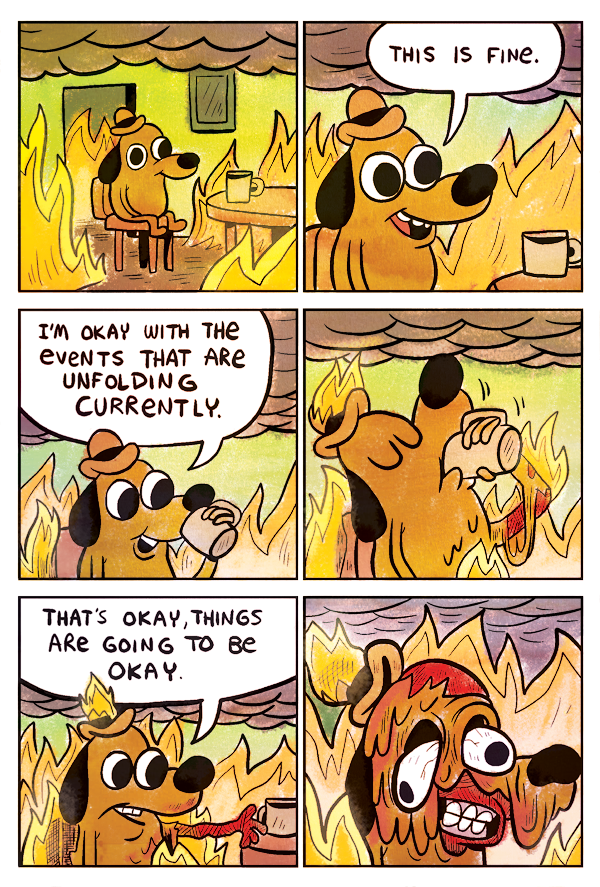
ZOS is literally ON FIRE right now. Whole teams have been gutted and need to be put back together. Work needs to reassigned to those still employed. The senior management has been removed after only a few months in position, and they're only working until the end of this month for handoff reasons. The entire company is grieving the losses - those who still have jobs are upset at losing the coworkers which have become friends.
But ESO is Not Dead Yet.
THAT is what Jason's comment is supposed to mean. Not that everything's okay because it really isn't! But that it's not the end YET. ZOS can still recover.Guildmaster of the UESP Guild on the North American PC/Mac Server 2500+ CP & also found on the European PC/Mac Server 2000+ CP
These characters are on both servers:
Alix de Feu - Breton Templar Healer level 50
Brings-His-Own-Forest - Argonian Pure Warden Healer level 50
Hrodulf Bearpaw - Nord Subclassed Warden Damage Dealer level 50
Jadisa al-Belkarth - Redguard Arcanist Damage Dealer level 50
NA-only characters:
Martin Draconis - Imperial Sorceror Healer (Aldmeri Dominion) level 50
Arzhela Petit - Breton Dragonknight Healer (Daggerfall Covenant) level 50
Bjornolfr Steel-Shaper - Nord Dragonknight Crafter (Ebonheart Pact) level 50
Verandis Bloodraven - Altmer Nightblade Healer & clone of Count Verandis Ravenwatch (Aldmeri Dominion) level 50
Gethin Oakrun - Bosmer Nightblade Thief (Ebonheart Pact) level 504 -
Artisian0001✭✭✭✭✭Multiple days and 10 pages later with extreme community pushback and not a single response from anyone working at Zenimax. A tale as old as time I guess.4
-
CAB_LifeClass Representative
Kevin already said it's going to take time, there hasn't been "silence". Why do so many people think they can get a fully revised roadmap done within a few days? They have a whole several months' worth of things they need to look at and the teams are probably still being restructured, which means work is still being evaluated. All of that is going to take time, nothing about it is damning.Is this week one or two of silence? I feel like not having a statement soon is rather damning of the state of the game behind the curtain.
Can we all please have patience and stop acting like something that should obviously take some time not coming out immediately is indicative of the worst?
I am one of the most optimistic people for the future of this game. However, taking weeks to months to release a roadmap speaks to something that has been systemic with this studio, which is their inability to produce content in a timely or competitive fashion. It should not take weeks to look at the workflow, prioritize 3 to 5 things, and then to assign them to what will obviously be a "tentative" order of release.Fitness/ Gaming/ Fantasy: https://www.youtube.com/channel/UC2qoTV-kge_bU90i2lgkyvA4 -
 CaptainVenom✭✭✭✭✭
✭I guess this is an update, too:We're also bringing our teams closer together across Bethesda. ZeniMax Online Studios will partner closely with Bethesda Game Studios on The Elder Scrolls franchise, while continuing to deliver incredible new experiences for The Elder Scrolls Online. Season One: Return of the Thieves Guild recently launched, and the team has more planned for the future. By aligning more directly across the franchise, we can create even better experiences for players.
Bringing our teams closer together is helping us build a stronger foundation for everything we create next.
From here.🌈 Ride with Pride🌈
Magicka/Damage Nightblade - PC - NA - DC4 -
 coop500✭✭✭✭✭
✭✭✭✭✭CaptainVenom wrote: »I guess this is an update, too:We're also bringing our teams closer together across Bethesda. ZeniMax Online Studios will partner closely with Bethesda Game Studios on The Elder Scrolls franchise, while continuing to deliver incredible new experiences for The Elder Scrolls Online. Season One: Return of the Thieves Guild recently launched, and the team has more planned for the future. By aligning more directly across the franchise, we can create even better experiences for players.
Bringing our teams closer together is helping us build a stronger foundation for everything we create next.
From here.
This is sadly most likely just PR coverage to give people false hope. The roadmap is the only way we're gonna see the truth of things.
Let's be honest, the roadmap was nice, but it's not an extremely high bar to match or even surpass it if any of these higherups are serious about helping and working with ZOS to improve the game. So if eventually poor Kevin comes in with a gutted roadmap? Then we know it's all lies, and sadly that's exactly what I expect it to be.Hoping for more playable races.
Hoping the game and it's team remains alive.
BRING BACK MAGICKA WEREWOLVES TO PVE4 -
baratron✭✭✭✭✭
✭notsojuicy wrote: »I don't understand halft of the discussions, like for example "uhhh, eso tavern is gone" this or that...
From an enterprise point of view high on the list of cutting costs is always marketing&events,
needless to say and highly debatable the value of such events from a financial and growth point of view for a product which is on the market for a decade....
The ESO Tavern was the German community's annual in-person event. It grew from an afternoon meet-up in a pub to a three day event in a castle with onsite camping and hostel rooms.
The key points are: it had a low budget and it almost always broke even.
From a financial point of view, it cost basically nothing because the costs were recouped in ticket sales. It allowed a lot of players to make new friends, meet the Devs, enjoy a whole range of activities, and of course it boosted good feelings towards ESO.Guildmaster of the UESP Guild on the North American PC/Mac Server 2500+ CP & also found on the European PC/Mac Server 2000+ CP
These characters are on both servers:
Alix de Feu - Breton Templar Healer level 50
Brings-His-Own-Forest - Argonian Pure Warden Healer level 50
Hrodulf Bearpaw - Nord Subclassed Warden Damage Dealer level 50
Jadisa al-Belkarth - Redguard Arcanist Damage Dealer level 50
NA-only characters:
Martin Draconis - Imperial Sorceror Healer (Aldmeri Dominion) level 50
Arzhela Petit - Breton Dragonknight Healer (Daggerfall Covenant) level 50
Bjornolfr Steel-Shaper - Nord Dragonknight Crafter (Ebonheart Pact) level 50
Verandis Bloodraven - Altmer Nightblade Healer & clone of Count Verandis Ravenwatch (Aldmeri Dominion) level 50
Gethin Oakrun - Bosmer Nightblade Thief (Ebonheart Pact) level 506 -
Arunei✭✭✭✭✭
✭✭✭✭✭
How can you claim this without having any idea what all was in their workflow? They likely already had the rest of the year's stuff started to some degree and who knows whatever other stuff they're working on that we haven't heard of yet because it's still in early development. No one can say it shouldn't take a couple of weeks because no one knows how much work they have to reevaluate and spread between everyone that's still working on the game.
Kevin already said it's going to take time, there hasn't been "silence". Why do so many people think they can get a fully revised roadmap done within a few days? They have a whole several months' worth of things they need to look at and the teams are probably still being restructured, which means work is still being evaluated. All of that is going to take time, nothing about it is damning.Is this week one or two of silence? I feel like not having a statement soon is rather damning of the state of the game behind the curtain.
Can we all please have patience and stop acting like something that should obviously take some time not coming out immediately is indicative of the worst?
I am one of the most optimistic people for the future of this game. However, taking weeks to months to release a roadmap speaks to something that has been systemic with this studio, which is their inability to produce content in a timely or competitive fashion. It should not take weeks to look at the workflow, prioritize 3 to 5 things, and then to assign them to what will obviously be a "tentative" order of release.PC-NA | Been around since closed beta | Alt account: Arunei PC-NA
Avid RPer. Hit me up in-game @Ras_Lei if you're interested in getting together for some arr-pee shenanigans!
RP Characters:
Sarah Lacroix: Breton Vampire who really really REALLY likes likes learning Magick and also her Altmer husbando
Kaalhil Swiftstrike: Tiny shapeshifting monster hunter Bosmeri lady with enough sass to kill a dragon or ten
Gwendolyn Jenelle: Friendly healer with a coffee addiction and her own medical practice
Krisiel: Literally crazy Werewolf, no like legit insane. She nuts
Kiju Veran: Ex-Fighters Guild Suthay who likes to punch things and is also a spy and ALSO a Werewolf
Niralae Elsinal: Young Altmeri woman with way too much Magicka and Vampire husbando
Slondor: TESified Slenderman, except lazier and has more of a thing for deals than Clavicus Vile does
Marius Vastino: Sarah's Imperial apathetic sire who likes to monologue
Lirawyn Calatare: Traveling performer and bard who's 101% vanilla bean
Soliril Larethian: Blind alchemist who uses animals to see and brews plagues in his spare time9 -
CAB_LifeClass Representative
How can you claim this without having any idea what all was in their workflow? They likely already had the rest of the year's stuff started to some degree and who knows whatever other stuff they're working on that we haven't heard of yet because it's still in early development. No one can say it shouldn't take a couple of weeks because no one knows how much work they have to reevaluate and spread between everyone that's still working on the game.
Kevin already said it's going to take time, there hasn't been "silence". Why do so many people think they can get a fully revised roadmap done within a few days? They have a whole several months' worth of things they need to look at and the teams are probably still being restructured, which means work is still being evaluated. All of that is going to take time, nothing about it is damning.Is this week one or two of silence? I feel like not having a statement soon is rather damning of the state of the game behind the curtain.
Can we all please have patience and stop acting like something that should obviously take some time not coming out immediately is indicative of the worst?
I am one of the most optimistic people for the future of this game. However, taking weeks to months to release a roadmap speaks to something that has been systemic with this studio, which is their inability to produce content in a timely or competitive fashion. It should not take weeks to look at the workflow, prioritize 3 to 5 things, and then to assign them to what will obviously be a "tentative" order of release.
They literally gave us a roadmap with specific times like September for the warden refresh. Of course they have some idea what is almost finished and what could be finished soon and what they should prioritize because it was already scheduled for release. So you just look at the stuff that is almost finished and you decide which of that is most important/beneficial, and you push it to the top of a (now) short list. The end.
I think we're past the point of thoughts and prayers for ZOS to be more efficient in terms of production and communication. And so are they, frankly. Now they need to deliver because quite literally the future of the game and probably studio depends on it. Sounds like even more resources are going to be dedicated towards supporting elder scrolls VI, so make of that what you will, too.
I don't do back-and-forths on the internet so you can respectfully have your say if you feel you need to, but I've said I'll have to say on the matter.
Edit: spelling mistakes!Edited by CAB_Life on July 18, 2026 3:56PMFitness/ Gaming/ Fantasy: https://www.youtube.com/channel/UC2qoTV-kge_bU90i2lgkyvA2 -
 James-Wayne✭✭✭✭✭
✭We need update 51 on PTS to keep people off the forums for awhile 😆PERTH, AUSTRALIA | PC | NA | @Aussie-Elders
TENTH ANNIVERSARY - Thanks for sticking with us for 10 years.
James-Wayne you earned this badge 9:56AM on 4th of February 2024.
529 people have also earned this badge.0 -
coop500✭✭✭✭✭
✭✭✭✭✭James-Wayne wrote: »We need update 51 on PTS to keep people off the forums for awhile 😆
Nah it'd just make it worse probs lol.Hoping for more playable races.
Hoping the game and it's team remains alive.
BRING BACK MAGICKA WEREWOLVES TO PVE0 -
 Seraphayel✭✭✭✭✭
✭✭✭✭✭Is this week one or two of silence? I feel like not having a statement soon is rather damning of the state of the game behind the curtain.
Honestly, I‘m pretty disappointed by this also. I expected an updated roadmap last week, the latest.
The layoffs happened two weeks ago, I think anyone can expect them to figure out the near future (e.g. all that’s coming in 2026) within a full work week, let alone two.
Especially in regards to the upcoming PTS we need more clarification in regards to U51 and the rest of the year.
After the drastically improved communication change that started early this year, this silence is rather disappointing.
Because we knew they can do better and they really did, the first 6 months of this year have been amazing and one of ESO‘s best.
Edited by Seraphayel on July 20, 2026 8:52AMPS5EUAldmeri Dominion- Khajiit Arcanist -5 -
KalevaLaine✭✭✭✭✭
✭Seraphayel wrote: »Is this week one or two of silence? I feel like not having a statement soon is rather damning of the state of the game behind the curtain.
Honestly, I‘m pretty disappointed by this also. I expected an updated roadmap last week, the latest.
The layoffs happened two weeks ago, I think anyone can expect them to figure out the near future (e.g. all that’s coming in 2026) within a full work week, let alone two.
Especially in regards to the upcoming PTS we need more clarification in regards to U51 and the rest of the year.
After the drastically improved communication change that started early this year, this silence is rather disappointing.
Because we knew they can do better and they really did, the first 6 months of this year have been amazing and one of ESO‘s best.
Couldn't agree more.
I was just thinking again here about @ZOS_JessicaFolsom last online on July 6. Is she laid off to? Or on holidays? On her LinkedIn there is activitiy 3 days ago.💜 シカバネ // PC EU (3600CP)
Fianna Rolaine - Templar Heal & DD // Valie Finwe - Templar Heal
Madena Rolaine - Necromancer Heal // Julienne Rolaine - Nightblade Heal
Mireli Telendas - Dragonknight Heal // From-Deepest-Ashes - Warden Heal
Taarie Finwe - Arcanist Heal // Elenwen Finwe - Sorcerer Heal
Jora Strong-Heart - Dragonknight Tank // Gharol gra-Shargakh - Templar DD
Dro'marash - Nightblade Roleplay Thief // Freir Ice-Fist - Warden Roleplay Sorcerer
Rad Red Rubbish - Templar PVP DD (AD)
My YouTube - https://www.youtube.com/@ShikabaneGaming0 -
BretonMage✭✭✭✭✭
✭✭✭After BGS (and Asha) came out with their statement comforting TES players and confirming that TES6 will be helped by ZOS, I'm looking forward to some good news about ESO in its turn. Or.. perhaps there's no good news?0 -
Haenk✭✭✭✭✭Artisian0001 wrote: »Multiple days and 10 pages later with extreme community pushback and not a single response from anyone working at Zenimax. A tale as old as time I guess.
Regular employees are not free to talk; those emloyees hired to do the talking probably are awaiting new directives from upper management. And, as we have already learned, there are many, many management levels that need coordination...
3