Maintenance for the week of September 7:
• PC/Mac: No maintenance – September 7
• PC/Mac: No maintenance – September 7
Chromosomes of Nirn

thechalkdust
✭✭✭
Let's begin with a selected reading from Mysterious Akavir:
You already know about the birds and the bees. Let me teach you about the cows and the snakes:
Please note: This is not a discussion of DSD's (disorders of sexual development, typically resulting in infertile intersex phenotypes) or gender-dysphoric (trans) identities operating independently of chromosomal systems. Those are real-life complexities beyond the scope of this discussion, and should be discussed elsewhere please.
Parthenogenesis is the ability of some females to produce offspring without a male partner. Plants and some insects practice a form of parthenogenesis that produces true clones of the mother. However, parthenogenesis in vertebrates work differently, producing half-clones instead. Half-clones receive one set of recombined chromosomes from the mother, then duplicate that set to form their second set (instead of inheriting a distinct set). The resulting organism is maximally 100% inbred, homozygotic for everything, and therefore all recessive traits will be expressed. Many will therefore not survive development, or inherit health problems. Many reptiles are capable of parthenogenesis, including pythons (XY) and rat snakes (ZW). Since they use different systems for sex determination, the results are dramatically different: female pythons will always produce XX female half-clones, but rat snake females only produce ZZ male half-clones (WW is lethal in that species).
So consider A Tale of Two Serpents who wash up on a snakeless island together: a female python and female rat snake. The python could successfully populate the island with female half-clones, but these would never be able to reshuffle their genetic material without a male present. Each first gen daughter would be a half-clone, then all subsequent generations are effectively full clones of the half-clones that were healthy enough to reach reproductive maturity. The rat snake would produce male half-clones, and those healthy enough to reach reproductive maturity and pass inspection could then mate with the mother, producing both males and females. Normally, inbreeding is inadvisable, but in this case the homozygotic male is a suitable breeding partner, already selectively filtered to eliminate any recessive traits that would cause trouble during development or before reproductive maturity. This population could produce both males and females, restoring sexual mechanisms, and reshuffling material with each generation, building diversity and accelerating adaptation to their new environment. Takeaway: in species retaining parthenogenesis, the ZW system is biologically superior at colonization from a single founder.
Real humans are mammals using the XY sex determination system. Although parthenogenesis was lost in our lineage, normal mammalian human females are XX-WW, therefore any event of human parthenogenesis would produce only XX-WW female offspring if we had retained that ability. For any human parthenogenesis event to produce male offspring, that would require the mother to belong to a unique lineage of "reptilian" females possessing the XX-ZW genotype. The resulting male half-clone would not be an XY mammalian pathway male, but an XX-ZZ reptilian pathway male. A serpent-man. Like the Tsaesci. Such "reptilian" humans would have entirely human autosomes, but operate on a different sex-determination system with complex cross-compatibility. They would be humans, but... parahumans. Our chromosome 9 is homologous to the set of genes that govern the reptilian pathway and parthenogenesis, and is the chromosome most likely to be recruited if such a ZW system existed in any human population (due to a Daedric or divine serpent seed curse).
Now that we understand the biological foundation for one species to contain four complex sex forms (and again, some in nature do), let's spell out all possibilities explicitly: the basic four combinations are XX-WW mammalian female, XY-WW mammalian male, XX-ZW reptilian female, XX-ZZ reptilian male. If the regimes breed within their own category, then sexual reproduction works normally, producing 50/50 male/female offspring of the same regime. But crossing regimes can get strange: reptilian males crossing with mammalian females can only produce reptilian females (XX-ZZ × XX-WW = XX-ZW). And there are two additional distinct sex forms that can emerge only from crossing-breeding mammalian males with reptilian females, in species where these combinations are viable: XY-ZW male reptilian-carriers, who in turn (if fertile) can produce XY-ZZ supermales with both masculinization pathways simultaneously activated. Altogether, the composite XY-ZW sex determination system has six possible sex forms: two female (mammalian & reptilian) and four male (mammalian, reptilian, reptilian carrier, and reptilian supermale). Reptilian carriers are the only reptilian males that could produce mammalian offspring, only by crossing with mammalian females.
All that being said, there are 23 possible results from a crossing event between these 6 sex forms. 8/23 results are mammalian, while the other 15/23 results are reptilian. Meaning: the reptilian masculinization pathway could enjoy a demographic advantage in the rare species having both forms, depending on relative fertility. Emerging Z-reptilian strains have an inherently subversive tactical strategy of concealing their existence, invisibly infiltrating, and demographically overwhelming an unsuspecting host population. This provides a biological explanation for Tsaesci serpent-men eating the men of Akavir, not transmissible "vampirism" but heritable rivalry, an emergent consequence of competing reproductive strategies. (Sure, you can hand-wave any magic explanation you want, but this is an exercise in grounding lore to reality.) And it provides an explanation for 3 distinct forms of Tsaesci male: normal reptilian males, reptilian carrier males (mammalian-passing appearance), and reptilian supermales (hyper-masculinized XY-ZZ Snake Kings). It also provides phenomenal story potential for a Tsaesci "Secret Wars" conflict exploding across Tamriel.
Hypermasculinization via dual pathways could also explain the true nature of Argonian Behemoths, and Naga could be the "mammalian" version of Argonian genetic expression if they use a similar composite sex determination system.
TLDR: This discussion is about mammalian vs reptilian pathways of masculinization and how they could provide a real-world biological basis informing game lore such as the Tsaesci serpent-men racial/curse dynamic. Out of the two options, it makes the most "biological sense" to implement playable Tsaesci serpent-man heritage at character creation (via a new race), not from a bite (new curse). It could be a racial curse from Boethiah, like the Orc/Malacath and Dunmer/Azura curses. An extra playable male sex option differentiating normal Tsaesci reptilian males from Akaviri human-passing carriers would be biologically sensible and world-enriching.
Edited by thechalkdust on 29 June 2026 04:07 "Akavir is the kingdom of the beasts. No Men or Mer live in Akavir, though Men once did. These Men, however, were eaten long ago by the vampiric Serpent Folk of Tsaesci."
You already know about the birds and the bees. Let me teach you about the cows and the snakes:
- Most mammals and some reptiles like pythons use a male-dominant XY sex determination system, where XX codes for default female development and XY overrides that to produce the male phenotype, usually via a major switch like our SRY gene. YY is degenerate and fatal in our species and most others.
- Most reptiles, including birds and most snakes, use a male-recessive ZW sex determination system, where ZZ codes for male phenotype and ZW codes for female. WW is also female, although this configuration can become degenerate (lethal or infertile) in some species.
- We can call the Y-dominant masculinization pathway "mammalian" and the ZZ-recessive masculinization pathway "reptilian" for simplicity, but that's not exactly accurate. They're broader than that, and some remarkable species use both. Complex combinations are biologically possible, and nature is known to switch it up from time to time.
- In most cases, the letters refer to system configuration (male-dominant or male-recessive), not to the actual shape of the chromosomes (which historically gave us X & Y).
- Systems vary in complexity depending on whether the masculinization genes (Y and/or Z) occupy the same chromosome (some fish) or live on separate chromosomes (some fish, amphibians, reptiles, insects). Lots of other systems exist, too. We'll only be discussing advanced species where the systems live separately, with an independent XY chromosome dynamic operating in a different location than the ZW chromosome dynamic.
Please note: This is not a discussion of DSD's (disorders of sexual development, typically resulting in infertile intersex phenotypes) or gender-dysphoric (trans) identities operating independently of chromosomal systems. Those are real-life complexities beyond the scope of this discussion, and should be discussed elsewhere please.
Parthenogenesis is the ability of some females to produce offspring without a male partner. Plants and some insects practice a form of parthenogenesis that produces true clones of the mother. However, parthenogenesis in vertebrates work differently, producing half-clones instead. Half-clones receive one set of recombined chromosomes from the mother, then duplicate that set to form their second set (instead of inheriting a distinct set). The resulting organism is maximally 100% inbred, homozygotic for everything, and therefore all recessive traits will be expressed. Many will therefore not survive development, or inherit health problems. Many reptiles are capable of parthenogenesis, including pythons (XY) and rat snakes (ZW). Since they use different systems for sex determination, the results are dramatically different: female pythons will always produce XX female half-clones, but rat snake females only produce ZZ male half-clones (WW is lethal in that species).
So consider A Tale of Two Serpents who wash up on a snakeless island together: a female python and female rat snake. The python could successfully populate the island with female half-clones, but these would never be able to reshuffle their genetic material without a male present. Each first gen daughter would be a half-clone, then all subsequent generations are effectively full clones of the half-clones that were healthy enough to reach reproductive maturity. The rat snake would produce male half-clones, and those healthy enough to reach reproductive maturity and pass inspection could then mate with the mother, producing both males and females. Normally, inbreeding is inadvisable, but in this case the homozygotic male is a suitable breeding partner, already selectively filtered to eliminate any recessive traits that would cause trouble during development or before reproductive maturity. This population could produce both males and females, restoring sexual mechanisms, and reshuffling material with each generation, building diversity and accelerating adaptation to their new environment. Takeaway: in species retaining parthenogenesis, the ZW system is biologically superior at colonization from a single founder.
Real humans are mammals using the XY sex determination system. Although parthenogenesis was lost in our lineage, normal mammalian human females are XX-WW, therefore any event of human parthenogenesis would produce only XX-WW female offspring if we had retained that ability. For any human parthenogenesis event to produce male offspring, that would require the mother to belong to a unique lineage of "reptilian" females possessing the XX-ZW genotype. The resulting male half-clone would not be an XY mammalian pathway male, but an XX-ZZ reptilian pathway male. A serpent-man. Like the Tsaesci. Such "reptilian" humans would have entirely human autosomes, but operate on a different sex-determination system with complex cross-compatibility. They would be humans, but... parahumans. Our chromosome 9 is homologous to the set of genes that govern the reptilian pathway and parthenogenesis, and is the chromosome most likely to be recruited if such a ZW system existed in any human population (due to a Daedric or divine serpent seed curse).
Now that we understand the biological foundation for one species to contain four complex sex forms (and again, some in nature do), let's spell out all possibilities explicitly: the basic four combinations are XX-WW mammalian female, XY-WW mammalian male, XX-ZW reptilian female, XX-ZZ reptilian male. If the regimes breed within their own category, then sexual reproduction works normally, producing 50/50 male/female offspring of the same regime. But crossing regimes can get strange: reptilian males crossing with mammalian females can only produce reptilian females (XX-ZZ × XX-WW = XX-ZW). And there are two additional distinct sex forms that can emerge only from crossing-breeding mammalian males with reptilian females, in species where these combinations are viable: XY-ZW male reptilian-carriers, who in turn (if fertile) can produce XY-ZZ supermales with both masculinization pathways simultaneously activated. Altogether, the composite XY-ZW sex determination system has six possible sex forms: two female (mammalian & reptilian) and four male (mammalian, reptilian, reptilian carrier, and reptilian supermale). Reptilian carriers are the only reptilian males that could produce mammalian offspring, only by crossing with mammalian females.
All that being said, there are 23 possible results from a crossing event between these 6 sex forms. 8/23 results are mammalian, while the other 15/23 results are reptilian. Meaning: the reptilian masculinization pathway could enjoy a demographic advantage in the rare species having both forms, depending on relative fertility. Emerging Z-reptilian strains have an inherently subversive tactical strategy of concealing their existence, invisibly infiltrating, and demographically overwhelming an unsuspecting host population. This provides a biological explanation for Tsaesci serpent-men eating the men of Akavir, not transmissible "vampirism" but heritable rivalry, an emergent consequence of competing reproductive strategies. (Sure, you can hand-wave any magic explanation you want, but this is an exercise in grounding lore to reality.) And it provides an explanation for 3 distinct forms of Tsaesci male: normal reptilian males, reptilian carrier males (mammalian-passing appearance), and reptilian supermales (hyper-masculinized XY-ZZ Snake Kings). It also provides phenomenal story potential for a Tsaesci "Secret Wars" conflict exploding across Tamriel.
Hypermasculinization via dual pathways could also explain the true nature of Argonian Behemoths, and Naga could be the "mammalian" version of Argonian genetic expression if they use a similar composite sex determination system.
TLDR: This discussion is about mammalian vs reptilian pathways of masculinization and how they could provide a real-world biological basis informing game lore such as the Tsaesci serpent-men racial/curse dynamic. Out of the two options, it makes the most "biological sense" to implement playable Tsaesci serpent-man heritage at character creation (via a new race), not from a bite (new curse). It could be a racial curse from Boethiah, like the Orc/Malacath and Dunmer/Azura curses. An extra playable male sex option differentiating normal Tsaesci reptilian males from Akaviri human-passing carriers would be biologically sensible and world-enriching.
DEV WISHLIST
New Class: Mechanist | New Weapon: 1H&Focus (Spellsword) | Housing: Synchronized Music Boxes, Furniture decon station, Lorekeeper's Bookshelf
New Class: Mechanist | New Weapon: 1H&Focus (Spellsword) | Housing: Synchronized Music Boxes, Furniture decon station, Lorekeeper's Bookshelf
10
-
 FlameDark✭✭✭✭✭Sir, this is the Bannered Mare...PC/NA CP 1150 - PvE
◆Arondael - Level 50 Magicka Necromancer ◆ Valyndrae (MAIN) - Level 50 Magicka Sorcerer ◆ Mithaedrun - Level 50 Stamina Arcanist
30 -
 Benzux✭✭✭✭As someone with an interest in biology and genetics, this was a highly intriguing read! The theory about the nature of Tsaesci definitely holds some water. I've always personally assumed that the men of Akavir (whose humanoid ghosts and skeletons we can witness in Oblivion, and whose descendants are present in Hakoshae in ESO) and the "serpent-folk" Tsaesci, such as Potentate Versidue-Shaie (based on what few descriptions we have of him and his son) are two different races, or simply shapeshifters by nature, but them being separate genotypes of a single species is an angle I hadn't thought of before.
As for the Argonians, we pretty much explicitly know that their different forms (including Behemoths and the physical traits of various different tribes, such as the "toad-like" Paatru and the winged Sarpa) are a result of direct genetic modification by the Hist trees. The Hist shaped the Argonians initially, and can continue to do so to both individuals later on in life, and to entire tribes from the moment of hatching.BenzuxGamer - Xbox One since day 1 - CP 1800+Guildmaster of the Sacrificial Warriors, one of the oldest and most member-orientated Guilds on the Xbox One EU Megaserver"Casual" player from Finland who enjoys questing and dumb builds even after well over 1000 CP levels and 4000+ hours. A fan of Argonians, Goats and Elk. Also a massive Otaku (MAL Profile)."Following the meta makes you a sheep. That's why I'm a goat: I go in the opposite direction and make use of the things the sheep cannot." - Me, 2019Characters:Ben-Zu - Argonian MagDK DPS - EP (Main)
Benzuth Telvanni - Dunmer MagSorc DPS - EP
Haknir Head-Crusher - Nord DK Tank/Stam DPS - EP
Delves-Deepest-Depths - Argonian StamBlade DPS - EP
Raises-The-Dead - Argonian Mag Necromancer DPS/Healer - EP (Previously a Sorc healer, RIP)
Bthuzdir Ynzavretz - Dwemer StamSorc DPS - AD (Dunmer in-game)
Fafnir the Dragon - Nord Stam DK DPS - EP
Bloodmage Thalnos - Breton MagBlade DPS - DC
Finnis Wolfheart - Bosmer Stam Warden DPS - EP
Gwyneth - Nord Warden Tank - EP
Kud-Wazei Xeroicas - Argonian Mag Templar DPS/Tank - EP
Barkskin Ben-Zhu - Argonian Warden Healer - EP (Alternate version of main)
Xal-Vakka Xeroicas - Argonian DK Healer - EP
Jaree-Shei the Wamasu - Argonian Sorcerer Tank - EP
Gwennen Ereloth - Snow Elf Mag Warden DPS - EP (Dunmer in-game)
Friedrich der Grosse - Imperial Nightblade Tank - EP
Warfarin - Altmer Nightblade Healer - EP
Lavinia Telvanni - Dunmer Arcanist MagDPS - EP
Studies-Dark-Secrets - Argonian Arcanist StamDPS - EP3 -
 Toanis✭✭✭✭✭Knowing that Argonians are bidirectionally hermaphroditic reptiles with a distinct sexual dimorphism, we should take that into account as an option. What if the Tsaesci are actually two compatible species? A mammalian that is actually the men "eaten" by the Tsaesci, and a reptilian where the females can change into supermales later in their life. In this case the hybrids could be sterile with no genetic acrobatics.Edited by Toanis on 28 June 2026 13:081
 -
Toanis✭✭✭✭✭
 This forum needs either a delete button or visible edit button...Edited by Toanis on 28 June 2026 12:510
 -
 Gabriel_H✭✭✭✭✭
✭✭✭✭While called "serpent-men" there is no definitive evidence to prove they are a race of men, and are just as likely to be a separate species of beastfolk. Being humanoid, doesn't make them human, and any resemblance to humans could be down to their ability to shapeshift.
The lore is very contradictory on the nature of the Tsaesci and as such any resolution to that lore one way or the other is unlikely to appear in ESO, as is more likely to be resolved in a TES stand-alone game.3 -
thechalkdust✭✭✭As for the Argonians, we pretty much explicitly know that their different forms (including Behemoths and the physical traits of various different tribes, such as the "toad-like" Paatru and the winged Sarpa) are a result of direct genetic modification by the Hist trees. The Hist shaped the Argonians initially, and can continue to do so to both individuals later on in life, and to entire tribes from the moment of hatching.
Ah yes. I cut my essay short, but I was thinking of the Hist as a sort of positive mediator between the different Argonian forms, keeping their genetic interactions complementary vs the parasitic and predatory relationship between men and Tsaesci.
It makes a lot of sense to reveal Tsaeci heritage as a curse of Boethiah (the Daedric Prince of Plots, Deceit, and Treachery, associated with serpents), inherited at birth (rather than bite). Unlike the Hist, Boethiah would be a negative mediator between the types, and drive the Tsaesci behavior of infiltration and conquest (in the guise of a serpent goddess, no doubt). This would complete a Bat-Wolf-Serpent 3-curse trifecta, with unique curses from Molag Bal, Hircine, and Boethiah respectively.
If devs ever make Tsaesci playable (dream big), implementing Boethiah's curse at character creation keeps it compatible with the other two curses. Offering the extra playable sex for Akaviri male carriers in addition to two "reptilian" sexes and unplayable supermales would all provide a level of biological realism. No female Tsaesci has been seen in-game and the reason could be because they're all reptilian, like pure Tsaesci males. Pure Akaviri humans are effectively extinct, only being born from 50% of matings between carriers/humans and queens, and they are probably culled or raised for food. All we've ever seen are probably all Akaviri male carriers, not true Tsaesci (and not true Akaviri).Edited by thechalkdust on 28 June 2026 17:20DEV WISHLIST
New Class: Mechanist | New Weapon: 1H&Focus (Spellsword) | Housing: Synchronized Music Boxes, Furniture decon station, Lorekeeper's Bookshelf1 -
 Soarora✭✭✭✭✭
✭✭✭✭✭This is cooler than Coldharbour; I had no idea the XY system and ZW system could be compatible! I’m sure this is not what anyone was going for with making the lore but exercises like these are rather enjoyable.
The “Elder Kings” series, which is a fan-made total conversion mod for the “Crusader Kings” game series, formulates Tsaesci as being man-like at birth but increasingly reptilian as the individual grows in power. Personally, for my Tsaesci-Imperial mixed characters, I treat the scales and reptilian eyes as a trait that can be passed down. Of course, shapeshifting also exists in The Elder Scrolls and the shapeshifting isn’t very grounded— you don’t drop all your armor on the ground when transforming into a werewolf (though it is implied that you took it off in Skyrim, as you return from form naked) and for some reason Vampire Lords/Bloodknights/Scions have exclusive armor on their vampiric form. But…
I think part of what makes TES so interesting is when it is grounded in a reality. Fantasy feels lofty, reality feels gritty, which is much my preference. The concept of a race with complex sex determination is super interesting, especially with a man-shaped race (as opposed to say, the Sload, which are a whole other can of worms…) and I think you’ve made a great argument here.
In terms of Argonians, I think the idea of Behemoths as supermales is interesting, especially since they aren’t part of a particular tribe, but based on what I could find on UESP about it (https://en.m.uesp.net/wiki/Online:Sali-Raniur , I give up making hyperlinks on mobile), Behemoths are more likely to be an epigenetics situation.
I have off-and-on been working on a phylogenetic tree and it bothers me to no end how Argonians work, since I’m breaking the rule of “species can’t come from other extant species”. Which also might be how elves work… which also doesn’t make me happy haha. But that’s another topic entirely.[PC/NA] Dungeoneer (Tank/DPS), Semi-retired Trialist, and amateur Battlegrounder (DPS) with a passion for The Elder Scrolls lore.
Current GM of Hard Dungeoneers
Tanks: Sorcerer - Necromancer - Templar
DPS: Frost Warden - Stamarc - StamDK - Hybrid NB Healer
Ex-Healer: Warden - Arcanist
Dungeons: 34/34 HMs - 28/28 Tris1 -
Soarora✭✭✭✭✭
✭✭✭✭✭thechalkdust wrote: »As for the Argonians, we pretty much explicitly know that their different forms (including Behemoths and the physical traits of various different tribes, such as the "toad-like" Paatru and the winged Sarpa) are a result of direct genetic modification by the Hist trees. The Hist shaped the Argonians initially, and can continue to do so to both individuals later on in life, and to entire tribes from the moment of hatching.
Ah yes. I cut my essay short, but I was thinking of the Hist as a sort of positive mediator between the different Argonian forms, keeping their genetic interactions complementary vs the parasitic and predatory relationship between men and Tsaesci.
It makes a lot of sense to reveal Tsaeci heritage as a curse of Boethiah (the Daedric Prince of Plots, Deceit, and Treachery, associated with serpents), inherited at birth (rather than bite). Unlike the Hist, Boethiah would be a negative mediator between the types, and drive the Tsaesci behavior of infiltration and conquest (in the guise of a serpent goddess, no doubt). This would complete a Bat-Wolf-Serpent 3-curse trifecta, with unique curses from Molag Bal, Hircine, and Boethiah respectively.
I think there is something to be said about the prevalence of “regular-looking” Argonians. Of course, it is a game limitation— we know that Cathay is not the default form of a Khajiit and yet that is most of what we see. But what is odd to me is how many tribes look similar or even the same. Their Hist determines their form (a Sarpa egg will grow into a Naga if put in the Hist-Sap of the Naga) but for the most part, the different traits between tribes that we see come down to scale color, fertility, and a mildly different head shape in the Naga. We know that Argonians don’t need a Hist to reproduce and when detached from the Hist, they do not produce eggs, instead they do live birth. I think this is more potential for the differences in Argonians being epigenetic— all Argonians may look like the “default”, but specific Hist-Sap can turn on genes during development.
Going back to sex determination, we know that Argonians change sexes throughout their life but that to do so, they must request a change through the Hist. I’m not well-versed in how sexes change over the lifespan of an individual in real-life, so I can’t further comment on that right now.
A Boethian curse upon the Tsaesci could certainly fit, though if I recall correctly, most of Akavir is combative (I suppose, not unlike Tamriel).
This is also a different topic perhaps worthy of its own post but I’m commenting it here so the concept isn’t lost to the void. There is a LOT of Dragon and Serpent imagery in TES. Akavir is associated with dragon imagery, the Ka Po’ Tun are associated with dragons, Akatosh is associated with dragons, time is associated with Dragons… then there’s The Serpent (constellation/mundus/Celestial), Satakal, Sorcerer-King Orgnum, and of course, the Tsaesci. That argument is much less biological and moreso a theological discussion, but again, didn’t want to forget haha.[PC/NA] Dungeoneer (Tank/DPS), Semi-retired Trialist, and amateur Battlegrounder (DPS) with a passion for The Elder Scrolls lore.
Current GM of Hard Dungeoneers
Tanks: Sorcerer - Necromancer - Templar
DPS: Frost Warden - Stamarc - StamDK - Hybrid NB Healer
Ex-Healer: Warden - Arcanist
Dungeons: 34/34 HMs - 28/28 Tris1 -
 baratron✭✭✭✭✭
✭We know that Argonians don’t need a Hist to reproduce and when detached from the Hist, they do not produce eggs, instead they do live birth. I think this is more potential for the differences in Argonians being epigenetic— all Argonians may look like the “default”, but specific Hist-Sap can turn on genes during development.
Going back to sex determination, we know that Argonians change sexes throughout their life but that to do so, they must request a change through the Hist. I’m not well-versed in how sexes change over the lifespan of an individual in real-life, so I can’t further comment on that right now.
This is something that a couple of us were talking about the other day - whether it's possible for Argonians who aren't affiliated with a Hist tree to change their gender. If so, do they have to "join" a village with a Hist tree and become "affiliated" with that Hist first? I really need to ask the Loremaster.
Also, I read the initial post in this thread and went "THE PLATYPUS". Apparently it has ten different sex chromosomes, none of which are homologous with the X and Y of humans or mice. Females have ten (!) Xs, and males have five pairs of XY. The last thing I read on the topic implied that some of these were more mammalian whereas others were more avian. But now I've found an article from 2021 which describes recent research which suggests that platypus chromosomes might have been circular once. Urgh, real life biology is so insanely complicated. I definitely prefer Tamriel/Nirn biology!Edited by baratron on 28 June 2026 22:31Guildmaster of the UESP Guild on the North American PC/Mac Server 2500+ CP & also found on the European PC/Mac Server 2000+ CP
These characters are on both servers:
Alix de Feu - Breton Templar Healer level 50
Brings-His-Own-Forest - Argonian Pure Warden Healer level 50
Hrodulf Bearpaw - Nord Subclassed Warden Damage Dealer level 50
Jadisa al-Belkarth - Redguard Arcanist Damage Dealer level 50
NA-only characters:
Martin Draconis - Imperial Sorceror Healer (Aldmeri Dominion) level 50
Arzhela Petit - Breton Dragonknight Healer (Daggerfall Covenant) level 50
Bjornolfr Steel-Shaper - Nord Dragonknight Crafter (Ebonheart Pact) level 50
Verandis Bloodraven - Altmer Nightblade Healer & clone of Count Verandis Ravenwatch (Aldmeri Dominion) level 50
Gethin Oakrun - Bosmer Nightblade Thief (Ebonheart Pact) level 502 -
Soarora✭✭✭✭✭
✭✭✭✭✭We know that Argonians don’t need a Hist to reproduce and when detached from the Hist, they do not produce eggs, instead they do live birth. I think this is more potential for the differences in Argonians being epigenetic— all Argonians may look like the “default”, but specific Hist-Sap can turn on genes during development.
Going back to sex determination, we know that Argonians change sexes throughout their life but that to do so, they must request a change through the Hist. I’m not well-versed in how sexes change over the lifespan of an individual in real-life, so I can’t further comment on that right now.
This is something that a couple of us were talking about the other day - whether it's possible for Argonians who aren't affiliated with a Hist tree to change their gender. If so, do they have to "join" a village with a Hist tree and become "affiliated" with that Hist first? I really need to ask the Loremaster.
Also, I read the initial post in this thread and went "THE PLATYPUS". Apparently it has ten different sex chromosomes, none of which are homologous with the X and Y of humans or mice. Females have ten (!) Xs, and males have five pairs of XY. The last thing I read on the topic implied that some of these were more mammalian whereas others were more avian. But now I've found an article from 2021 which describes recent research which suggests that platypus chromosomes might have been circular once. Urgh, real life biology is so insanely complicated. I definitely prefer Tamriel/Nirn biology!
I feel like its implied that they could, by the Behemoth transformation I linked, but it would be cool to have a more concrete answer!
Fruit flies are similar in that they have way "too many" sex chromosomes, they have several sexes based entirely on the ratio of how many X:Y they have.[PC/NA] Dungeoneer (Tank/DPS), Semi-retired Trialist, and amateur Battlegrounder (DPS) with a passion for The Elder Scrolls lore.
Current GM of Hard Dungeoneers
Tanks: Sorcerer - Necromancer - Templar
DPS: Frost Warden - Stamarc - StamDK - Hybrid NB Healer
Ex-Healer: Warden - Arcanist
Dungeons: 34/34 HMs - 28/28 Tris0 -
 Ratzkifal✭✭✭✭✭
✭✭✭✭✭Interesting read, very cool biology lesson and perhaps also relevant for a moonless explanation of Khajiiti furstock, but honestly, personally, I still prefer the fan lore that the Elder Kings mod for Crusader Kings came up with for the Tsaesci.
Tsaesci are born looking like east Asian humans but can undergo rituals (involving human sacrifice, hence the "vampiric" monicker) that increase their lifespan and makes them appear more snake-like the more they undergo "Tsaescence". That's how you get the best of both, reconsile the contradictions, while also contextualizing what lore we do have on the Tsaesci by adding to their culture (rather than their genetics).
Here is what that looks like: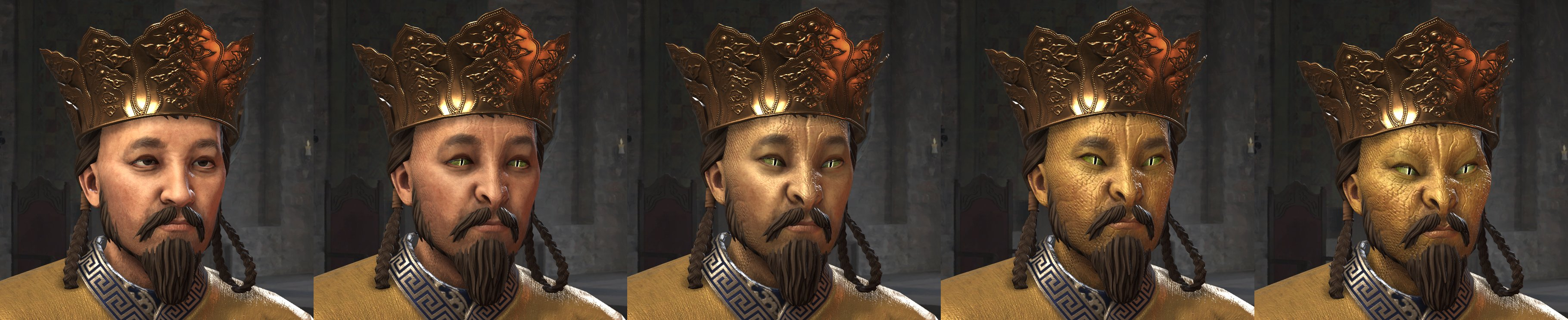 This Bosmer was tortured to death. There is nothing left to be done.2
 -
thechalkdust✭✭✭Tsaesci are born looking like east Asian humans but can undergo rituals (involving human sacrifice, hence the "vampiric" monicker) that increase their lifespan and makes them appear more snake-like the more they undergo "Tsaescence".
That is very cool. I like it. It's compatible with the "genetic" model I've suggested and could enrich the system if/when devs explore Akavir.
Some more from Mysterious Akavir:The serpent-folk ate all the Men of Akavir a long time ago, but still kind of look like them.
...
After the Serpent-Folk ate all the Men, they tried to eat all the Dragons.
To me, this suggests a Tsaesci attempt to crossbreed with Dragons and assimilate their genome. They wanted to BECOME the dragons, just as they became the Akaviri. But they failed. Their method of proliferation relies on swapping a compatible species from XY to ZW, and dragons are not XY to begin with. (But can you blame a guy for trying?) Tosh Raka later succeeded by some other method, probably using divine intervention rather than Daedric snakeblood.
The technical details don't need to be explained in-game, but just for fun, I've charted the complete Punnett square of crossing possibilities, assuming all combinations are viable and fertile: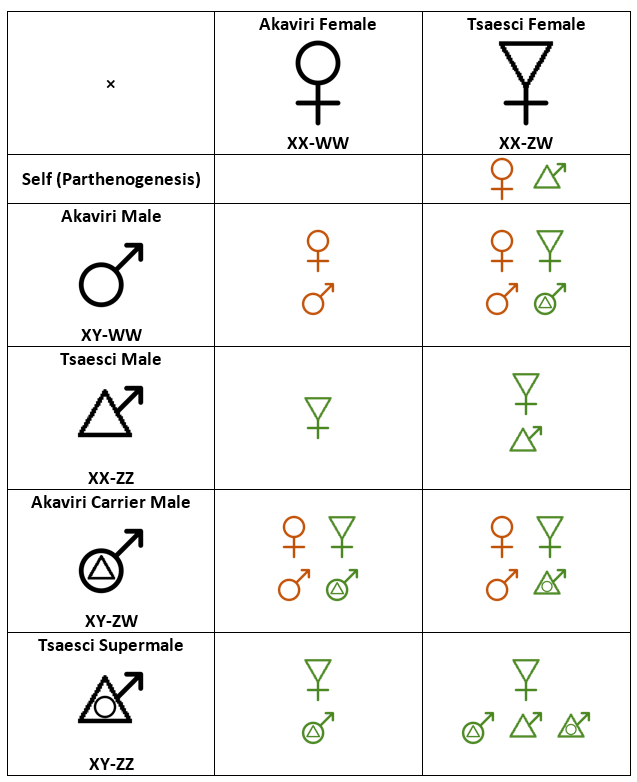
If devs were to build a Tsaesci society and Secret Wars plot around this biological foundation, the following details would add depth to the worldbuilding by implicitly encoding all of the fundamentals about their biology into their society without explicitly explaining all of the "XY-ZW sex magic":- If the Tsaesci were created by Boethiah from Akaviri humans (like Orcs/Malacath and Dunmer/Azura), then the curse may only be compatible with Akaviri genetics. This would explain why the Tsaesci haven't conquered Tamriel already. Not enough susceptible hosts, and it's not transmissible like vampirism/lycanthropy.
- The main storyline could uncover a Tsaesci attempt to develop a strain compatible with the races of Tamriel. Just because it didn't work on the dragons doesn't mean in won't work in the closest relatives of the Akaviri, Imperials. A successful Imperial-Tsaesci hybrid inheriting the reptilian heritage would be an existential threat to all men of Tamriel.
- Rather than individual personal marriages, Tsaesci might stratify their society into four main Dens based on which of the reproductive pathways the mothers of that Den follow, and breed freely within their Den:
- Virgin Den - The most bloodthirsty Tsaesci females cannot tolerate a mate. Instead, upon maturity they begin parthenogenesis, producing twins: an Akaviri daughter and Tsaesci son. Lore could stipulate that if the son fails to eat his sister's heart before sleeping, then the mother eats them both. Males of the den would be prized as reliable mates and subjects for genetic experimentation. Though the den produces no Tsaesci daughters of its own, it is collectively responsible for the rearing of all females until Den selection.
- Vanilla Den - Tsaesci females and Tsaesci males reproduce normally. This Den would be the "normal" type mirroring XY dynamics. Collectively responsible for the rearing of all normal Tsaesci males.
- Blood Den - The Tsaesci priestess class mixes with carriers (or even Akaviri males in earlier stages of invasion), producing Akaviri human offspring in 50% of births, which they harvest for blood sacrifice to Boethiah. In exchange, Boethiah blessed the males of these unions as supermales. Consequently, it must be important in Tsaesci culture that only the greatest of carriers gain the honor of access to Tsaesci priestesses. Otherwise, carriers are best suited for infiltration of human populations. Collectively responsible for the rearing and training of carriers as spies, seducers, and expendable warriors.
- Den of Fertility - The most fertile, multiparous lines of Tsaesci females would mate with supermales, producing all four reptilian types, with 75% of offspring being male. This Den would mass-produce, raise, and cull supermales, who are susceptible to dysfunctional, dysregulated hypermasculinization. The Den would operate a vicious selection program on each generation of supermales, allowing only the best to survive and breed.
Building around this foundation would create a deeply realistic Tsaesci society. The social structure already encodes the biology, but more technical details can be included in lorebooks of the priestess class, who might be the only ones who deeply understand the dynamics (through their own lens).Edited by thechalkdust on 29 June 2026 22:45DEV WISHLIST
New Class: Mechanist | New Weapon: 1H&Focus (Spellsword) | Housing: Synchronized Music Boxes, Furniture decon station, Lorekeeper's Bookshelf1 -
The_Drop_Bear✭✭✭✭Taeseci aren't snakes.
We see from their armoured forms and ghosts that they have two arms, two legs and no tail.
They may have scaled skin, but outside that they are humanoid in form.
Obviously there is the fact that they might physically where skins as disguises as Renulad seemed to imply.0 -
thechalkdust✭✭✭The_Drop_Bear wrote: »Taeseci aren't snakes. We see from their armoured forms and ghosts that they have two arms, two legs and no tail.
Correct. Tsaesci are not snakes. My lesson in snake reproduction helps explain what Mysterious Akavir could mean when it says the Tsaesci Serpent Folk are a form of beastfolk who "ate" the men of Akavir:Akavir is the kingdom of the beasts. No Men or Mer live in Akavir, though Men once did. These Men, however, were eaten long ago by the vampiric Serpent Folk of Tsaesci.
...
The serpent-folk ate all the Men of Akavir a long time ago, but still kind of look like them.
...
After the Serpent-Folk ate all the Men, they tried to eat all the Dragons.
How does a beast race "eat" men, but then look like them? Devs could choose a dozen different answers, from mere metaphor to shapeshifters... but the existing lore strongly suits a biological mammalian-vs-reptilian reproductive infiltration conflict as I've described, with ZW reptilians assimilating an XY host population. Using Boethiah as the Daedric creator of the curse fits like a glove. A magic curse doesn't have to rigorously follow biology rules, of course, I just think this is the coolest angle for a future story.DEV WISHLIST
New Class: Mechanist | New Weapon: 1H&Focus (Spellsword) | Housing: Synchronized Music Boxes, Furniture decon station, Lorekeeper's Bookshelf0

