Maintenance for the week of August 31:
• [COMPLETE] ESO Store and Account System for maintenance – September 3, 10:00AM EDT (14:00 UTC) - 12:00PM EDT (16:00 UTC)
• [COMPLETE] ESO Store and Account System for maintenance – September 3, 10:00AM EDT (14:00 UTC) - 12:00PM EDT (16:00 UTC)
(Tales of Tribute) - My Chances of Going Second are Too High

Personofsecrets
✭✭✭✭✭
✭✭✭✭
✭✭✭✭
Back during April, I reached out to a ZOS team member regarding my chances of going second in Tales of Tribute. After months of tracking my in game statistics, I found that over 2106 games, I had only gone first 1004 times. So my deficit was 102 games toward going second.
It was explained to me that the game uses it's version of a 50/50 coin toss to decide who goes first. There is not built-in weighting logic for who goes first.
That "coin" seems to be unfair since the proportion of games gone first is significantly different from 0.5 at the 5% significance level. At the time I felt like maybe I was just very unlucky, but that I would see things smooth out over time. That didn't happen.
Here I am in August with 2933 games recorded and 1404 times having gone first. If there was truly a 50/50 coin toss, I would have expected my deficit toward going second to have stayed around the 100 game deficit. Instead, that deficit has increased by nearly 20%. It was this slow march, over months and months of play, that got me to find a deficit to begin with. At first a noticed a 20 game defict, then 30, then 40, then 60 and 70 which is when I first contacted a ZOS team member and my concern was not answered. Then in April a 100 game deficit. Now a 120 game deficit.
It seems pretty clear that the scales of balance are tipped for some reason. It doesn't really make sense that I could increase my sample size by 800 games, but that the "coin" still seems to be unfair since the proportion of games gone first is still significantly different from 0.5 at the 5% significance level.
Where this becomes extra frustrating is that the game is horrendously balanced toward first player winning. I have a 88.3% win rate gong first and a 72.1% win rate going second in the ranked mode. There are high ranked leaderboard players who need to go first against me in order to not have a 70% to 80% chance of me winning due to the lopsided strategies that they rely on.
@sayswhoto
It was explained to me that the game uses it's version of a 50/50 coin toss to decide who goes first. There is not built-in weighting logic for who goes first.
That "coin" seems to be unfair since the proportion of games gone first is significantly different from 0.5 at the 5% significance level. At the time I felt like maybe I was just very unlucky, but that I would see things smooth out over time. That didn't happen.
Here I am in August with 2933 games recorded and 1404 times having gone first. If there was truly a 50/50 coin toss, I would have expected my deficit toward going second to have stayed around the 100 game deficit. Instead, that deficit has increased by nearly 20%. It was this slow march, over months and months of play, that got me to find a deficit to begin with. At first a noticed a 20 game defict, then 30, then 40, then 60 and 70 which is when I first contacted a ZOS team member and my concern was not answered. Then in April a 100 game deficit. Now a 120 game deficit.
It seems pretty clear that the scales of balance are tipped for some reason. It doesn't really make sense that I could increase my sample size by 800 games, but that the "coin" still seems to be unfair since the proportion of games gone first is still significantly different from 0.5 at the 5% significance level.
Where this becomes extra frustrating is that the game is horrendously balanced toward first player winning. I have a 88.3% win rate gong first and a 72.1% win rate going second in the ranked mode. There are high ranked leaderboard players who need to go first against me in order to not have a 70% to 80% chance of me winning due to the lopsided strategies that they rely on.
@sayswhoto
Rest in Peace:
The Dragonknight
2014-2025
This commemoration is for the class that has constantly been plundered and dismantled by designers for no obvious reason while other classes continue to have coherent skill lines and feel both powerful and cool.
The Dragonknight
2014-2025
This commemoration is for the class that has constantly been plundered and dismantled by designers for no obvious reason while other classes continue to have coherent skill lines and feel both powerful and cool.
0
-
 ESO_player123✭✭✭✭✭
✭✭✭I do not know if that 50/50 "coin" is fair, but your chance of going first did not change:
1004/2106 = 0.4767331434 (~47 .67 %)
1404/2933 = 0.47869076031 (~47.87 %)
In fact, it even got a tiny bit better (or should I say closer to 50/50) by 0.00195761691 (~0.2 %).
Edit: I would expect the percentage to be closer to 50/50, but whatever they are doing stays consistent.
Edited by ESO_player123 on August 17, 2026 1:59PM2 -
Personofsecrets✭✭✭✭✭
✭✭✭✭ESO_player123 wrote: »I do not know if that 50/50 "coin" is fair, but your chance of going first did not change:
1004/2106 = 0.4767331434 (~47 .67 %)
1404/2933 = 0.47869076031 (~47.87 %)
In fact, it even got a tiny bit better (or should I say closer to 50/50) by 0.00195761691 (~0.2 %).
Thank you for sharing.
Regarding the fairness aspect, there are some specific players who I go first against more often, but some other players who are pests as they seem to go first against me all of the time.Rest in Peace:
The Dragonknight
2014-2025
This commemoration is for the class that has constantly been plundered and dismantled by designers for no obvious reason while other classes continue to have coherent skill lines and feel both powerful and cool.0 -
ESO_player123✭✭✭✭✭
✭✭✭Personofsecrets wrote: »ESO_player123 wrote: »I do not know if that 50/50 "coin" is fair, but your chance of going first did not change:
1004/2106 = 0.4767331434 (~47 .67 %)
1404/2933 = 0.47869076031 (~47.87 %)
In fact, it even got a tiny bit better (or should I say closer to 50/50) by 0.00195761691 (~0.2 %).
Thank you for sharing.
Regarding the fairness aspect, there are some specific players who I go first against more often, but some other players who are pests as they seem to go first against me all of the time.
I do agree that It feels that I go second against some players more often. Do you have the statistics per player (without naming them of course)? It also feels that going first/second goes in clusters (kind of like in this playing session you get to go first most of the time and in this one second most of the time).Edited by ESO_player123 on August 17, 2026 2:06PM0 -
 LootAllTheStuff✭✭✭✭✭The problem with a 50:50 chance is that, if you get a big run (or series of runs) against you in the initial stages, it can take a long time to bring the observed rate up to that 50% line. In other games where I've tracked similar statistics, it's very much been an exponential curve. In effect, you need to keep doubling the number of observations in order to see the observed rate change much at all.
I'd also point out that it's not the absolute deficit you should be looking at, since the total number of observations is obviously changing - you want to look at the relative deficit.
So, as ESO_player123 points out, for your first 2106 runs you 'won' 1004/2106 times (47.677%) giving you a relative deficit of 49/2106 = 0.0233 (2.33%)
For your next (2933-2106) = 827 runs, you won (1404-1004) = 400 times (48.37%) giving you a relative deficit of 13.5/827 = 0.0163 (1.63%). IOW you were still winning the toss fewer times than an exact 50:50, but not by as wide a margin.
To meaningfully compare, though, you'd want the next ~2000 instead of 827 runs. Alternatively, if you have all the individual stats, you could break it down into 3 equal blocks and do the same calculations.
I have a love-hate relationship with statistics - I love playing around with it, but I hate experiencing the results!2 -
Personofsecrets✭✭✭✭✭
✭✭✭✭ESO_player123 wrote: »Personofsecrets wrote: »ESO_player123 wrote: »I do not know if that 50/50 "coin" is fair, but your chance of going first did not change:
1004/2106 = 0.4767331434 (~47 .67 %)
1404/2933 = 0.47869076031 (~47.87 %)
In fact, it even got a tiny bit better (or should I say closer to 50/50) by 0.00195761691 (~0.2 %).
Thank you for sharing.
Regarding the fairness aspect, there are some specific players who I go first against more often, but some other players who are pests as they seem to go first against me all of the time.
I do agree that It feels that I go second against some players more often. Do you have the statistics per player (without naming them of course)? It also feels that going first/second goes in clusters (kind of like in this playing session you get to go first most of the time and in this one second most of the time).
Yes, I have these statistics on a per player basis. I can try to extract that info from how ever impressive stats stores it. The only issue in the per player analysis is that there are many players who I haven't played that many games against. For example, I think that one of these players had gone 1st against me like the first 6 games we played, but then things leveled out after initial burst.
And yea, 1st / 2nd player seems to cluster. IDK how I would prove that with the data. There are other strange RNG things too which just seem wacky.
When I lose, that too seems to be in clusters. Of course someone could blame tilt. I personally think that losing clusters coincide with going second clusters, but going first doesn't seem to be the key to breaking the losing cluster.
Players that I'm playing against for the 1st time seem to have a large winning chance against me.
Of course, there is also the card repeat issue which I'm fairly certain is real and not just something that seems to exist due to some kind of statistical thing. That said, I have concrete data for 1st and second player choice as well as odds of going 1st or 2nd against specific players, so I'm inclined to brush other weird observations off since I don't have data that I can point to.Rest in Peace:
The Dragonknight
2014-2025
This commemoration is for the class that has constantly been plundered and dismantled by designers for no obvious reason while other classes continue to have coherent skill lines and feel both powerful and cool.0 -
Personofsecrets✭✭✭✭✭
✭✭✭✭LootAllTheStuff wrote: »The problem with a 50:50 chance is that, if you get a big run (or series of runs) against you in the initial stages, it can take a long time to bring the observed rate up to that 50% line. In other games where I've tracked similar statistics, it's very much been an exponential curve. In effect, you need to keep doubling the number of observations in order to see the observed rate change much at all.
I'd also point out that it's not the absolute deficit you should be looking at, since the total number of observations is obviously changing - you want to look at the relative deficit.
So, as ESO_player123 points out, for your first 2106 runs you 'won' 1004/2106 times (47.677%) giving you a relative deficit of 49/2106 = 0.0233 (2.33%)
For your next (2933-2106) = 827 runs, you won (1404-1004) = 400 times (48.37%) giving you a relative deficit of 13.5/827 = 0.0163 (1.63%). IOW you were still winning the toss fewer times than an exact 50:50, but not by as wide a margin.
To meaningfully compare, though, you'd want the next ~2000 instead of 827 runs. Alternatively, if you have all the individual stats, you could break it down into 3 equal blocks and do the same calculations.
I have a love-hate relationship with statistics - I love playing around with it, but I hate experiencing the results!
I've sort of already analyzed my disparity as 2nd player in chunks. I've been reviewing my games for over a year and was calculating the the disparity rate on a monthly basis. During February of 2025 the results were 889 games as 1st player and 943 games as second player. So the current rate of going first is crappier than it was last year after an additional thousnad games were played. This isn't doubling up in games per your preference, but it still seems like I have a big enough sample size of games to expect a fair 'coin.'
My stats are littered with this type manifestation of going second over and over.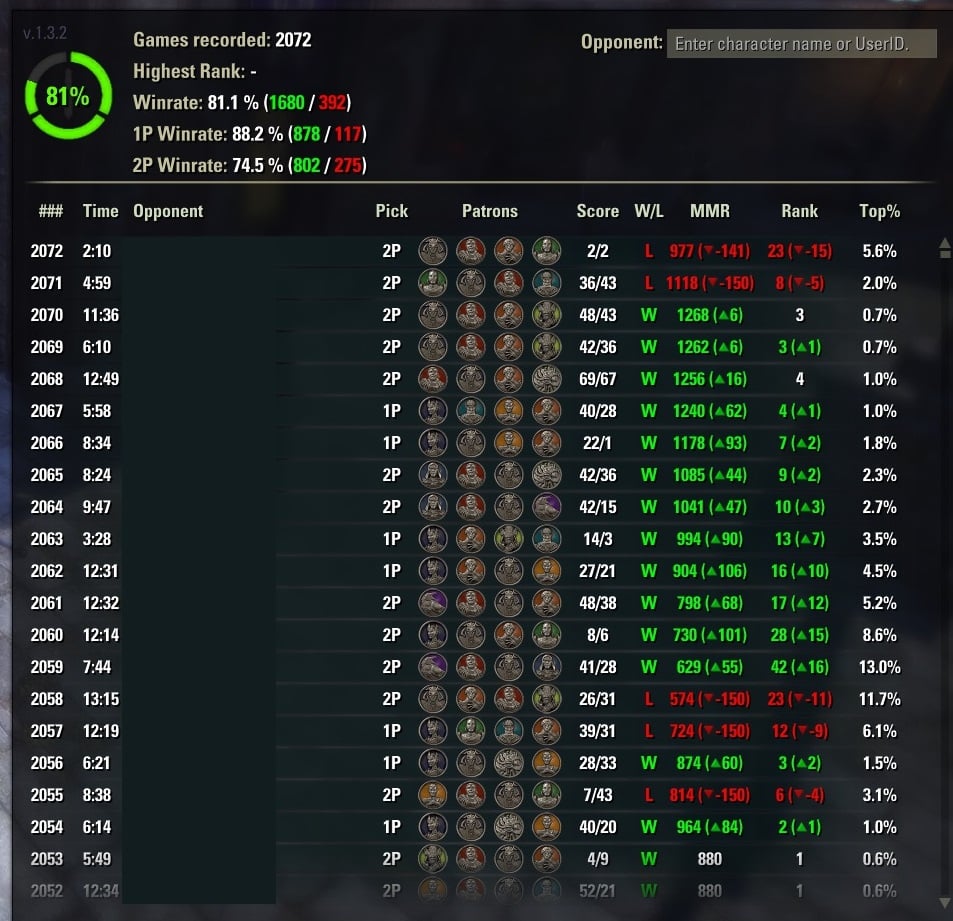
Rest in Peace:
The Dragonknight
2014-2025
This commemoration is for the class that has constantly been plundered and dismantled by designers for no obvious reason while other classes continue to have coherent skill lines and feel both powerful and cool.0 -
LootAllTheStuff✭✭✭✭✭Personofsecrets wrote: »ESO_player123 wrote: »Personofsecrets wrote: »ESO_player123 wrote: »I do not know if that 50/50 "coin" is fair, but your chance of going first did not change:
1004/2106 = 0.4767331434 (~47 .67 %)
1404/2933 = 0.47869076031 (~47.87 %)
In fact, it even got a tiny bit better (or should I say closer to 50/50) by 0.00195761691 (~0.2 %).
Thank you for sharing.
Regarding the fairness aspect, there are some specific players who I go first against more often, but some other players who are pests as they seem to go first against me all of the time.
I do agree that It feels that I go second against some players more often. Do you have the statistics per player (without naming them of course)? It also feels that going first/second goes in clusters (kind of like in this playing session you get to go first most of the time and in this one second most of the time).
Yes, I have these statistics on a per player basis. I can try to extract that info from how ever impressive stats stores it. The only issue in the per player analysis is that there are many players who I haven't played that many games against. For example, I think that one of these players had gone 1st against me like the first 6 games we played, but then things leveled out after initial burst.
And yea, 1st / 2nd player seems to cluster. IDK how I would prove that with the data. There are other strange RNG things too which just seem wacky.
Clustering is expected behaviour for binary outcomes from true RNGs. However, run lengths would also be expected to follow a certain distribution (allowing for sample size). That's getting pretty deep into statistical theory, but the short version is that it's one of the things statisticians look for in identifying truly random versus non-random outcomes. If you have access to an actual stats package of some kind, it's something you could look into. That's getting pretty deep in the weeds, though.1 -
Personofsecrets✭✭✭✭✭
✭✭✭✭LootAllTheStuff wrote: »Personofsecrets wrote: »ESO_player123 wrote: »Personofsecrets wrote: »ESO_player123 wrote: »I do not know if that 50/50 "coin" is fair, but your chance of going first did not change:
1004/2106 = 0.4767331434 (~47 .67 %)
1404/2933 = 0.47869076031 (~47.87 %)
In fact, it even got a tiny bit better (or should I say closer to 50/50) by 0.00195761691 (~0.2 %).
Thank you for sharing.
Regarding the fairness aspect, there are some specific players who I go first against more often, but some other players who are pests as they seem to go first against me all of the time.
I do agree that It feels that I go second against some players more often. Do you have the statistics per player (without naming them of course)? It also feels that going first/second goes in clusters (kind of like in this playing session you get to go first most of the time and in this one second most of the time).
Yes, I have these statistics on a per player basis. I can try to extract that info from how ever impressive stats stores it. The only issue in the per player analysis is that there are many players who I haven't played that many games against. For example, I think that one of these players had gone 1st against me like the first 6 games we played, but then things leveled out after initial burst.
And yea, 1st / 2nd player seems to cluster. IDK how I would prove that with the data. There are other strange RNG things too which just seem wacky.
Clustering is expected behaviour for binary outcomes from true RNGs. However, run lengths would also be expected to follow a certain distribution (allowing for sample size). That's getting pretty deep into statistical theory, but the short version is that it's one of the things statisticians look for in identifying truly random versus non-random outcomes. If you have access to an actual stats package of some kind, it's something you could look into. That's getting pretty deep in the weeds, though.
When I release my game, I'll have to make sure to not use true RNG. lolRest in Peace:
The Dragonknight
2014-2025
This commemoration is for the class that has constantly been plundered and dismantled by designers for no obvious reason while other classes continue to have coherent skill lines and feel both powerful and cool.0 -
LootAllTheStuff✭✭✭✭✭I mean, there are arguments FOR rigging the system. For example, I once programmed a relatively simple math game for my kids when they were very young. I realised pretty quickly that you didn't want true RNG with young players because if the player hit a run of bad rolls, it would lead to tears and frustration. So a big nope on that - curated rolls are the way to go there.
And there's definitely an argument to be made for more curated rolls in ESO too, especially when it comes to collectibles with very low drop chances, because then the probability a single player experiencing long losing runs is higher. And, in fact, the forums are full of exactly such anecdotes.
0 -
ESO_player123✭✭✭✭✭
✭✭✭LootAllTheStuff wrote: »Personofsecrets wrote: »ESO_player123 wrote: »Personofsecrets wrote: »ESO_player123 wrote: »I do not know if that 50/50 "coin" is fair, but your chance of going first did not change:
1004/2106 = 0.4767331434 (~47 .67 %)
1404/2933 = 0.47869076031 (~47.87 %)
In fact, it even got a tiny bit better (or should I say closer to 50/50) by 0.00195761691 (~0.2 %).
Thank you for sharing.
Regarding the fairness aspect, there are some specific players who I go first against more often, but some other players who are pests as they seem to go first against me all of the time.
I do agree that It feels that I go second against some players more often. Do you have the statistics per player (without naming them of course)? It also feels that going first/second goes in clusters (kind of like in this playing session you get to go first most of the time and in this one second most of the time).
Yes, I have these statistics on a per player basis. I can try to extract that info from how ever impressive stats stores it. The only issue in the per player analysis is that there are many players who I haven't played that many games against. For example, I think that one of these players had gone 1st against me like the first 6 games we played, but then things leveled out after initial burst.
And yea, 1st / 2nd player seems to cluster. IDK how I would prove that with the data. There are other strange RNG things too which just seem wacky.
Clustering is expected behaviour for binary outcomes from true RNGs. However, run lengths would also be expected to follow a certain distribution (allowing for sample size). That's getting pretty deep into statistical theory, but the short version is that it's one of the things statisticians look for in identifying truly random versus non-random outcomes. If you have access to an actual stats package of some kind, it's something you could look into. That's getting pretty deep in the weeds, though.
Is clustering related to a playing session expected though? It feels like a player gets assigned some kind of number(s) on login that defines how "lucky" they are going to be during that session. I understand that it is in humans' nature to seek patterns even where there is only random noise, but this is not related only to ToT. There are accounts of getting more leads from treasure maps if you already got one during that playing session. Same for infamous trophies (that is how I finished my collection).0 -
Personofsecrets✭✭✭✭✭
✭✭✭✭Same for crates IMO. If I get a legendary or apex, then I often get another one right away before there is drought agaon. Many of these times, the identical prize dropped.Rest in Peace:
The Dragonknight
2014-2025
This commemoration is for the class that has constantly been plundered and dismantled by designers for no obvious reason while other classes continue to have coherent skill lines and feel both powerful and cool.0 -
LootAllTheStuff✭✭✭✭✭ESO_player123 wrote: »LootAllTheStuff wrote: »Personofsecrets wrote: »ESO_player123 wrote: »Personofsecrets wrote: »ESO_player123 wrote: »I do not know if that 50/50 "coin" is fair, but your chance of going first did not change:
1004/2106 = 0.4767331434 (~47 .67 %)
1404/2933 = 0.47869076031 (~47.87 %)
In fact, it even got a tiny bit better (or should I say closer to 50/50) by 0.00195761691 (~0.2 %).
Thank you for sharing.
Regarding the fairness aspect, there are some specific players who I go first against more often, but some other players who are pests as they seem to go first against me all of the time.
I do agree that It feels that I go second against some players more often. Do you have the statistics per player (without naming them of course)? It also feels that going first/second goes in clusters (kind of like in this playing session you get to go first most of the time and in this one second most of the time).
Yes, I have these statistics on a per player basis. I can try to extract that info from how ever impressive stats stores it. The only issue in the per player analysis is that there are many players who I haven't played that many games against. For example, I think that one of these players had gone 1st against me like the first 6 games we played, but then things leveled out after initial burst.
And yea, 1st / 2nd player seems to cluster. IDK how I would prove that with the data. There are other strange RNG things too which just seem wacky.
Clustering is expected behaviour for binary outcomes from true RNGs. However, run lengths would also be expected to follow a certain distribution (allowing for sample size). That's getting pretty deep into statistical theory, but the short version is that it's one of the things statisticians look for in identifying truly random versus non-random outcomes. If you have access to an actual stats package of some kind, it's something you could look into. That's getting pretty deep in the weeds, though.
Is clustering related to a playing session expected though? It feels like a player gets assigned some kind of number(s) on login that defines how "lucky" they are going to be during that session. I understand that it is in humans' nature to seek patterns even where there is only random noise, but this is not related only to ToT. There are accounts of getting more leads from treasure maps if you already got one during that playing session. Same for infamous trophies (that is how I finished my collection).
Typically there's a seed value for the RNG algorithm that gets set when you launch a particular toon. If you know the algorithm, you can predict the sequence of values returned starting from any given seed value - the algorithm is deterministic in that sense. The trick is to NOT start with the same seed value every single time the game is played.
For games, such a recursive algorithm is usually good enough. It gives you a a new value in a sequence of results each time the RNG gets called, which then get translated into "success" or "failure" using a % of the available range of values. Clustering refers to having runs of success/fail outcomes.
So if you were simply tossing a coin, it would be the number of heads in a row, or the number of tails between heads. You would be very unlikely to get strictly alternating heads and tails, and if you saw that (or all heads), you'd know the coin tosses were being manipulated in some way. Another way of saying it is that you should expect to get runs of good and bad luck, of variable length - that's clustering, which you should always expect unless the RNG is being manipulated.
A side effect of the way recursive RNG algorithms work is that you can start on a certain seed value where the next 10 values in a row will all be >than (or alternatively <than) the middle value. If the weight (drop chance) was 50%, that would then give you a run of 10 successive wins or losses. A different seed value might see you switch back and forth either side of the middle value several times.
Some players will try getting a lead or item to drop and, if they are unsuccessful, quit and load a different character so that they get a different seed value and start in a different part of the sequence the RNG algorithm generates. Whether that's actually an effective strategy is difficult to tell, as cognitive bias means you only tend to hear about the times it did - not the times it made no difference at all.
Edited by LootAllTheStuff on August 17, 2026 9:37PM0 -
 MasterSpatula✭✭✭✭✭
✭✭✭✭✭In a large enough system, any outcome, no matter how improbable, becomes inevitable.
An improbable number of bad results makes players feel singled out for unfair treatment and is simply bad design.
ZOS knows the second. They also know the first and do nothing about it. Unmitigated RNG systems abound in this game, 12 years in. Once you know what the consequences of your actions are and you refuse to address them, those consequences move from accidental to intentional.Edited by MasterSpatula on August 17, 2026 9:40PM"A probable impossibility is preferable to an improbable possibility." - Aristotle2 -
 sayswhoto✭✭✭One way to look at it is: "What is the cumulative probability of going first 1404 times or less out of 2933 games?". This is assuming 50/50.
I got lazy and asked AI, and the answer was 1.1%. And like you mentioned you have p-value less than 5%. Beng very unlucky isn't ruled out, but, knowing ToT, I doubt this is random chance.
The other thing to note is if you see absurd streaks like going second 20 times in a row followed by going first 20 times in a row to balance it out. That is obviosly busted and might get hidden when examining larger sample sizes of aggregate data. I think something like 5 to 8 times a row can still be relatively common in a true 50/50 though.
Practically, I don't know mow much ZOS cares about ToT at this point. With all that is going on, I can't see them justifying working on ToT over something like class reworks. I'm also not sure ESO tries to implement RNG that appears truly random. And lastly, I've said this in many posts before that I suspect some background system is at work in ToT.
0 -
sayswhoto✭✭✭To add, the part about going first or second more against certain players (if that can be tracked) will probably reveal more than looking at 1000's of games.0
-
Personofsecrets✭✭✭✭✭
✭✭✭✭Well, one player I track I have the following record against.
47 total games
19 games as 1st player
28 games as 2nd player
During August, excluding 1 game that had a technical issue, I have gone 1st one time and have gone 2nd 6 times. When I go first, I win 73.7% of my games against them. When I go second, I win only 39.3% of my games. Not only is the game poorly balanced, but the first and second choosing system is also poor in such a way that it gives an edge to certain players. I'm rounding a little bit, but the other player basically get's a free game every 20 games due to the going first advantage.Rest in Peace:
The Dragonknight
2014-2025
This commemoration is for the class that has constantly been plundered and dismantled by designers for no obvious reason while other classes continue to have coherent skill lines and feel both powerful and cool.0 -
sayswhoto✭✭✭All of that actually looks fairly normal, just on the lower side of probable events.
The August event of going second 6 times out of 7 just for that one player might be an outlier but it depends on seveal other factors.
If I look at wins as 1st player (19*0.737) and 2nd player (28*0.393) that is about 25 wins total out of 47 games. Which is roughly 50/50 games are a win/loss against this opponent.
I had similar numbers back in 2024. You mentioned in the past about how this game tends to normalize people to 50%. Maybe that is how the matchmaking is done. In June 2024 I had exactly 50/50 (81 games first and 81 games second).
0 -
sayswhoto✭✭✭It would be sort of pointless to play if the game went: "I see your win rate is going too far above 50%. Better start making you go second now until you're back down to 50".0
-
Personofsecrets✭✭✭✭✭
✭✭✭✭It would be sort of pointless to play if the game went: "I see your win rate is going too far above 50%. Better start making you go second now until you're back down to 50".
It would be pointless unless you are a game developer.
"According to another aspect, the matchmaking server may store a win/loss percentage for each user (or vehicle) at a given battle level. As the player’s win/loss ratio decreases, the player becomes more likely to be placed in battles having battle levels at the lower end of the allowable range, whereas as the player’s win/loss ration increases, the player becomes more likely to be placed in battles having battle levels at the upper end of the allowable range. Thus, when a player has been repeatedly put into too many difficult battles, the balancing is done in favor of easier battle sessions, thereby encouraging the player by providing an easier game environment. Similarly, when the player has been repeatedly put into too many easy battles, the balancing is done in favor of harder battle sessions, thereby keeping the player challenged instead of letting the player become bored with easy games."
Note: There is no way that ToT has such a system. I just doubt how the coin flip and tavern flops are determined.Rest in Peace:
The Dragonknight
2014-2025
This commemoration is for the class that has constantly been plundered and dismantled by designers for no obvious reason while other classes continue to have coherent skill lines and feel both powerful and cool.0 -
ESO_player123✭✭✭✭✭
✭✭✭On a related note, today the tavern dealt me 3 kwama egg mine/ebony mine cards on the same turn.Two back to back and then another one card apart.0 -
sayswhoto✭✭✭ESO_player123 wrote: »On a related note, today the tavern dealt me 3 kwama egg mine/ebony mine cards on the same turn.Two back to back and then another one card apart.
That probably happens more than it should. That's the secret to practically winning the game on turn 1 when choosing Hlaalu.Personofsecrets wrote: »It would be sort of pointless to play if the game went: "I see your win rate is going too far above 50%. Better start making you go second now until you're back down to 50".Personofsecrets wrote: »It would be pointless unless you are a game developer.0 -
sayswhoto✭✭✭I hate how they got rid of the edit on web browser. Didn't mean to hit reply.Personofsecrets wrote: »It would be pointless unless you are a game developer.
Ironically, if win rates settle around 70%-80% for Turn 1 and 40%-50% for Turn 2, then it makes me less motivated to play. It's not solved but getting closer.
0 -
LootAllTheStuff✭✭✭✭✭I hate how they got rid of the edit on web browser. Didn't mean to hit reply.
Just so you know, the edit function isn't actually gone, it's just that the icon is no longer being loaded. If you move your cursor around in the area just left of the post number (#4 or whatever) you should see the tooltip pop up and you can click on it.
Edit to add: I don't believe this was intentional - it happened after a platform update, and it appears that resource locations got moved without all the code being updated.
Edited by LootAllTheStuff on August 21, 2026 2:52PM1 -
sayswhoto✭✭✭LootAllTheStuff wrote: »
Just so you know, the edit function isn't actually gone, it's just that the icon is no longer being loaded. If you move your cursor around in the area just left of the post number (#4 or whatever) you should see the tooltip pop up and you can click on it.
I see it now, thanks.0