Maintenance for the week of August 24:
• PC/Mac: No maintenance – August 24
• PC/Mac: No maintenance – August 24
Official Discussion Thread for "Developer Deep Dive—Season Zero’s Challenge Difficulty
-
 BelthondSoul ShrivenHi, super excited about this!
However, as many have mentioned, the state it's presented in right now is not exactly one that would be fair for everybody. I'm not sure if I agree or disagree with the many suggestions I see about creating instances and split the players by difficulty, but I do have an idea that builds up on the system ZOS has presented.
If...
> De-buffing a player (does less dmg + takes more dmg) playing on higher difficulty --> Another player on lower difficulty joining the fight would just blast though the enemies = not fun ;
> Buffing an enemy (does more dmg + takes less dmg) that a player on higher difficulty engages --> Another player on lower difficulty joining the fight would just be useless against it = not fun ;
...What about a mix of both?
> When a player chooses a higher difficulty, they get a debuff making them take more dmg (depending on the difficulty level) ;
> When they engage an enemy, the enemy gets a buff (visible or invisible), that makes them take less damage (or grants them more health, the outcome is the same but I do believe it "feels" less like a debuff and more real if the damage numbers of a player don't change depending on the difficulty the play on) ;
> That way, a player on higher difficulty will experience more challenging combat as is the goal (taking more damage and the enemy taking less dmg will last longer thus be able to use mechanics etc.).
Now, when different difficulties meet...
My initial idea was to make the buff on the mob determined by the highest difficulty amongst the players that fight it. But that creates issues if higher-difficulty players join mid or at the end of a normal-difficulty fight, getting better rewards unfairly.
So I think the only solution is to make the difficulty tier of the buff applied to the enemy be locked by the difficulty level of the player that first engages it. The balancing and avoiding abusive scenarios will have to be done through the rewards.
Let's observe the scenario :
> Player on normal difficulty engages mob --> Mob is locked on normal difficulty. If a higher-difficulty player joins in, let's say playing on Vestige, although they would have the debuff that makes them take more damage (potentially making the fight a little harder), the mob is taking normal damage. It wouldn't be fair to give them a full Vestige reward. But to give them a normal Adventurer reward would also be unfair because the damage they received during the fight was indeed greater. More importantly, it would remove any motivation for a high-difficulty player to join in a fight (WB etc.) that has already been locked into lower difficulty. A formula has to be determined here for a fair portion of reward base on the difficulty the mob was locked on (maybe 50% more gold or something, you get the idea). That way, higher-difficulty players would still have a "reason" to join in and help even if they don't get the full reward promised by their chosen difficulty level.
Applicable to the opposite scenario:
> Player on Vestige difficulty engages mob --> Mob is locked on Vestige difficulty. If a lower-difficulty player joins in, the enemy is much more resistant but the, let's say, Seasoned-difficulty player takes more damage but not as much as the Vestige tier, so the fight is the same for him, only a bit longer. I *do* realize this affects the lower-difficulty player in the sense that their gameplay isn't completely unchanged, but I think making different difficulties in this way coexist will require some compromises. A reward has to be determined that is greater than the Seasoned level but of course lower than the Vestige one. That way, lower-difficulty players can still participate in fights with other players that are on higher difficulty, without burning through the mobs' health and without getting trampled by it.
I know this probably isn't perfect or free of loopholes, but I feel like it's closer to being fair than what has been proposed right now. Glad to discuss it!
0 -
 spartaxoxo✭✭✭✭✭
✭✭✭✭✭tomofhyrule wrote: ».robwolf666 wrote: »tomofhyrule wrote: »I get that a lot of people want sharded instances, but that would completely ruin the experience of new players in the basic difficulty.
The way zones work, you only see /zone chat in your specific instance. That means that if someone in the basic 'shard' is struggling to kill a 10m HP world boss like Ghishzor and calls for help, nobody in the "sweaty no noobs allowed" shard would be able to hear it.
Which is exactly how it was in the early days of ESO when we were all newbies learning the game. Why rob the new newbies of that experience?
Yes, and it was [snip], and it almost killed the game.
Until they found a way - first with Wrothgar, then with One Tamriel - to have as many players as technically possible together in one zone: all kinds of experience, alliance, quests state, whatever.
Nostalgia shouldn't ignore the fact that this is literally what saved the game.
No it did not. I see this referenced all the time. The game's population was the most vibrant and booming during the first two years. What saved this game was covid. No surprise now we see the true fruits of all the "new player experience" a stagnant and dieing population.
...
...
uhh... that is factually incorrect.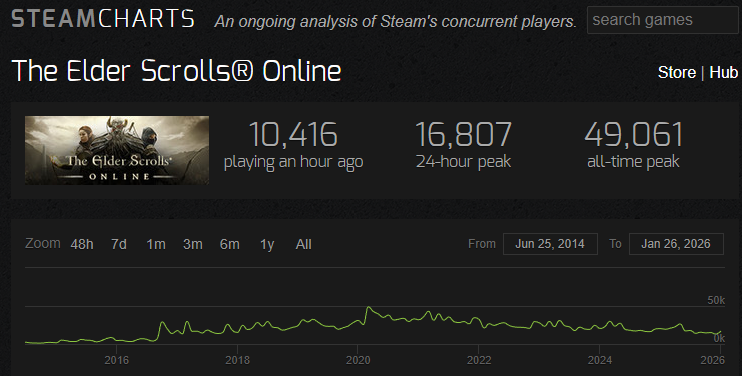
I know SteamCharts is not the be all and end all, but we can definitely get ideas of trends. And the trend here shows that the game is pretty low on the pop charts (in the single-digit thousands) at the beginning. ESO was not doing incredibly well for the first two years.
But the first spike is October 2016, jumping up from an average around 5k to 29k. So what happened in October 2016 that massively boomed the population? It wasn't COVID. One Tamriel came out in October 2016.
The population was staying consistent after that (at about 4x the population pre-2016, I might add) until COVID did hit, which you can also see in March 2020. And since then, the game has been on a steady decline... and it's still not even at its pre-One Tamriel levels.
I expect you're actually referencing player sentiment, in that the people who were playing at that time were extremely hardcore into the game. But in no universe was a massive population there. There are currently more players than there were back then, they're just not as hardcore.
No one.... used... steam... in the first 4 years of the game. I was actually HERE in those years. And the first year of the game, which steam did not even exist for it nor did consoles; pvp population caps were much higher and fielded multiple locked campaigns. Each campaign had its own stories and experiences written into legends. All lost to time because the vast majority of the hardcore old vets quit the game the second zos started the casualization process.
[edited to remove quote]
Steam wouldn't have data if it did not exist. Devs themselves have discussed in the past how the game would not even be here if not for One Tamriel because it was dead on arrival and that One Tamriel saved the game. Most recently they actually also credited it to a specific man, who has since passed, who was willing to give them a chance to fix their disastrous launch and said they don't know that the game would still be here if they had launched today instead.“Making games is risky. It's a lot of time, it's a lot of money, and it's not an exact science,” Lambert says, reflecting on the second chance ESO had to appeal to fans.
“I think we were incredibly lucky to have leadership like Robert Altman,” Lambert continues. “He believed in the people, he believed in his IPs, and he believed in the game that we had. And he was like, ‘Go fix it.’”
Robert A. Altman founded ZeniMax in 1999, shortly after the release of Redguard, overseeing The Elder Scrolls through its defining years. ZeniMax Online was founded nearly a decade later in 2007, which is what ultimately gave us ESO.
“I have worked at various studios, various companies over the years. And Robert was special,” he says. “He was the guy who gave us that chance. I don't know that we would have had that same opportunity at other companies.”
Altman passed away in 2021, leaving behind a team that fondly remembers his leadership. Now, with all of the changes in the industry over the course of his tenure, they are all aware that they’re playing by very different rules.
“When I think about when I was a kid, opportunities for entertainment were comparatively limited,” says Giacomini. “And now there are so many games, there are streaming services at our fingertips.
“It's very difficult to succeed. There's so many players that are trusting us with one of the most precious resources, their free time,” Giacomini continues. “Add to that the fact that production costs have increased pretty dramatically. It's challenging.”
https://www.msn.com/en-us/entertainment/gaming/elder-scrolls-online-interview-the-developers-who-want-to-create-a-30-year-mmo/ar-AA1Ma0zxEdited by spartaxoxo on January 27, 2026 12:07AM1 -
 ESO_player123✭✭✭✭✭
✭✭✭Hi, super excited about this!
However, as many have mentioned, the state it's presented in right now is not exactly one that would be fair for everybody. I'm not sure if I agree or disagree with the many suggestions I see about creating instances and split the players by difficulty, but I do have an idea that builds up on the system ZOS has presented.
If...
> De-buffing a player (does less dmg + takes more dmg) playing on higher difficulty --> Another player on lower difficulty joining the fight would just blast though the enemies = not fun ;
> Buffing an enemy (does more dmg + takes less dmg) that a player on higher difficulty engages --> Another player on lower difficulty joining the fight would just be useless against it = not fun ;
...What about a mix of both?
> When a player chooses a higher difficulty, they get a debuff making them take more dmg (depending on the difficulty level) ;
> When they engage an enemy, the enemy gets a buff (visible or invisible), that makes them take less damage (or grants them more health, the outcome is the same but I do believe it "feels" less like a debuff and more real if the damage numbers of a player don't change depending on the difficulty the play on) ;
> That way, a player on higher difficulty will experience more challenging combat as is the goal (taking more damage and the enemy taking less dmg will last longer thus be able to use mechanics etc.).
Now, when different difficulties meet...
My initial idea was to make the buff on the mob determined by the highest difficulty amongst the players that fight it. But that creates issues if higher-difficulty players join mid or at the end of a normal-difficulty fight, getting better rewards unfairly.
So I think the only solution is to make the difficulty tier of the buff applied to the enemy be locked by the difficulty level of the player that first engages it. The balancing and avoiding abusive scenarios will have to be done through the rewards.
Let's observe the scenario :
> Player on normal difficulty engages mob --> Mob is locked on normal difficulty. If a higher-difficulty player joins in, let's say playing on Vestige, although they would have the debuff that makes them take more damage (potentially making the fight a little harder), the mob is taking normal damage. It wouldn't be fair to give them a full Vestige reward. But to give them a normal Adventurer reward would also be unfair because the damage they received during the fight was indeed greater. More importantly, it would remove any motivation for a high-difficulty player to join in a fight (WB etc.) that has already been locked into lower difficulty. A formula has to be determined here for a fair portion of reward base on the difficulty the mob was locked on (maybe 50% more gold or something, you get the idea). That way, higher-difficulty players would still have a "reason" to join in and help even if they don't get the full reward promised by their chosen difficulty level.
Applicable to the opposite scenario:
> Player on Vestige difficulty engages mob --> Mob is locked on Vestige difficulty. If a lower-difficulty player joins in, the enemy is much more resistant but the, let's say, Seasoned-difficulty player takes more damage but not as much as the Vestige tier, so the fight is the same for him, only a bit longer. I *do* realize this affects the lower-difficulty player in the sense that their gameplay isn't completely unchanged, but I think making different difficulties in this way coexist will require some compromises. A reward has to be determined that is greater than the Seasoned level but of course lower than the Vestige one. That way, lower-difficulty players can still participate in fights with other players that are on higher difficulty, without burning through the mobs' health and without getting trampled by it.
I know this probably isn't perfect or free of loopholes, but I feel like it's closer to being fair than what has been proposed right now. Glad to discuss it!
I already replied to a similar "tagging" suggestion, so this will be a repeat. I do not think that locking the difficulty based on the difficulty level of the first person to tag the mob is the way to go.
Boss situation: Vestige tags it, Adventure arrives but does not want to fight higher difficulty version for Adventurer rewards. So, they are forced to wait while the Vestige finishes the fight (which might take a while) and then wait for the boss to respawn.
Trash packs: Adventurer tags as many mobs as possible with an AoE and then fights/nukes them at their leisure. Vestige is left with the current state of the mobs.0 -
 SilverBride✭✭✭✭✭
✭✭✭✭✭If I am understanding how this will work the mob won't change at all regardless of who tags it first. If an Adventurer and a Vestige both attack the same mob it will be no different than it is now when a level 10 and a CP 3600 both attack the same mob. If the mob locks to the difficulty of whoever tags it first then it takes away the optional part of the feature for the other player. But the mob doesn't change anyway... just the player.Edited by SilverBride on January 27, 2026 3:55PMPCNA1 -
BelthondSoul ShrivenESO_player123 wrote: »
I already replied to a similar "tagging" suggestion, so this will be a repeat. I do not think that locking the difficulty based on the difficulty level of the first person to tag the mob is the way to go.
Boss situation: Vestige tags it, Adventure arrives but does not want to fight higher difficulty version for Adventurer rewards. So, they are forced to wait while the Vestige finishes the fight (which might take a while) and then wait for the boss to respawn.
Trash packs: Adventurer tags as many mobs as possible with an AoE and then fights/nukes them at their leisure. Vestige is left with the current state of the mobs.
In the Boss situation, the Adventure wouldn’t be fighting a « fully » higher difficulty mob, as the player would take Adventure damage if on that difficulty. The boss would only have more health/take less damage, so the Adventure could still participate in the fight in a meaningful way, without getting destroyed themselves.
Also as explained, the reward wouldn’t be an Adventurer one, but rather something between the Adventurer and Vestige in this case, to reward them still from participating in a longer fight. I don’t think anybody in this situation would purposely ignore the first player and wait for the boss to respawn and fight it on Adventurer mode.Edited by Belthond on January 27, 2026 8:59AM0 -
flyingparchment✭✭✭do we know how companions will work on the harder difficulties? if the self-nerf slider only applies to the player rather than the mobs, i suppose companions will be unaffected and do the same DPS regardless of difficulty?
it might be nice if they could get some buffs as the difficulty goes up, to make them feel a little more useful.0 -
ESO_player123✭✭✭✭✭
✭✭✭ESO_player123 wrote: »
I already replied to a similar "tagging" suggestion, so this will be a repeat. I do not think that locking the difficulty based on the difficulty level of the first person to tag the mob is the way to go.
Boss situation: Vestige tags it, Adventure arrives but does not want to fight higher difficulty version for Adventurer rewards. So, they are forced to wait while the Vestige finishes the fight (which might take a while) and then wait for the boss to respawn.
Trash packs: Adventurer tags as many mobs as possible with an AoE and then fights/nukes them at their leisure. Vestige is left with the current state of the mobs.
In the Boss situation, the Adventure wouldn’t be fighting a « fully » higher difficulty mob, as the player would take Adventure damage if on that difficulty. The boss would only have more health/take less damage, so the Adventure could still participate in the fight in a meaningful way, without getting destroyed themselves.
Also as explained, the reward wouldn’t be an Adventurer one, but rather something between the Adventurer and Vestige in this case, to reward them still from participating in a longer fight. I don’t think anybody in this situation would purposely ignore the first player and wait for the boss to respawn and fight it on Adventurer mode.
With the proposed rewards (a bit more XP and a bit more gold), I would not want a longer fight for a part of that reward on a difficulty I did not sign up for (yes, I know that those rewards are just a starter). I would prefer they separate the players into different instances than implement any form of tagging.1 -
 LootAllTheStuff✭✭✭✭✭SilverBride wrote: »If I am understanding how this will work the mob won't change at all regardless of who tags it first. If an Adventurer and a Vestige both attack the same mob it will be no different than it is now when a level 10 and a CP 3600 both attack the same mob. If the mob locks to the difficulty of whoever tags it first then it takes away the optional part of the feature for the other player. But the mob doesn't change anyway... just the player.
Just read the description, and I don't think that's completely correct. It looks like the scaling will be implemented through player modifiers, not enemy modifiers. IOW the boss will have the same hit points and damage values, but the player on the higher difficulty will get hit with (dmg * modifier) with modifiers > 1, and deal (dmg * modifier) with modifier < 1.
That seems like a reasonable first stab at the difficulty system, since it's effectively a simple addition to the existing modifier formulas and doesn't require any additional coding for the mobs and bosses.0 -
 Taarente✭✭✭✭I understand what this is trying to address, but I do have some concerns about the direction and its wider impact.
First, who is this actually aimed at?
Is this intended for a very small percentage of highly optimised players, a broader mid-tier audience, or most of the playerbase? It’s not clear which group this is meant to serve, and without that clarity it’s hard to see how the design can land well.
Second, any form of this risks increasing elitism.
Even if unintentionally, difficulty labels and visible distinctions tend to create social pressure and comparison in a shared world. That rarely ends well in an MMO, especially one that has worked hard to remain accessible.
The naming also feels problematic.
Titles like these don’t just describe difficulty — they signal status. That can easily come across as ego-boosting rather than descriptive, which again feeds into division rather than choice.
It’s also worth noting that genuinely punishing content already exists.
Veteran dungeons, trials, hard modes, arenas, Infinite Archive, and PvP already provide places for players who want to push limits. If the goal is to offer more challenge, expanding or deepening those spaces feels more coherent than redefining overland.
Overland content has a specific role in ESO.
It’s where story, exploration, atmosphere, and world-building live. For many players it’s intentionally a safe, welcoming space — somewhere to exist in the world without pressure. Changing that risks undermining one of the game’s core strengths.
Finally, there’s a tension with the “play your way” message.
In practice, the game already strongly rewards “damage, damage, damage.” Introducing optional difficulty on top of that doesn’t really broaden playstyles — it just asks some players to opt into more friction while the same dominant approach continues to shape shared spaces.
I’m not opposed to challenge — far from it — but I worry that this approach adds complexity and social friction without clearly solving a real problem. It feels like something that could be looked back on and thought, it might have been better to leave overland as it was.6 -
 Tariq9898✭✭✭✭✭I understand what this is trying to address, but I do have some concerns about the direction and its wider impact.
First, who is this actually aimed at?
Is this intended for a very small percentage of highly optimised players, a broader mid-tier audience, or most of the playerbase? It’s not clear which group this is meant to serve, and without that clarity it’s hard to see how the design can land well.
Second, any form of this risks increasing elitism.
Even if unintentionally, difficulty labels and visible distinctions tend to create social pressure and comparison in a shared world. That rarely ends well in an MMO, especially one that has worked hard to remain accessible.
The naming also feels problematic.
Titles like these don’t just describe difficulty — they signal status. That can easily come across as ego-boosting rather than descriptive, which again feeds into division rather than choice.
It’s also worth noting that genuinely punishing content already exists.
Veteran dungeons, trials, hard modes, arenas, Infinite Archive, and PvP already provide places for players who want to push limits. If the goal is to offer more challenge, expanding or deepening those spaces feels more coherent than redefining overland.
Overland content has a specific role in ESO.
It’s where story, exploration, atmosphere, and world-building live. For many players it’s intentionally a safe, welcoming space — somewhere to exist in the world without pressure. Changing that risks undermining one of the game’s core strengths.
Finally, there’s a tension with the “play your way” message.
In practice, the game already strongly rewards “damage, damage, damage.” Introducing optional difficulty on top of that doesn’t really broaden playstyles — it just asks some players to opt into more friction while the same dominant approach continues to shape shared spaces.
I’m not opposed to challenge — far from it — but I worry that this approach adds complexity and social friction without clearly solving a real problem. It feels like something that could be looked back on and thought, it might have been better to leave overland as it was.
Adding in Overland difficulty is worth the trouble and sacrifices. As ZOS said this is a “highly requested feature.”
You’re right, overland is for story and that is exactly why I fight for Overland difficulties - to feel the narrative stakes. To experience the threat of the final boss. To be immersed with the atmospheric realms of Oblivion. Plus, this is also optional and players don’t have to increase the difficulty if they don’t want to.
Many people think:
- solo = casual.
- group = endgame.
They completely neglect solo endgame.
For many players including myself - solo, story, and endgame come together as one. We want to quest alone on hard difficulties.Edited by Tariq9898 on January 27, 2026 7:52PM13 -
Taarente✭✭✭✭I understand what this is trying to address, but I do have some concerns about the direction and its wider impact.
First, who is this actually aimed at?
Is this intended for a very small percentage of highly optimised players, a broader mid-tier audience, or most of the playerbase? It’s not clear which group this is meant to serve, and without that clarity it’s hard to see how the design can land well.
Second, any form of this risks increasing elitism.
Even if unintentionally, difficulty labels and visible distinctions tend to create social pressure and comparison in a shared world. That rarely ends well in an MMO, especially one that has worked hard to remain accessible.
The naming also feels problematic.
Titles like these don’t just describe difficulty — they signal status. That can easily come across as ego-boosting rather than descriptive, which again feeds into division rather than choice.
It’s also worth noting that genuinely punishing content already exists.
Veteran dungeons, trials, hard modes, arenas, Infinite Archive, and PvP already provide places for players who want to push limits. If the goal is to offer more challenge, expanding or deepening those spaces feels more coherent than redefining overland.
Overland content has a specific role in ESO.
It’s where story, exploration, atmosphere, and world-building live. For many players it’s intentionally a safe, welcoming space — somewhere to exist in the world without pressure. Changing that risks undermining one of the game’s core strengths.
Finally, there’s a tension with the “play your way” message.
In practice, the game already strongly rewards “damage, damage, damage.” Introducing optional difficulty on top of that doesn’t really broaden playstyles — it just asks some players to opt into more friction while the same dominant approach continues to shape shared spaces.
I’m not opposed to challenge — far from it — but I worry that this approach adds complexity and social friction without clearly solving a real problem. It feels like something that could be looked back on and thought, it might have been better to leave overland as it was.
Adding in Overland difficulty is worth the trouble and sacrifices. As ZOS said this is a “highly requested feature.”
You’re right, overland is for story and that is exactly why I fight for Overland difficulties - to feel the narrative stakes. To experience the threat of the final boss. To be immersed with the atmospheric realms of Oblivion. Plus, this is also optional and players don’t have to increase the difficulty if they don’t want to.
Many people think:
- solo = casual.
- group = endgame.
They completely neglect solo endgame.
For many players including myself - solo, story, and endgame come together as one. We want to quest alone on hard difficulties.
What you're describing isn't really overland difficulty so much as a solo-RPG version of ESO. That's a valid thing to want, but it isn't what ESO's shared overland is designed to be, nor what it should be forced to become.
Also ZOS gave us Craglorn that everyone complained was too hard. World bosses used to require large groups to take on and dungeons used to be properly difficult.Edited by Taarente on January 28, 2026 8:52AM1 -
robwolf666✭✭✭✭✭
✭I understand what this is trying to address, but I do have some concerns about the direction and its wider impact.
First, who is this actually aimed at?
Is this intended for a very small percentage of highly optimised players, a broader mid-tier audience, or most of the playerbase? It’s not clear which group this is meant to serve, and without that clarity it’s hard to see how the design can land well.
Second, any form of this risks increasing elitism.
Even if unintentionally, difficulty labels and visible distinctions tend to create social pressure and comparison in a shared world. That rarely ends well in an MMO, especially one that has worked hard to remain accessible.
The naming also feels problematic.
Titles like these don’t just describe difficulty — they signal status. That can easily come across as ego-boosting rather than descriptive, which again feeds into division rather than choice.
It’s also worth noting that genuinely punishing content already exists.
Veteran dungeons, trials, hard modes, arenas, Infinite Archive, and PvP already provide places for players who want to push limits. If the goal is to offer more challenge, expanding or deepening those spaces feels more coherent than redefining overland.
Overland content has a specific role in ESO.
It’s where story, exploration, atmosphere, and world-building live. For many players it’s intentionally a safe, welcoming space — somewhere to exist in the world without pressure. Changing that risks undermining one of the game’s core strengths.
Finally, there’s a tension with the “play your way” message.
In practice, the game already strongly rewards “damage, damage, damage.” Introducing optional difficulty on top of that doesn’t really broaden playstyles — it just asks some players to opt into more friction while the same dominant approach continues to shape shared spaces.
I’m not opposed to challenge — far from it — but I worry that this approach adds complexity and social friction without clearly solving a real problem. It feels like something that could be looked back on and thought, it might have been better to leave overland as it was.
Adding in Overland difficulty is worth the trouble and sacrifices. As ZOS said this is a “highly requested feature.”
You’re right, overland is for story and that is exactly why I fight for Overland difficulties - to feel the narrative stakes. To experience the threat of the final boss. To be immersed with the atmospheric realms of Oblivion. Plus, this is also optional and players don’t have to increase the difficulty if they don’t want to.
Many people think:
- solo = casual.
- group = endgame.
They completely neglect solo endgame.
For many players including myself - solo, story, and endgame come together as one. We want to quest alone on hard difficulties.
What you're describing isn't really overland difficulty so much as a solo-RPG version of ESO. That's a valid thing to want, but it isn't what ESO's shared overland is designed to be, nor what it should be forced to become.
Also ZOS gave us Craglorn that everyone complained was too hard. World bosses used to require large groups to take on and dungeons used to be properly difficult.
It shouldn't be "forced" to become anything, that's the exact opposite of "play how you want".
Personally, I would love a FO76-like private instance to be added as an option to ESO+ - it would certainly add more value to the sub, and bring the game in line with Skyrim etc (in terms of playing alone) - just without a ridiculous price attached to it.4 -
 Muizer✭✭✭✭✭
✭I understand what this is trying to address, but I do have some concerns about the direction and its wider impact.
Some good questions. Perhaps as someone who has followed the overland thread for years I can give you some insight in what the variant ZOS is implementing is and is not about.First, who is this actually aimed at?
Is this intended for a very small percentage of highly optimised players, a broader mid-tier audience, or most of the playerbase? It’s not clear which group this is meant to serve, and without that clarity it’s hard to see how the design can land well.
The challenge difficulty as it is currently framed is aimed at the bulk of players for whom overland is their main activity who feel they are not being tested enough by that content. It is a scaling solution after all. No amount of scaling will result in the kind of challenge endgame PvE offers (larger number of mobs and unique environmental and boss mechanics). It will be a different animal. At high difficulty levels, it will be much less a matter of 'choreography' than endgame PvE. It will be about increased risk from being hit at all (not dodging/blocking) for longer.Second, any form of this risks increasing elitism.
Even if unintentionally, difficulty labels and visible distinctions tend to create social pressure and comparison in a shared world. That rarely ends well in an MMO, especially one that has worked hard to remain accessible.
Personally I doubt this will be a big problem. Unlike is the case for instanced content with forced grouping, we can only guess at what motivates players in overland anyway. If someone is out there on normal difficulty perhaps they are not that good at combat. Much more likely they're just interested in the story or perhaps farming mats. Why should people care?The naming also feels problematic.
Titles like these don’t just describe difficulty — they signal status. That can easily come across as ego-boosting rather than descriptive, which again feeds into division rather than choice.
Personally I'm in favour of much more granularity (being able to modify incoming and outgoing damage independently). That would kind of make any kind of naming impossible. Perhaps they can use colours instead.It’s also worth noting that genuinely punishing content already exists.
Veteran dungeons, trials, hard modes, arenas, Infinite Archive, and PvP already provide places for players who want to push limits. If the goal is to offer more challenge, expanding or deepening those spaces feels more coherent than redefining overland.
Difficult overland will be categorically different from existing endgame PvE, because the encounters are fundamentally different. It's going to be a completely different experience.Overland content has a specific role in ESO.
It’s where story, exploration, atmosphere, and world-building live. For many players it’s intentionally a safe, welcoming space — somewhere to exist in the world without pressure. Changing that risks undermining one of the game’s core strengths.
Actually, the only impact to be expected is for performance in combat to be equalized somewhat, narrowing the perceived skill gap. After all, players with a high combat performance playing at high difficulty will appear to be less good than they would be playing on normal!Finally, there’s a tension with the “play your way” message.
In practice, the game already strongly rewards “damage, damage, damage.” Introducing optional difficulty on top of that doesn’t really broaden playstyles — it just asks some players to opt into more friction while the same dominant approach continues to shape shared spaces.
You have a point here. I'd like to see more combinations of incoming and outgoing damage modifiers. That would allow for more diverse play styles. E.g. a tank character could raise incoming damage increase modifier more than that reduction in outgoing damage. A dd might want to do the reverse.I’m not opposed to challenge — far from it — but I worry that this approach adds complexity and social friction without clearly solving a real problem. It feels like something that could be looked back on and thought, it might have been better to leave overland as it was.
I would like to think of challenge difficulty as a way for players to fine-tune their own experience. I think as long as that's the goal, we will be fine. The main problem that keeps coming back is the reward system. In theory I don't think there should be any status or accompanying rewards with this system. But, in practice not having any reward would be experienced as a disincentive / losing out. So there's a balance there. But I'm definitely against rewards that are exclusive or categorically different (the way e.g. monster sets are for vet dungeons).Please stop making requests for game features. ZOS have enough bad ideas as it is!0 -
jle30303✭✭✭✭✭
✭I have a bit of a problem with the whole "we want increased difficulty" idea:
The existing areas of the game that ARE already more difficult - things like DLC dungeons, delves, public dungeons and World Bosses, let alone the original "groups and veterans only" Craglorn, which has long since been outstripped in difficulty - are well-nigh deserted.
Including, being well-nigh deserted by exactly the players who claim to want a more difficult experience.4 -
ESO_player123✭✭✭✭✭
✭✭✭I have a bit of a problem with the whole "we want increased difficulty" idea:
The existing areas of the game that ARE already more difficult - things like DLC dungeons, delves, public dungeons and World Bosses, let alone the original "groups and veterans only" Craglorn, which has long since been outstripped in difficulty - are well-nigh deserted.
Including, being well-nigh deserted by exactly the players who claim to want a more difficult experience.
Well, to be fair, you put a lot of different stuff in the same pile here. Delves, public dungeons, and base game world bosses are deserted because they are no longer more difficult. They are trivial. That is why people want them to become challenging again. And that is what is being addressed with the upcoming overland difficulty options. DLC dungeons do not belong to this pile IMO. People still do them in groups and also solo them as a challenge. Also, they are not considered overland and are not the target of these changes.3 -
 AlexanderDeLarge✭✭✭✭✭
✭I have a bit of a problem with the whole "we want increased difficulty" idea:
The existing areas of the game that ARE already more difficult - things like DLC dungeons, delves, public dungeons and World Bosses, let alone the original "groups and veterans only" Craglorn, which has long since been outstripped in difficulty - are well-nigh deserted.
Including, being well-nigh deserted by exactly the players who claim to want a more difficult experience.
If you tell me as a player that I am expected to isolate myself in instanced content for an acceptable level of difficulty
e.g. not this: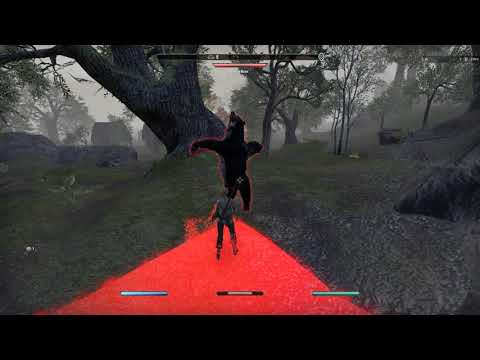 https://youtu.be/CLYwxXFqEZk
I'm gonna start asking myself why I'm even playing a MMO.3 -
 Warhawke_80✭✭✭✭✭
✭They are doing it right... higher challenges gives only more gold and XP...I am very interested to see how many people actually engage with the higher challenges ...and what direction the game will take if the vast majority of players stay at the adventure level.....
Edited by Warhawke_80 on January 31, 2026 8:08PM““Elric knew. The sword told him, without words of any sort. Stormbringer needed to fight, for that was its reason for existence...”― Michael Moorcock, Elric of Melniboné3 -
spartaxoxo✭✭✭✭✭
✭✭✭✭✭I have a bit of a problem with the whole "we want increased difficulty" idea:
The existing areas of the game that ARE already more difficult - things like DLC dungeons, delves, public dungeons and World Bosses, let alone the original "groups and veterans only" Craglorn, which has long since been outstripped in difficulty - are well-nigh deserted.
Including, being well-nigh deserted by exactly the players who claim to want a more difficult experience.
DLC dungeons are not deserted. IDK where that's even coming from. Dungeon queue as a whole is in bad shape but that's because of the lack of tanks not because of any category of dungeons.
Base game quests are also deserted should we also use that as a reason to not offer casually questing any longer? The zones empty after they launch because questing is one and done content. But plenty of players aren't happy with the current state of questing and either refrain from doing it entirely or do it for the sake of rewards/completionism without actually finding it super fun. Neither of those things are sustainable and we're watching the playerbase shrink little bit by little bit. Ignoring the feedback as to why from various crowds isn't a good idea. And the lack of difficulty in the questing is a very common complaint.
Edited by spartaxoxo on January 31, 2026 1:46AM4 -
 Attorneyatlawl✭✭✭✭✭
✭✭✭Warhawke_80 wrote: »They are doing it right higher challenges gives only more gold and XP...I am very interested to see how many people actually engage with the higher challenges ...and what direction the game will take if the vast majority of players stay at the adventure level.....
Actually, it's much less xp given per hour because it will take longer to kill the mobs. I'll still use it for questing, but it's a shame it'll need to be disabled when I'm doing anything else... 5x longer to kill a mob vs 2x xp, and you're taking 6x incoming damage. I'm a lowbie champion level so I actually need the xp.-First-Wave Closed Beta Tester of the Psijic Order, aka the 0.016 percent.
Exploits suck. Don't blame just the game, blame the players abusing them!
-Playing since July 2013, back when we had a killspam channel in Cyrodiil and the lands of Tamriel were roamed by dinosaurs.
________________
-In-game mains abound with "Nerf" in their name. As I am asked occasionally, I do not play on anything but the PC NA Megaserver at this time.4 -
flyingparchment✭✭✭The existing areas of the game that ARE already more difficult - things like DLC dungeons, delves, public dungeons and World Bosses, let alone the original "groups and veterans only" Craglorn, which has long since been outstripped in difficulty - are well-nigh deserted.
Including, being well-nigh deserted by exactly the players who claim to want a more difficult experience.
this post makes very little sense to me, because delves and public dungeons are not "more difficult". delves have exactly the same mob packs as overland. public dungeons have the same weak mobs, just in larger packs, which makes no difference when you're AoEing them. public dungeon bosses die to a single flail > flail > beam.
that last part is not an exaggeration: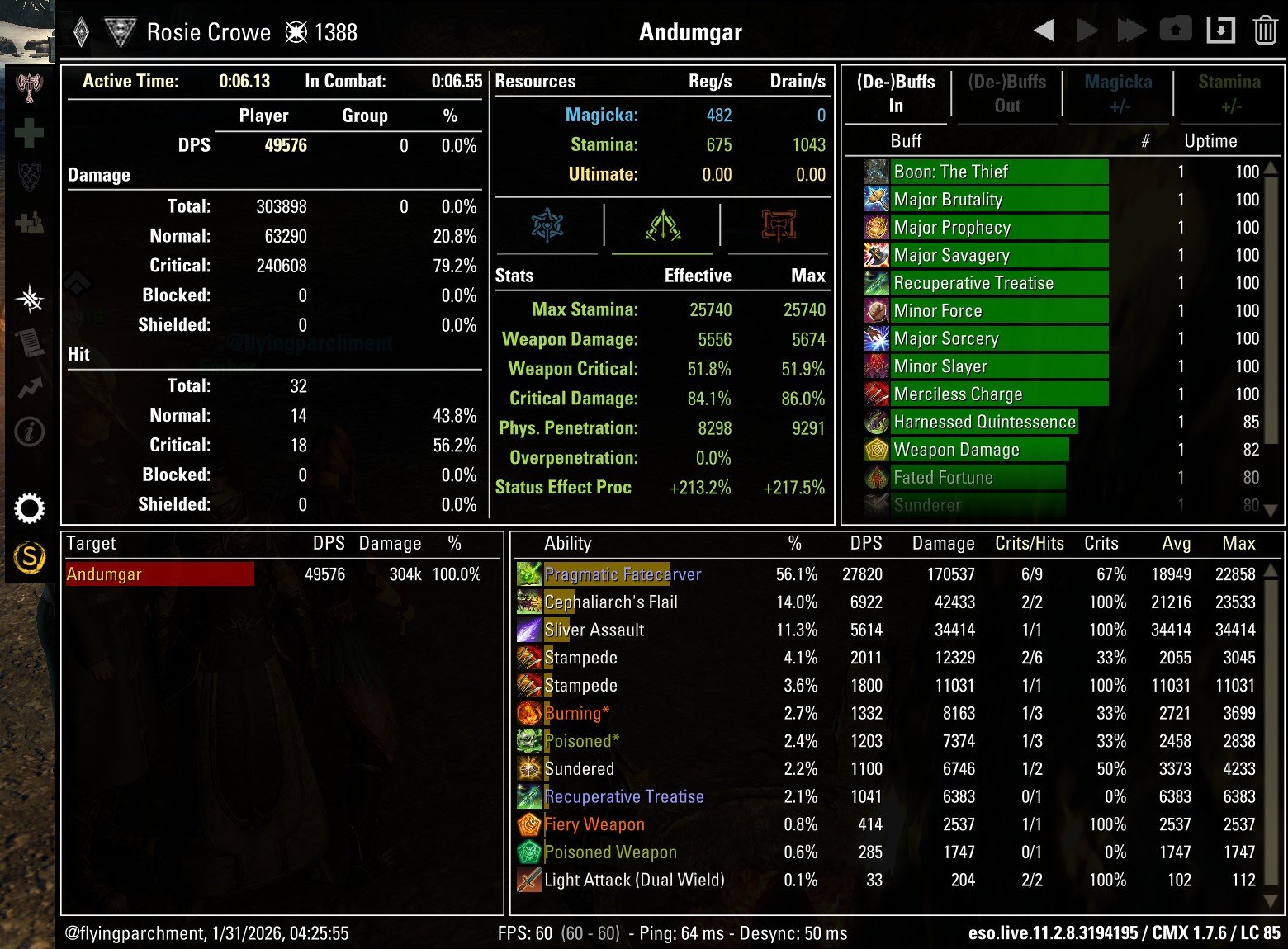
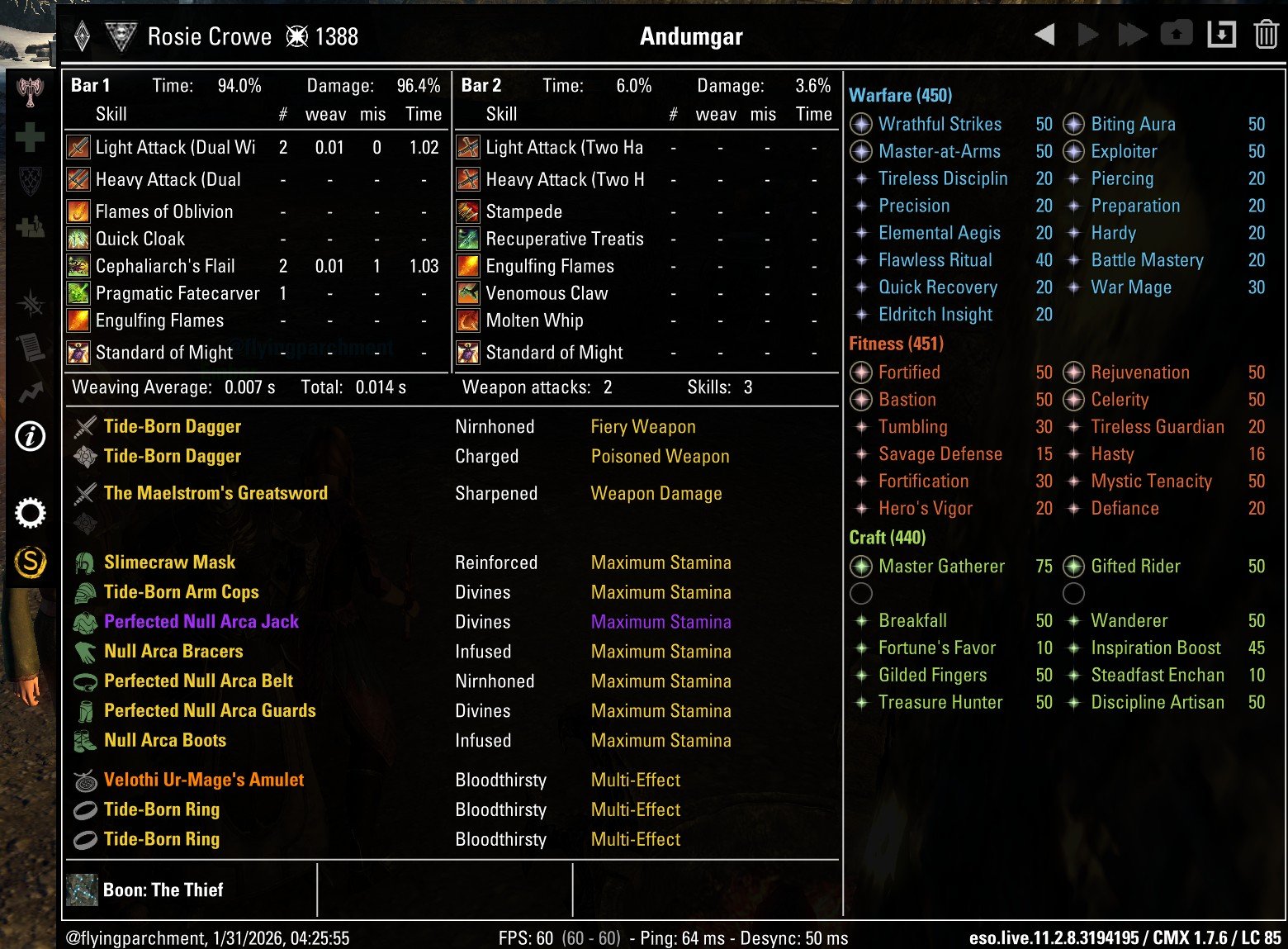
i can't speak for anyone else, but this is not the level of difficulty i want more of.
i also don't find delves or public dungeons deserted. except when i'm playing at very off-peak times, it's unusual that i'm in a delve or public dungeon and there isn't at least 1-2 other people there as well.
DLC world bosses are a little more interesting, but there's only so many of them, and it's kind of boring to kill the same ones over and over again. what i want is for the entire game to be challenging and demand skillful play, not for 95% of the game to be trivial and boring with a little bit of more difficult side content.Edited by flyingparchment on January 31, 2026 4:39AM5 -
 AlterBlika✭✭✭✭✭Tbh can't really do much about overland difficulty. The cleanest way would be to implement separate instances (much like vet and normal content) for each difficulty but I doubt the game has enough players to sustain this now.
Can we expect something more difficult than vestige though? Something closer to a vDLC boss for quest bosses, that would be so peak3 -
AlexanderDeLarge✭✭✭✭✭
✭Hopefully they'll reevaluate their stance on separate instancing once we get crossplay. The concern about separating the community doesn't really make much sense when you have 3 platforms combined into one "server".
Also I've always found it funny how veteran overland requests were labelled a vocal minority and that no one will use the feature, but the moment we get it, instancing is off limits and there's a lot of concern because it'll leave the normal overland a ghost town.5 -
luc76985✭✭✭I understand what this is trying to address, but I do have some concerns about the direction and its wider impact.
First, who is this actually aimed at?
Is this intended for a very small percentage of highly optimised players, a broader mid-tier audience, or most of the playerbase? It’s not clear which group this is meant to serve, and without that clarity it’s hard to see how the design can land well.
Second, any form of this risks increasing elitism.
Even if unintentionally, difficulty labels and visible distinctions tend to create social pressure and comparison in a shared world. That rarely ends well in an MMO, especially one that has worked hard to remain accessible.
The naming also feels problematic.
Titles like these don’t just describe difficulty — they signal status. That can easily come across as ego-boosting rather than descriptive, which again feeds into division rather than choice.
It’s also worth noting that genuinely punishing content already exists.
Veteran dungeons, trials, hard modes, arenas, Infinite Archive, and PvP already provide places for players who want to push limits. If the goal is to offer more challenge, expanding or deepening those spaces feels more coherent than redefining overland.
Overland content has a specific role in ESO.
It’s where story, exploration, atmosphere, and world-building live. For many players it’s intentionally a safe, welcoming space — somewhere to exist in the world without pressure. Changing that risks undermining one of the game’s core strengths.
Finally, there’s a tension with the “play your way” message.
In practice, the game already strongly rewards “damage, damage, damage.” Introducing optional difficulty on top of that doesn’t really broaden playstyles — it just asks some players to opt into more friction while the same dominant approach continues to shape shared spaces.
I’m not opposed to challenge — far from it — but I worry that this approach adds complexity and social friction without clearly solving a real problem. It feels like something that could be looked back on and thought, it might have been better to leave overland as it was.
Fully agree. I am pretty skeptical that this will do anything constructive for the playerbase but I'm willing to wait and see (because what choice do we have).3 -
DidactisoSoul ShrivenI’m sure some of you already know this, but there is a video with over 280k views that touched on this topic. A top comment even asked for a harder overland with 800 likes. And that’s not even counting the Overland forum posts which has been going on for 5 years. As a matter of fact, ZOS even created that post because many complained about the lack of difficulty due to One Tamriel in 2016. So this has been a major complaint for almost 10 years across the forums, YouTube, discord, and Reddit.
As someone said, this is worth the sacrifices and hardship. And the sooner ZOS gets this out (without rushing of course), the sooner we can offer feedback so ZOS can iron things out.
I for one am exited for this. Being immersed with the environment and stories are the biggest factors for myself and many. With this new QoL feature, I now have more agency on how I want to experience the biggest aspect of this game: questing. https://youtu.be/DXerFpiCca8?si=15lgqHLMqQTtnK72
 https://youtu.be/iJPMT26raNc?si=kA01IVgBQWRazVba Edited by Didactiso on February 2, 2026 4:04PM9
 -
SerafinaWaterstar✭✭✭✭✭
✭✭So, where once it was just for the joy of challenge, now there is additional rewards, with demands for extra shinies.
What of us who have done all the overland quests? Can’t repeat them, as are one and done.
And Account Wide Achievements killed off the need for additional characters (another thing ‘demanded’ by many here).4 -
AlexanderDeLarge✭✭✭✭✭
✭For most of us involved in that 500+ page long thread, we were always asking for additional rewards to keep the reward structure in parity with every other veteran aspect of the game. If I'm consuming more consumables, repairing my gear more and exponentially slowing down my kills, why shouldn't I get additional rewards to keep up? Why shouldn't veteran overland drop purple gear just like veteran dungeons, arenas and trials do? I shouldn't have to beg ZOS for reward parity so I don't go broke just because I had the audacity to play the game my way, meaning the way it originally was back when I bought it.
Now if you're advocating for a New Game+/progression reset for zones in the various challenge modes I'm right there with you. I want that too. But that's not a reason to not have this feature. It's a enhancement to the game that we arguably should've always had, just like we should've always had veteran overland.5 -
AlexanderDeLarge✭✭✭✭✭
✭Also people in this community keep acting like we're 'moving the goalpost' for asking for veteran-level rewards, but y'all are the ones trying to make veteran overland the exception to the rule of more difficulty = more rewards in every other bit of veteran content.
One side is arguing for consistency. The other is arguing for deviating from that consistency. Who is really moving the goalpost here?5 -
 coop500✭✭✭✭✭
✭✭✭✭✭I understand what this is trying to address, but I do have some concerns about the direction and its wider impact.
First, who is this actually aimed at?
Is this intended for a very small percentage of highly optimised players, a broader mid-tier audience, or most of the playerbase? It’s not clear which group this is meant to serve, and without that clarity it’s hard to see how the design can land well.
Second, any form of this risks increasing elitism.
Even if unintentionally, difficulty labels and visible distinctions tend to create social pressure and comparison in a shared world. That rarely ends well in an MMO, especially one that has worked hard to remain accessible.
The naming also feels problematic.
Titles like these don’t just describe difficulty — they signal status. That can easily come across as ego-boosting rather than descriptive, which again feeds into division rather than choice.
It’s also worth noting that genuinely punishing content already exists.
Veteran dungeons, trials, hard modes, arenas, Infinite Archive, and PvP already provide places for players who want to push limits. If the goal is to offer more challenge, expanding or deepening those spaces feels more coherent than redefining overland.
Overland content has a specific role in ESO.
It’s where story, exploration, atmosphere, and world-building live. For many players it’s intentionally a safe, welcoming space — somewhere to exist in the world without pressure. Changing that risks undermining one of the game’s core strengths.
Finally, there’s a tension with the “play your way” message.
In practice, the game already strongly rewards “damage, damage, damage.” Introducing optional difficulty on top of that doesn’t really broaden playstyles — it just asks some players to opt into more friction while the same dominant approach continues to shape shared spaces.
I’m not opposed to challenge — far from it — but I worry that this approach adds complexity and social friction without clearly solving a real problem. It feels like something that could be looked back on and thought, it might have been better to leave overland as it was.
Fully agree. I am pretty skeptical that this will do anything constructive for the playerbase but I'm willing to wait and see (because what choice do we have).
I agree with this concern too. I think a few changes ZOS has done/is doing with this year feels like it's going to pit casual players against elites and vice versa. The community has, in my experience, already become more toxic than it ever was a few years ago, and stuff like this, implemented in this way, is going to make it worse.
Solutions are difficult to formulate that don't bring their own issues, but I do believe the pitting against each other thing should be considered.Hoping for more playable races.
Hoping the game and it's team remains alive.
BRING BACK MAGICKA WEREWOLVES TO PVE3 -
 SneaK✭✭✭✭✭
✭I understand what this is trying to address, but I do have some concerns about the direction and its wider impact.
First, who is this actually aimed at?
Is this intended for a very small percentage of highly optimised players, a broader mid-tier audience, or most of the playerbase? It’s not clear which group this is meant to serve, and without that clarity it’s hard to see how the design can land well.
Second, any form of this risks increasing elitism.
Even if unintentionally, difficulty labels and visible distinctions tend to create social pressure and comparison in a shared world. That rarely ends well in an MMO, especially one that has worked hard to remain accessible.
The naming also feels problematic.
Titles like these don’t just describe difficulty — they signal status. That can easily come across as ego-boosting rather than descriptive, which again feeds into division rather than choice.
It’s also worth noting that genuinely punishing content already exists.
Veteran dungeons, trials, hard modes, arenas, Infinite Archive, and PvP already provide places for players who want to push limits. If the goal is to offer more challenge, expanding or deepening those spaces feels more coherent than redefining overland.
Overland content has a specific role in ESO.
It’s where story, exploration, atmosphere, and world-building live. For many players it’s intentionally a safe, welcoming space — somewhere to exist in the world without pressure. Changing that risks undermining one of the game’s core strengths.
Finally, there’s a tension with the “play your way” message.
In practice, the game already strongly rewards “damage, damage, damage.” Introducing optional difficulty on top of that doesn’t really broaden playstyles — it just asks some players to opt into more friction while the same dominant approach continues to shape shared spaces.
I’m not opposed to challenge — far from it — but I worry that this approach adds complexity and social friction without clearly solving a real problem. It feels like something that could be looked back on and thought, it might have been better to leave overland as it was.
Fully agree. I am pretty skeptical that this will do anything constructive for the playerbase but I'm willing to wait and see (because what choice do we have).
I agree with this concern too. I think a few changes ZOS has done/is doing with this year feels like it's going to pit casual players against elites and vice versa. The community has, in my experience, already become more toxic than it ever was a few years ago, and stuff like this, implemented in this way, is going to make it worse.
Solutions are difficult to formulate that don't bring their own issues, but I do believe the pitting against each other thing should be considered.
Feel like this is a red herring, “elite” players aren’t going to come in droves to play hard overland for XP and gold they don’t need. The system they are putting out offers nothing outside of a more efficient grinding mechanism. There is zero risk in participating in it and the rewards are purely XP/gold grinds.
In short, people will play it, because why not, but it adds no value to the game other than more efficient grinding."IMO"Aldmeri Dominion1 Nightblade - 1 Templar - 7 Hybrid Mutt Abominations1 -
coop500✭✭✭✭✭
✭✭✭✭✭I understand what this is trying to address, but I do have some concerns about the direction and its wider impact.
First, who is this actually aimed at?
Is this intended for a very small percentage of highly optimised players, a broader mid-tier audience, or most of the playerbase? It’s not clear which group this is meant to serve, and without that clarity it’s hard to see how the design can land well.
Second, any form of this risks increasing elitism.
Even if unintentionally, difficulty labels and visible distinctions tend to create social pressure and comparison in a shared world. That rarely ends well in an MMO, especially one that has worked hard to remain accessible.
The naming also feels problematic.
Titles like these don’t just describe difficulty — they signal status. That can easily come across as ego-boosting rather than descriptive, which again feeds into division rather than choice.
It’s also worth noting that genuinely punishing content already exists.
Veteran dungeons, trials, hard modes, arenas, Infinite Archive, and PvP already provide places for players who want to push limits. If the goal is to offer more challenge, expanding or deepening those spaces feels more coherent than redefining overland.
Overland content has a specific role in ESO.
It’s where story, exploration, atmosphere, and world-building live. For many players it’s intentionally a safe, welcoming space — somewhere to exist in the world without pressure. Changing that risks undermining one of the game’s core strengths.
Finally, there’s a tension with the “play your way” message.
In practice, the game already strongly rewards “damage, damage, damage.” Introducing optional difficulty on top of that doesn’t really broaden playstyles — it just asks some players to opt into more friction while the same dominant approach continues to shape shared spaces.
I’m not opposed to challenge — far from it — but I worry that this approach adds complexity and social friction without clearly solving a real problem. It feels like something that could be looked back on and thought, it might have been better to leave overland as it was.
Fully agree. I am pretty skeptical that this will do anything constructive for the playerbase but I'm willing to wait and see (because what choice do we have).
I agree with this concern too. I think a few changes ZOS has done/is doing with this year feels like it's going to pit casual players against elites and vice versa. The community has, in my experience, already become more toxic than it ever was a few years ago, and stuff like this, implemented in this way, is going to make it worse.
Solutions are difficult to formulate that don't bring their own issues, but I do believe the pitting against each other thing should be considered.
Feel like this is a red herring, “elite” players aren’t going to come in droves to play hard overland for XP and gold they don’t need. The system they are putting out offers nothing outside of a more efficient grinding mechanism. There is zero risk in participating in it and the rewards are purely XP/gold grinds.
In short, people will play it, because why not, but it adds no value to the game other than more efficient grinding.
Totally missing the point of what I was talking about, both me and the two players I responded to.
We weren't talking about rewards, we were talking about attitude and status, plus with the current setup of someone on easy mode able to barge in and wipe someone's boss fight who's playing on a harder mode, robbing them of that difficult experience.
The concern here is going both ways, both sides causing hardache and stirring bitterness towards the other.
I will agree with an aspect of what you're saying though in the sense of how I personally still believe the best solution is different instances, instead of players on different difficulties playing together. Casual folks won't be totally abandoned, there's going to be plenty of experienced players still chilling on Adventure Mode to help with World Bosses and the like.Hoping for more playable races.
Hoping the game and it's team remains alive.
BRING BACK MAGICKA WEREWOLVES TO PVE1