Maintenance for the week of September 7:
• PC/Mac: No maintenance – September 7
• PC/Mac: No maintenance – September 7
ESO 3.0… This is Depressing

SummersetCitizen
✭✭✭✭✭
Leadership has framed this update as the most significant transformation since One Tamriel… a moment often remembered as ESO’s de facto 2.0. If these changes are meant to signal an ESO 3.0, then they point not to renewal, but to a markedly diminished and sobering phase of the game’s life cycle.
Abandoning Expansions
Folding DLCs into the base game represents a concession strategy, not a growth strategy. Expansion sales no longer justify their production and marketing costs.
Increased Reliance on Legacy Content
Recycling legacy rewards is not an act of player-friendly generosity; it is asset amortization—extracting additional value from previously developed content.
Battle Pass as Revenue Smoothing
The removal of daily logins and Endeavors is particularly revealing. These systems existed to inflate daily active users. Replacing them with a Battle Pass signals that raw daily user metrics are no longer sufficient; ZOS now requires monetized engagement density rather than mere presence.
Pivot from New Content to System Reworks
Development focus has shifted away from large-scale content additions toward reworking existing systems, a hallmark of late-stage live service maintenance.
Quality-of-Life Monetization Rollback
This rollback is not altruistic. It is a churn-reduction tactic designed to remove friction for existing players while consolidating monetization into fewer, higher-conversion channels—primarily the Battle Pass and ESO+.
Eventization and FOMO Compression
Time-limited, cyclical events increase short-term engagement intensity but reduce the amount of permanent content, compressing player activity into predictable monetization windows.
Steam Charts as Corroborating Evidence
Steam Charts are not the primary metric, but they do corroborate the trend: a long-term decline in average and peak concurrent players, with no sustained population recovery even following major updates.
ESO is no longer structured as a game pursuing growth. It is structured as a product optimized for revenue stability from a shrinking but loyal player base.
Edited by ZOS_Hadeostry on January 11, 2026 11:11PM Abandoning Expansions
Folding DLCs into the base game represents a concession strategy, not a growth strategy. Expansion sales no longer justify their production and marketing costs.
Increased Reliance on Legacy Content
Recycling legacy rewards is not an act of player-friendly generosity; it is asset amortization—extracting additional value from previously developed content.
Battle Pass as Revenue Smoothing
The removal of daily logins and Endeavors is particularly revealing. These systems existed to inflate daily active users. Replacing them with a Battle Pass signals that raw daily user metrics are no longer sufficient; ZOS now requires monetized engagement density rather than mere presence.
Pivot from New Content to System Reworks
Development focus has shifted away from large-scale content additions toward reworking existing systems, a hallmark of late-stage live service maintenance.
Quality-of-Life Monetization Rollback
This rollback is not altruistic. It is a churn-reduction tactic designed to remove friction for existing players while consolidating monetization into fewer, higher-conversion channels—primarily the Battle Pass and ESO+.
Eventization and FOMO Compression
Time-limited, cyclical events increase short-term engagement intensity but reduce the amount of permanent content, compressing player activity into predictable monetization windows.
Steam Charts as Corroborating Evidence
Steam Charts are not the primary metric, but they do corroborate the trend: a long-term decline in average and peak concurrent players, with no sustained population recovery even following major updates.
ESO is no longer structured as a game pursuing growth. It is structured as a product optimized for revenue stability from a shrinking but loyal player base.
90
-
Malprave✭✭✭✭✭Unfortunately this is exactly right. I can’t argue with any of it. As someone that’s played since beta I’m sad that it looks like the end has arrived.
I quit playing a couple of months ago and nothing in yesterday’s presentation makes me think I’ll be returning.
It looks like more fiddling with things nobody asked for in lieu of providing substantial new content.38 -
 lillybit✭✭✭✭✭
✭✭A company has less customers and can't carry on acting like they have the same turnover. If they need a year or so for them to concentrate on making a game more people want to play I don't see that as a bad thing necessary.PS4 EU20 -
 MincMincMinc✭✭✭✭✭
✭✭Splitting the monetization off of content and making it more as a standalone cosmetic unlock IMO is better. Granted we shall see how it unfolds. IMO the more we see actual gameplay and combat split away the better.
Letting the dlc monetization dictate the direction and balance of combat has broken ESO's kneecaps too many times
- warden
- psijic
- necro
- mythics
- arcanist
- scribing
- monomyth
Feel free to name the power crept BIS proc set of each dlc release on your own.
Id rather pay 3x the subscription and gut out all the daily logins and quest chores. The point of playing a game is to play a game, not do the dishes for 3 hours before getting to do any real gameplay.I only use insightful
BG MMR should NOT reset, zos sponsored smurfing is a terrible design choice.
PvP needs more incentives, even simple potion mats or gold would be better than rewards for the worthy inventory bloat26 -
SummersetCitizen✭✭✭✭✭MincMincMinc wrote: »Splitting the monetization off of content and making it more as a standalone cosmetic unlock IMO is better.
I can see your point, but it seems to be done out of necessity and not player benefit.
They are giving out new content for free because it is too thin (and recently bug-filled) to expect people to pay for moving forward.22 -
Gabriel_H✭✭✭✭✭
✭✭✭✭SummersetCitizen wrote: »Abandoning Expansions
Folding DLCs into the base game represents a concession strategy, not a growth strategy. Expansion sales no longer justify their production and marketing costs.
Old expansions and DLCs aren't marketed. The marketing goes into the new stuff. Nothing has changed.SummersetCitizen wrote: »Increased Reliance on Legacy Content
Recycling legacy rewards is not an act of player-friendly generosity; it is asset amortization—extracting additional value from previously developed content.
Two things can be true at the same time.SummersetCitizen wrote: »Battle Pass as Revenue Smoothing
The removal of daily logins and Endeavors is particularly revealing. These systems existed to inflate daily active users. Replacing them with a Battle Pass signals that raw daily user metrics are no longer sufficient; ZOS now requires monetized engagement density rather than mere presence.
The replaced daily logins and endeavours will still be available in the new system for those who logon and play - and they can do so for free.SummersetCitizen wrote: »Pivot from New Content to System Reworks
Development focus has shifted away from large-scale content additions toward reworking existing systems, a hallmark of late-stage live service maintenance.
Listening to customer complaints, and addressing them is bad now?SummersetCitizen wrote: »Quality-of-Life Monetization Rollback
This rollback is not altruistic. It is a churn-reduction tactic designed to remove friction for existing players while consolidating monetization into fewer, higher-conversion channels—primarily the Battle Pass and ESO+.
Nothing has been rolled back. They are adding QoL improvements that players have been asking for.SummersetCitizen wrote: »Eventization and FOMO Compression
Time-limited, cyclical events increase short-term engagement intensity but reduce the amount of permanent content, compressing player activity into predictable monetization windows.
Yes. Running a business. Premium+ is a blatant money grab, but it is also a tier above where we were with chapters. The cost of premium which gives the same as previous chapters is the same cost of those said chapters.
What is not known yet, is whether the gameplay hours will be equivelant. And if less then players have the option to simply play for free and forgo cosmetics. Which many do now with things in Crown Store. The fundamental model hasn't changed. If you want to perma-unlock Tomes you pay for it, like you did with Chapters.SummersetCitizen wrote: »Steam Charts as Corroborating Evidence
Steam Charts are not the primary metric, but they do corroborate the trend: a long-term decline in average and peak concurrent players, with no sustained population recovery even following major updates.
And we shall see if that changes.SummersetCitizen wrote: »ESO is no longer structured as a game pursuing growth. It is structured as a product optimized for revenue stability from a shrinking but loyal player base.
It was never structered as a game pursuing growth. It is and always will be a product optimized for revenue stability. No money, no game.
21 -
 Eldovar✭✭✭✭✭
✭✭MincMincMinc wrote: »Splitting the monetization off of content and making it more as a standalone cosmetic unlock IMO is better.
I think the new monetization model has even become worse now.
Going forward they will also use now all monetization models know to gaming:
- buy the game
- buy DLC in the crown store (older zones + dungeons)
- buy cosmetics in the crown store
- buy a subscription for some exclusive features
- buy a premium battlepass and a premium+ battlepass for cosmetics
- buy crowns in pre-defined packs
- buy gambling lootboxes
- do weekly challenges to earn cosmetic currency with a limited amount of rerolls
Not mentioned yet but surely coming at some point (100 percent sure):
- buy battle pass tier skips with crowns
- buy extra rerolls for weekly challenges
- buy mini event passes like New Life pass, White Streak pass with a limited free version and Premium upgrade.
I play some F2P games that are more generous and have half of these monetization systems.
And for people say that we get all the content for free now. What actual new content is in the roadmap besides the trial? I saw no new dungeons, zones, delves, sets, etc.
I only saw lots of reimaging of old (remastered) content and new 'modes' announced. Also reverting 3 years of bad decisions isn't really a feature. It's great, but it should be side notes to the presentation and not dominating the narrative. I must be getting old because I heard the word 'rewards' 50 times in the stream. I am probably old but I don't play games for rewards. The reward should be great stories, engaging gameplay and an immersive world.
Edited by Eldovar on January 8, 2026 4:16PM38 -
 Tonturri✭✭✭✭✭SummersetCitizen wrote: »MincMincMinc wrote: »Splitting the monetization off of content and making it more as a standalone cosmetic unlock IMO is better.
I can see your point, but it seems to be done out of necessity and not player benefit.
They are giving out new content for free because it is too thin (and recently bug-filled) to expect people to pay for moving forward.
This choice astounds me. Maybe they'll still have player hour spent in XYZ zone to go off of, but I'm a lil bamboozled as to how not asking for payment for stuff that takes the most effort is going to work out, and getting that money instead from stuff that takes the least effort (cosmetics)? Maybe they think players are more likely to pay more and more often for shinies instead of content, and the free stuff will bring in enough people who also buy the cosmetic shinies.
Heck...I don't think ZOS is the type to try and play 5D chess, but if this also means they no longer feel pressured to add power crept proc sets and mythics to new content...
Genuinely curious to see how this works out (or doesn't) for ZOS.1 -
SummersetCitizen✭✭✭✭✭Old expansions and DLCs aren't marketed. The marketing goes into the new stuff. Nothing has changed.
Folding expansions into the base game signals that new expansions no longer function as the primary, growth-driving premium product, regardless of how legacy content is marketed.Nothing has been rolled back. They are adding QoL improvements that players have been asking for.
QoL improvements are best understood as churn-reduction measures that consolidate monetization into fewer, higher-conversion systems.
These aren’t due to player feedback. Many of these new “features” could have been easily added long ago, but were still making money at that point.
15 -
Gabriel_H✭✭✭✭✭
✭✭✭✭SummersetCitizen wrote: »MincMincMinc wrote: »Splitting the monetization off of content and making it more as a standalone cosmetic unlock IMO is better.
I can see your point, but it seems to be done out of necessity and not player benefit.
They are giving out new content for free because it is too thin (and recently bug-filled) to expect people to pay for moving forward.
This choice astounds me. Maybe they'll still have player hour spent in XYZ zone to go off of, but I'm a lil bamboozled as to how not asking for payment for stuff that takes the most effort is going to work out, and getting that money instead from stuff that takes the least effort (cosmetics)? Maybe they think players are more likely to pay more and more often for shinies instead of content, and the free stuff will bring in enough people who also buy the cosmetic shinies.
Heck...I don't think ZOS is the type to try and play 5D chess, but if this also means they no longer feel pressured to add power crept proc sets and mythics to new content...
Genuinely curious to see how this works out (or doesn't) for ZOS.
They will be hoping people move to ESO+, as well as shelling out a few bucks for the equivelant of crown store cosmetics - basically the exact same foundations of their current model.
The problem is, that model only works if the content is enjoyable, the classes are balanced, the PvP is solid, the bugs are fixed - basically what players have always asked for.6 -
kevkj✭✭✭✭✭You have some valid points, but I think you missed the mark on the following.SummersetCitizen wrote: »
Increased Reliance on Legacy Content
Recycling legacy rewards is not an act of player-friendly generosity; it is asset amortization—extracting additional value from previously developed content.
Battle Pass as Revenue Smoothing
The removal of daily logins and Endeavors is particularly revealing. These systems existed to inflate daily active users. Replacing them with a Battle Pass signals that raw daily user metrics are no longer sufficient; ZOS now requires monetized engagement density rather than mere presence.
Quality-of-Life Monetization Rollback
This rollback is not altruistic. It is a churn-reduction tactic designed to remove friction for existing players while consolidating monetization into fewer, higher-conversion channels—primarily the Battle Pass and ESO+.
These three criticisms are predicated on the idea that between ZOS and the player, one side must always 'lose' when a change is made. None of what you said is necessarily untrue, but is an over villainization of ZOS.
Of course ZOS is not altruistic, but to lump these in as somehow harmful to the player is ridiculous and only serves to taint your otherwise valid criticism of other announced changes.Edited by kevkj on January 8, 2026 4:22PM15 -
SummersetCitizen✭✭✭✭✭
I’m not saying ZOS is evil or that players have to “lose” for the company to win. This isn’t a moral argument, it’s about incentives and power.These three criticisms are predicated on the idea that between ZOS and the player, one side must always 'lose' when a change is made. None of what you said is necessarily untrue, but is an over villainization of ZOS.
Of course ZOS is not altruistic, but to lump these in as somehow harmful to the player is ridiculous and only serves to taint your otherwise valid criticism of other announced changes.
ZOS isn’t a peer in the community; it’s a business providing a paid service. Players fund the game, but ZOS controls the IP, the rules, and the monetization. Framing the relationship as “we’re all in this together” blurs that imbalance.
Changes can benefit players and the company at the same time, but they’re still designed primarily to reduce risk and increase revenue. Pointing that out isn’t villainization… it’s basic consumer awareness.
The real problem isn’t criticism going too far; it’s criticism getting softened until expectations drop. In a live-service game where players don’t own anything and switching costs are high, scrutiny isn’t hostility. It’s the only leverage players have.18 -
 Morvan✭✭✭✭✭
✭All the changes sound really good, every future expansion will be free as part of base game, we'll still get zones, we'll still get questlines, the monetization will be on cosmetics only, no more content or items behind paywalls.
I feel like most people who feel negative about this is probably misunderstanding what those changes mean, or are just afraid of change, we're still getting a massive amount of content and quality of life updates that we've been asking for so long, they're revamping classes, weapon skill lines and werewolves, this will be a great year for ESO.
But of course, you can never please everyone.@MorvanClaude on PC/NA, don't try to trap me with lore subjects, it will work🦇8 -
MincMincMinc✭✭✭✭✭
✭✭SummersetCitizen wrote: »MincMincMinc wrote: »Splitting the monetization off of content and making it more as a standalone cosmetic unlock IMO is better.
I can see your point, but it seems to be done out of necessity and not player benefit.
They are giving out new content for free because it is too thin (and recently bug-filled) to expect people to pay for moving forward.
to be fair i think we need to point out that the old content was too thin. 90% of the content was starter zone difficulty. How many hours of gameplay could we have had if every zone was more difficult?
My best bet to somewhat fix the game would be to fix the difficulty and loot pools. Could even go as far to have each difficulty give white/green/blue/purple/gold gear the harder it is. So many people payed for eso+ over 10 years and never even went into most of the zones because they were boring. Make the actual game worth playing and then introduce something like new weapons to get people to replay the content at a proper difficulty again.I only use insightful
BG MMR should NOT reset, zos sponsored smurfing is a terrible design choice.
PvP needs more incentives, even simple potion mats or gold would be better than rewards for the worthy inventory bloat6 -
kevkj✭✭✭✭✭SummersetCitizen wrote: »I’m not saying ZOS is evil or that players have to “lose” for the company to win. This isn’t a moral argument, it’s about incentives and power.
ZOS isn’t a peer in the community; it’s a business providing a paid service. Players fund the game, but ZOS controls the IP, the rules, and the monetization. Framing the relationship as “we’re all in this together” blurs that imbalance.
Changes can benefit players and the company at the same time, but they’re still designed primarily to reduce risk and increase revenue. Pointing that out isn’t villainization… it’s basic consumer awareness.
The real problem isn’t criticism going too far; it’s criticism getting softened until expectations drop. In a live-service game where players don’t own anything and switching costs are high, scrutiny isn’t hostility. It’s the only leverage players have.
But what is your criticism here? That.. ZOS should lock up content they already spent money on, not adjust their monetization to fit player and wider industry trends or remove monetization options that generated more negative publicity/ill will than revenue?
There's consumer awareness and there's thinking that you are the only one in the room who realizes that GASP this video game company is trying to improve their revenue in gross numbers and cadence by (you won't believe this) generating customer goodwill.Edited by kevkj on January 8, 2026 4:39PM4 -
 spartaxoxo✭✭✭✭✭
✭✭✭✭✭SummersetCitizen wrote: »
Well, they said that there will still be quests. I personally think they've got a surprise small zone in store for us (maybe Winter Hold) but that might just be copium. There will definitely be questing though with Thieves Guild and Sheogorath themes.
We got Nightmarket instead of dungeons. They may or may not be comparable.
I think it will probably in terms of hours of playtime be comparable to Solstice, tbh. Just less structured and coming out piece mail instead of all at once in June. But time will tell.Edited by spartaxoxo on January 8, 2026 4:40PM3 -
Eldovar✭✭✭✭✭
✭✭All the changes sound really good, every future expansion will be free as part of base game, we'll still get zones, we'll still get questlines, the monetization will be on cosmetics only, no more content or items behind paywalls.
I feel like most people who feel negative about this is probably misunderstanding what those changes mean, or are just afraid of change, we're still getting a massive amount of content and quality of life updates that we've been asking for so long, they're revamping classes, weapon skill lines and werewolves, this will be a great year for ESO.
But of course, you can never please everyone.
I am one of those.
I don't care about cosmetics because I already have a truckload. So I should be over the moon that I never have to spend a dime on ESO anymore and get to play all 'expansions'.
But the reason I am disappointed because I know these 'expansion' will be micro content drops because it happens all the time when games go into the battlepass era.
I know these are these are singleplayer games. But Assassins Creeds Valhalla and Shadows for example have both DLC and free content patch updates. DLC packs are huge chunks of content with a big new map, biome, enemies, main- and side quests keeping me busy for days.
And all the free updates these games got are one or two missions or modes every 6 months that keep me busy for 2 hours and it's over again.
I understand why some people love this switch. If I just started out or was in my first year of ESO I would be over the moon. All this free content coming and improvements on top of stuff you haven't even touched. But people who caught up with all the content over the years, we get thrown under the bus. We can replay old content with some new animations again and wearing a new outfit we grinded in the battlepass. Or play dungeons again whe played 100 times before but this time story mode. Yay!Edited by Eldovar on January 8, 2026 4:43PM19 -
Gabriel_H✭✭✭✭✭
✭✭✭✭SummersetCitizen wrote: »Folding expansions into the base game signals that new expansions no longer function as the primary, growth-driving premium product, regardless of how legacy content is marketed.
It doesn't. It represents an industry standard. Your view is too narrow.SummersetCitizen wrote: »QoL improvements are best understood as churn-reduction measures that consolidate monetization into fewer, higher-conversion systems.
Or as the company listening to their customers. Your view is too one sided.SummersetCitizen wrote: »These aren’t due to player feedback. Many of these new “features” could have been easily added long ago, but were still making money at that point.
They could not have. Any company has limited resouces.
Under old management those resources were put into massive one-year expansions (and their/his failed pet project).
New management appear to be addressing some of the larger pain points that players have expressed over the years. They have a choice with their limited resources - only work on new stuff, only work on QoL, or mix both - the chose the latter.8 -
SummersetCitizen✭✭✭✭✭But what is your criticism here? That.. ZOS should lock up content they already spent money on, not adjust their monetization to fit player and wider industry trends or remove monetization options that generated more negative publicity/ill will than revenue?
The criticism isn’t that ZOS should hoard content or avoid adapting… adjusting monetization is expected in any live service.
The point is that these changes reveal whose incentives are being prioritized: they reduce risk and stabilize revenue for ZOS, often at the expense of long-term growth or player leverage.
They opened the stream by talking about balancing player expectations with the realities of running the studio. I can appreciate that, but it’s also fair to critique those realities… especially a studio that seems to have squandered so much goodwill and past success.10 -
 randconfig✭✭✭✭✭SummersetCitizen wrote: »Leadership has framed this update as the most significant transformation since One Tamriel… a moment often remembered as ESO’s de facto 2.0. If these changes are meant to signal an ESO 3.0, then they point not to renewal, but to a markedly diminished and sobering phase of the game’s life cycle.
Abandoning Expansions
Folding DLCs into the base game represents a concession strategy, not a growth strategy. Expansion sales no longer justify their production and marketing costs.
Increased Reliance on Legacy Content
Recycling legacy rewards is not an act of player-friendly generosity; it is asset amortization—extracting additional value from previously developed content.
Battle Pass as Revenue Smoothing
The removal of daily logins and Endeavors is particularly revealing. These systems existed to inflate daily active users. Replacing them with a Battle Pass signals that raw daily user metrics are no longer sufficient; ZOS now requires monetized engagement density rather than mere presence.
Pivot from New Content to System Reworks
Development focus has shifted away from large-scale content additions toward reworking existing systems, a hallmark of late-stage live service maintenance.
Quality-of-Life Monetization Rollback
This rollback is not altruistic. It is a churn-reduction tactic designed to remove friction for existing players while consolidating monetization into fewer, higher-conversion channels—primarily the Battle Pass and ESO+.
Eventization and FOMO Compression
Time-limited, cyclical events increase short-term engagement intensity but reduce the amount of permanent content, compressing player activity into predictable monetization windows.
Steam Charts as Corroborating Evidence
Steam Charts are not the primary metric, but they do corroborate the trend: a long-term decline in average and peak concurrent players, with no sustained population recovery even following major updates.
ESO is no longer structured as a game pursuing growth. It is structured as a product optimized for revenue stability from a shrinking but loyal player base.
While I agree your concerns are valid, I would just be careful of confirmation bias. For example, "pivoting from new content to system reworks" could be interpreted as a sign of decline, but it could equally be a sign of building a strong foundation to support even better new content expansions. One of the few issues I can absolutely believe ZOS devs on is the fact that it takes up a lot of resources and time to step away from developing new content to fix emerging bugs or existing bugs that have accumulated over the years, which can significantly hinder the development of new content. If I recall correctly, there were a number of bugs that were huge setbacks in development for last years content, like memory allocation problems with the new combat animations and then the subclassing system changes made the necromancer summons fail to work (which they've only been able to hotfix, not sure if or when we'll get a full fix), and then a number of bugs with the writhing wall event.. All things that likely played into the content we got being not that great last year, in addition to Microsoft gutting their studios to invest more into AI slop2 -
 wolfie1.0.✭✭✭✭✭
✭✭✭✭SummersetCitizen wrote: »MincMincMinc wrote: »Splitting the monetization off of content and making it more as a standalone cosmetic unlock IMO is better.
I can see your point, but it seems to be done out of necessity and not player benefit.
They are giving out new content for free because it is too thin (and recently bug-filled) to expect people to pay for moving forward.
This choice astounds me. Maybe they'll still have player hour spent in XYZ zone to go off of, but I'm a lil bamboozled as to how not asking for payment for stuff that takes the most effort is going to work out, and getting that money instead from stuff that takes the least effort (cosmetics)? Maybe they think players are more likely to pay more and more often for shinies instead of content, and the free stuff will bring in enough people who also buy the cosmetic shinies.
Heck...I don't think ZOS is the type to try and play 5D chess, but if this also means they no longer feel pressured to add power crept proc sets and mythics to new content...
Genuinely curious to see how this works out (or doesn't) for ZOS.
Its probably in the data. I dont know how zos gets its revenue but I csn guess and heres my speculation:
- Chapters and dlc are their lowest source of revenue.
- ESO+ makes up a decent percentage of stable revenue source.
- most of the revenue comes from crown store.
If you consider the above, and the time spent in game. Most causual players that buy a dlc or chapter spend 30 to 40 hours doing thar content and then leave till the next one.
There are an increasing number of players that just sub and are willing to wait a year for the new content to open up to them via plus.
Most of the complaints about new zones are things that are issues with quality, like writing, inconsistent quests, lacking in visuals, etc. Things impacted by crunch goals and hard deadlines.
By releasing itself feom those rigid timelines it should allow zos to release content when its ready and in theory better quality.
In the process the seasonal tome monetization should allow them to keep the lights on.
Is it likely going to be a light year on content. Yes, but what content we DO get will be free to anyone that owns the game.
So I guess its a matter of preference here.
Would you rather have a repeat of last years content at a higher price or this new set up?7 -
SummersetCitizen✭✭✭✭✭licenturion wrote: »But people who caught up with all the content over the years, we get thrown under the bus. We can replay old content with some new animations again and wearing a new outfit we grinded in the battlepass. Or play dungeons again whe played 100 times before but this time story mode. Yay!
This encapsulates a big reason why ESO 3.0 is depressing to those who have been loyal for years.
13 -
 Seraphayel✭✭✭✭✭
✭✭✭✭✭SummersetCitizen wrote: »Pivot from New Content to System Reworks
Development focus has shifted away from large-scale content additions toward reworking existing systems, a hallmark of late-stage live service maintenance.
This is simply not true. Not by any margin. Most of the other points are either moot or false as well, but I'm too tired to go all over them.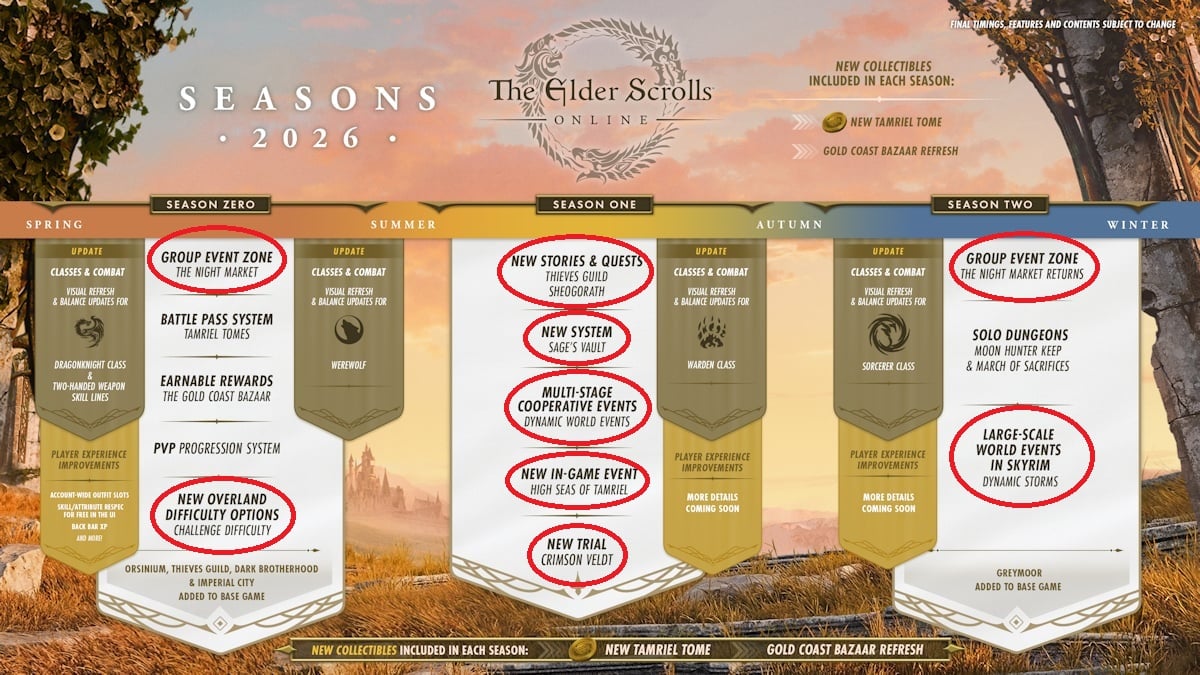
This does not look like "maintenance mode".Edited by Seraphayel on January 8, 2026 4:49PMPS5EUAldmeri Dominion- Khajiit Arcanist -27 -
 Juju_beans✭✭✭✭✭
✭It takes time to transition to a new mode of MMO gameplay.
And there's gonna be bumps in the road.
WOW is vertical progression...always chasing the new and shiny and leaving the old behind
GW2 is horizontal progression...there's new and shiny but the old content is still relavant for progression.
ESO is morphing and it will take time IMHO4 -
wolfie1.0.✭✭✭✭✭
✭✭✭✭SummersetCitizen wrote: »
I’m not saying ZOS is evil or that players have to “lose” for the company to win. This isn’t a moral argument, it’s about incentives and power.These three criticisms are predicated on the idea that between ZOS and the player, one side must always 'lose' when a change is made. None of what you said is necessarily untrue, but is an over villainization of ZOS.
Of course ZOS is not altruistic, but to lump these in as somehow harmful to the player is ridiculous and only serves to taint your otherwise valid criticism of other announced changes.
ZOS isn’t a peer in the community; it’s a business providing a paid service. Players fund the game, but ZOS controls the IP, the rules, and the monetization. Framing the relationship as “we’re all in this together” blurs that imbalance.
Changes can benefit players and the company at the same time, but they’re still designed primarily to reduce risk and increase revenue. Pointing that out isn’t villainization… it’s basic consumer awareness.
The real problem isn’t criticism going too far; it’s criticism getting softened until expectations drop. In a live-service game where players don’t own anything and switching costs are high, scrutiny isn’t hostility. It’s the only leverage players have.
Your not wrong. But I will say this. The new monetization set up is way more friendly to bring in new players.
I have tried to recruit people into playing but they see the 10 years worth of chapters and dlc and the cost to obtain all of them... it often drives them away. Especially when some can only be purchased with crowns. That cant really continue, and zos has ignored the issue and basically said to those players hey its easier to sub.
4 -
 AScarlato✭✭✭✭✭
✭✭✭A company has less customers and can't carry on acting like they have the same turnover. If they need a year or so for them to concentrate on making a game more people want to play I don't see that as a bad thing necessary.
It would have been nice if they didn't funnel money out of ESO and into another MMO they ended up cancelling.20 -
kevkj✭✭✭✭✭SummersetCitizen wrote: »
The criticism isn’t that ZOS should hoard content or avoid adapting… adjusting monetization is expected in any live service.
The point is that these changes reveal whose incentives are being prioritized: they reduce risk and stabilize revenue for ZOS, often at the expense of long-term growth or player leverage.
They opened the stream by talking about balancing player expectations with the realities of running the studio. I can appreciate that, but it’s also fair to critique those realities… especially a studio that seems to have squandered so much goodwill and past success.
And this was what I've been asking the whole time, how do these 3 changes in particular impact long term growth? Don't just say that it will, explain yourself.
Recycling legacy content is only bad for player growth if it's not matched by the addition of new content. I'll admit, what we have been shown so far seems a bit bare but therein the problem is lack of new content rather than legacy content being dusted off now and then.
If anything, you could argue that by homogenizing with the rest of the industry and adopting the Battlepass model that it's one of the ways they are seeking to attract players that were at odds with their previous model. They are reducing friction in onboarding new players at the expense of portions of the existing players who will reject this change. That's a risk that is directly antithetical to the idea they are focused on staying comfortable with what they have rather than growth. I'm personally indifferent, so I'm not arguing this from a position of loving the battlepass model.
Removing predatory real money purchase options is also incompatible with the idea that it's part of a shrinking vision for the game. We have decades of dying online games as proof that predatory sales tend to get added to games in death throes rather than be removed. As an aside, I'm very much in the camp that ESO's active population has been in decline so it's not because I'm in denial of that reality.4 -
Juju_beans✭✭✭✭✭
✭wolfie1.0. wrote: »Your not wrong. But I will say this. The new monetization set up is way more friendly to bring in new players.
I have tried to recruit people into playing but they see the 10 years worth of chapters and dlc and the cost to obtain all of them... it often drives them away. Especially when some can only be purchased with crowns. That cant really continue, and zos has ignored the issue and basically said to those players hey its easier to sub.
Actually I'm there now with GW2. I just started playing and there's a decade plus of new content to buy.
So I'm waiting until their spring sale of content and gems. Meanwhile I have plenty to keep me busy.
ESO also has sales...both for content and crowns. And ESO providing new stuff for base game players could be an incentive for new players to jump in without having to buy all the other content past base game.
1 -
SummersetCitizen✭✭✭✭✭Seraphayel wrote: »This does not look like "maintenance mode".
I strongly disagree. Most of what you’ve highlighted isn’t new permanent content.
These are small chunks, limited events, or temporary updates that may or may not come back, and any new additions are largely just quests added to existing zones.18 -
Gabriel_H✭✭✭✭✭
✭✭✭✭SummersetCitizen wrote: »But what is your criticism here? That.. ZOS should lock up content they already spent money on, not adjust their monetization to fit player and wider industry trends or remove monetization options that generated more negative publicity/ill will than revenue?
The criticism isn’t that ZOS should hoard content or avoid adapting… adjusting monetization is expected in any live service.
The point is that these changes reveal whose incentives are being prioritized: they reduce risk and stabilize revenue for ZOS, often at the expense of long-term growth or player leverage.
They opened the stream by talking about balancing player expectations with the realities of running the studio. I can appreciate that, but it’s also fair to critique those realities… especially a studio that seems to have squandered so much goodwill and past success.
It would great if we lived in a world of sunshine and rainbows where money meant nothing but we don't. The game needs to make money, they are opening it up to newer players by making it free. They are then hoping to hook those players with ESO+, possibly Premium, and offering a new tier above Chapter pricing (Premium+) to hook the whales. They are hoping to sell some crowns.
That is the exact same fundamental foundation as before - get people playing - get them buying ESO+ and Crowns. Nothing has fundamentally changed, other than to those higher up the chain who see this model as a better basis for making money. It's all perception.
Yet the same problem remains, to keep those players they need to address the players concerns about the game - and for the first time in a truly meaningful way they appear to be trying to do that.
Your critiques are being directed at ZOS, but the fault is the system. This is how Capitalism works - If they don't stabilize the revenue they close.7
This discussion has been closed.