Maintenance for the week of March 16:
• [IN PROGRESS] ESO Store and Account System for maintenance – March 18, 6:00AM EDT (10:00 UTC) - 4:00PM EDT (20:00 UTC)
• [IN PROGRESS] ESO Store and Account System for maintenance – March 18, 6:00AM EDT (10:00 UTC) - 4:00PM EDT (20:00 UTC)
Official Discussion Thread for "ESO Leadership’s 2025 End-of-Year Letters to the Community"
-
 Malyore✭✭✭✭✭
✭IMO, how you guys treat PTS feedback is going to be one of the most impactful ways to demonstrate "actions speak louder than words". If there's changes that people straight up don't like on PTS, pumping the brakes on that feature's launch is going to gain the whole company some credibility.
Conversely, if people are poking holes in combat changes, pointing out nasty bugs with content and events, and not one actual developer says anything, then it's going to sink the new leaderships's credibility and another year's content.
We are discussing a better feedback loop for PTS and a better framing for PTS. That way, we are getting the information needed, but we are also communicating what a proper timeline to see suggested fixes are for you, the player.
For example, changing a damage number is something that is realistic for a quick fix during a PTS cycle. Changing an animation for something is something that would take months, because we need to coordinate with various teams to work on the change. Sounds, VFX, SFX, art direction. So trying to give a better example of timeframe for changes is something we are looking at to provide better context around. That is in addition to working toward more back and forth communication.
There are quite a few things we need to change process wise to make this all happen, some of which you will learn about on Jan. 7, but we hope to have more details on PTS as a process and some of our changes within the first few months of 2026.
Hold on Kevin, I want to make sure this is correct. It takes MONTHS to change an animation on something... due to how far apart ZOS keeps their dev teams separated?
Aside from that, as others have said if there's a major issue discovered in the PTS and if it can't be fixed by the time of release, then the thing's release should ideally just be reversed to its pre-PTS state until the fix is ready.8 -
 SneaK✭✭✭✭✭
✭IMO, how you guys treat PTS feedback is going to be one of the most impactful ways to demonstrate "actions speak louder than words". If there's changes that people straight up don't like on PTS, pumping the brakes on that feature's launch is going to gain the whole company some credibility.
Conversely, if people are poking holes in combat changes, pointing out nasty bugs with content and events, and not one actual developer says anything, then it's going to sink the new leaderships's credibility and another year's content.
We are discussing a better feedback loop for PTS and a better framing for PTS. That way, we are getting the information needed, but we are also communicating what a proper timeline to see suggested fixes are for you, the player.
For example, changing a damage number is something that is realistic for a quick fix during a PTS cycle. Changing an animation for something is something that would take months, because we need to coordinate with various teams to work on the change. Sounds, VFX, SFX, art direction. So trying to give a better example of timeframe for changes is something we are looking at to provide better context around. That is in addition to working toward more back and forth communication.
There are quite a few things we need to change process wise to make this all happen, some of which you will learn about on Jan. 7, but we hope to have more details on PTS as a process and some of our changes within the first few months of 2026.
Sorry, but this example doesn’t really resonate. I don’t think we’re mostly worried about animations or visuals at this point. The PTS feedback folks are crying about typically has to do with balance. That’s the feedback that has been ignored. I can applaud the communication, but still feels like we’re just off in terms of issues. It’s not as simple as a number either, it’s how things/systems hit the PTS that have a ripple effect to other things in game. Not trying to sound gloom or doom just trying to be honest. When multiple people are saying the same thing about stacking damage skill lines and it’s just ignored then we live with it for months, a response about visual effects really misses the mark.
That said, I’m curious now.. let’s say yall change a skill, by the time it hits PTS is it too far gone to revert if it’s an overall net negative change?Edited by SneaK on December 22, 2025 9:49PM"IMO"Aldmeri Dominion1 Nightblade - 1 Templar - 7 Hybrid Mutt Abominations7 -
 ZhuJiuyin✭✭✭✭✭
✭We are discussing a better feedback loop for PTS and a better framing for PTS. That way, we are getting the information needed, but we are also communicating what a proper timeline to see suggested fixes are for you, the player.
For example, changing a damage number is something that is realistic for a quick fix during a PTS cycle. Changing an animation for something is something that would take months, because we need to coordinate with various teams to work on the change. Sounds, VFX, SFX, art direction. So trying to give a better example of timeframe for changes is something we are looking at to provide better context around. That is in addition to working toward more back and forth communication.
There are quite a few things we need to change process wise to make this all happen, some of which you will learn about on Jan. 7, but we hope to have more details on PTS as a process and some of our changes within the first few months of 2026.
I agree with others who have said that the most common feedback on PTS is usually not related to animations or visuals, but rather to balance.
For example, the most common feedback on PTS regarding Sorc's Monolith of Storms was its poor 5-item bonus because:
1. It couldn't crit (and wasn't fixed until the very last minute).
2. Strict limitations (An enemy can only take damage from this set once every 2 seconds. Class sets like Corpseburster, which also deal area damage, don't have similar limitations, making Corpseburster still one of Necro's preferred sets).
3. Low damage output (Without the Energized passive, Monolith of Storms deals less damage than most sets).
4. Unbearable procedural conditions (Storm Calling doesn't often fulfill procedural conditions or fit into skill rotations).
Conversely, the least complained-about aspect was the animation of Monolith of Storms. However, just as the Holy Roman Empire was neither holy nor Roman, Monolith of Storms is neither Monolith nor Storms; it's merely a few ugly lightning rods. But this is precisely what receives the fewest complaints, because before the terrible animations, there are other things players care about more: poor balance.
Furthermore, many things that players felt only needed a slight buff/nerf, such as Pyrebrand, were ultimately over-adjusted, rendering them completely unusable or excessively powerful.
Past experience shows that the phrase "...changing a damage number is something that is realistic for a quick fix during a PTS cycle..." often turns into a massive buff/nerf delayed for several patches. Some obviously bad balance issues remain uncorrected even after the PTS ends. For example, during the U46 PTS, players pointed out that Grim Focus's free weapon damage made the skill too powerful, but it wasn't balanced until U47.
Therefore, I think what players are more curious about is how long "quick fix" actually takes, and what the developers mean by "changing a damage number"? Based on past cases, why does a simple request for damage balance often take 4-5 weeks or even longer?"是燭九陰,是燭龍。"──by "The Classic of Mountains and Seas "English is not my first language,If something is ambiguous, rude due to context and translation issues, etc., please remind me, thanks.6 -
 Hotdog_23✭✭✭✭✭
✭✭Nice to see you acknowledge that 2025 was not a good year for ESO. In fact, I would say it has been your worst so far as a whole. Now, whether you know from listening to your players or from your internal metrics of less player engagement, I don’t know. I do hope it has put your feet to the fire and you do bring it next year. I fear another bad year like 2025, and ESO may not recover from it.
I know, for me personally, I am not blindly purchasing the season pass like I always have as soon as it is available. I want to see what I am getting this time, and not promising it will be great, trust us again. That train has moved on.
Not going to lie, I have lost faith in you, and it is going to take a lot to earn it back. Prove it time for me. Don’t get me wrong, I hope you find that magic again; I just don’t think you can after this past year's failure. You were told about how bad this year was and did nothing to really fix it. Just more promises of how great things are going to be; just wait and trust us.
Stay safe and happy holidays!! 4
4 -
 ZOS_KevinCommunity ManagerHold on Kevin, I want to make sure this is correct. It takes MONTHS to change an animation on something... due to how far apart ZOS keeps their dev teams separated?
Aside from that, as others have said if there's a major issue discovered in the PTS and if it can't be fixed by the time of release, then the thing's release should ideally just be reversed to its pre-PTS state until the fix is ready.
No, it's not because teams are separated or anything like that. When something ships, other things are already in the works. Dev pipelines can take 12-18months for something to ship. All we are saying is, for bigger changes like changing an animation, teams all need to rearrange things to make sure they can fit in the fix while not causing cascading impacts that could cause issues with other parts of development.
And also wanted to clarify, I was using my example as just that. It is only an example of things we need to consider during PTS. Not a specific example of only focusing on animations over balance.
Community Manager for ZeniMax Online Studio and Elder Scrolls OnlineDev Tracker | Service Alerts | ESO Twitter7 -
 ceruulean✭✭✭✭tomofhyrule wrote: »So what - beyond Crown Crates - is ESO going to charge for?
A quality game that doesn't deliberately hide information and make you want to bang your head against the wall with every interaction...? I'm talking basic features like account-wide settings (this can be done client sided with little server load), showing the GCD with skills being blacked out, and minimap.
How many players have went to a guild store and said, "There's nothing for sale..."? Because the store provides a blank front, with no call to action or anything? Latest listings, "browse categories and press search"Edited by ceruulean on December 23, 2025 3:23PM4 -
twisttop138✭✭✭✭✭
✭We are discussing a better feedback loop for PTS and a better framing for PTS. That way, we are getting the information needed, but we are also communicating what a proper timeline to see suggested fixes are for you, the player.
For example, changing a damage number is something that is realistic for a quick fix during a PTS cycle. Changing an animation for something is something that would take months, because we need to coordinate with various teams to work on the change. Sounds, VFX, SFX, art direction. So trying to give a better example of timeframe for changes is something we are looking at to provide better context around. That is in addition to working toward more back and forth communication.
There are quite a few things we need to change process wise to make this all happen, some of which you will learn about on Jan. 7, but we hope to have more details on PTS as a process and some of our changes within the first few months of 2026.
I agree with others who have said that the most common feedback on PTS is usually not related to animations or visuals, but rather to balance.
For example, the most common feedback on PTS regarding Sorc's Monolith of Storms was its poor 5-item bonus because:
1. It couldn't crit (and wasn't fixed until the very last minute).
2. Strict limitations (An enemy can only take damage from this set once every 2 seconds. Class sets like Corpseburster, which also deal area damage, don't have similar limitations, making Corpseburster still one of Necro's preferred sets).
3. Low damage output (Without the Energized passive, Monolith of Storms deals less damage than most sets).
4. Unbearable procedural conditions (Storm Calling doesn't often fulfill procedural conditions or fit into skill rotations).
Conversely, the least complained-about aspect was the animation of Monolith of Storms. However, just as the Holy Roman Empire was neither holy nor Roman, Monolith of Storms is neither Monolith nor Storms; it's merely a few ugly lightning rods. But this is precisely what receives the fewest complaints, because before the terrible animations, there are other things players care about more: poor balance.
Furthermore, many things that players felt only needed a slight buff/nerf, such as Pyrebrand, were ultimately over-adjusted, rendering them completely unusable or excessively powerful.
Past experience shows that the phrase "...changing a damage number is something that is realistic for a quick fix during a PTS cycle..." often turns into a massive buff/nerf delayed for several patches. Some obviously bad balance issues remain uncorrected even after the PTS ends. For example, during the U46 PTS, players pointed out that Grim Focus's free weapon damage made the skill too powerful, but it wasn't balanced until U47.
Therefore, I think what players are more curious about is how long "quick fix" actually takes, and what the developers mean by "changing a damage number"? Based on past cases, why does a simple request for damage balance often take 4-5 weeks or even longer?
I'm also curious about the wording "a better framing for PTS." Like how the players view the pts now is framed in the wrong way. Like they want to change that and frame the pts in a different light.1 -
 Destai✭✭✭✭✭
✭✭✭✭Hold on Kevin, I want to make sure this is correct. It takes MONTHS to change an animation on something... due to how far apart ZOS keeps their dev teams separated?
Aside from that, as others have said if there's a major issue discovered in the PTS and if it can't be fixed by the time of release, then the thing's release should ideally just be reversed to its pre-PTS state until the fix is ready.
No, it's not because teams are separated or anything like that. When something ships, other things are already in the works. Dev pipelines can take 12-18months for something to ship. All we are saying is, for bigger changes like changing an animation, teams all need to rearrange things to make sure they can fit in the fix while not causing cascading impacts that could cause issues with other parts of development.
And also wanted to clarify, I was using my example as just that. It is only an example of things we need to consider during PTS. Not a specific example of only focusing on animations over balance.
I think what they're getting at is something like U48 animations where it clearly was not showtime ready. That's an example where people are saying "revert, reassess". Are you guys prepared to shelve a release - either in part or in whole - if the PTS feedback is showing it's either going to be poorly perceived or is not Live-ready?6 -
 tomofhyrule✭✭✭✭✭
✭✭✭✭✭twisttop138 wrote: »We are discussing a better feedback loop for PTS and a better framing for PTS. That way, we are getting the information needed, but we are also communicating what a proper timeline to see suggested fixes are for you, the player.
For example, changing a damage number is something that is realistic for a quick fix during a PTS cycle. Changing an animation for something is something that would take months, because we need to coordinate with various teams to work on the change. Sounds, VFX, SFX, art direction. So trying to give a better example of timeframe for changes is something we are looking at to provide better context around. That is in addition to working toward more back and forth communication.
There are quite a few things we need to change process wise to make this all happen, some of which you will learn about on Jan. 7, but we hope to have more details on PTS as a process and some of our changes within the first few months of 2026.
I agree with others who have said that the most common feedback on PTS is usually not related to animations or visuals, but rather to balance.
For example, the most common feedback on PTS regarding Sorc's Monolith of Storms was its poor 5-item bonus because:
1. It couldn't crit (and wasn't fixed until the very last minute).
2. Strict limitations (An enemy can only take damage from this set once every 2 seconds. Class sets like Corpseburster, which also deal area damage, don't have similar limitations, making Corpseburster still one of Necro's preferred sets).
3. Low damage output (Without the Energized passive, Monolith of Storms deals less damage than most sets).
4. Unbearable procedural conditions (Storm Calling doesn't often fulfill procedural conditions or fit into skill rotations).
Conversely, the least complained-about aspect was the animation of Monolith of Storms. However, just as the Holy Roman Empire was neither holy nor Roman, Monolith of Storms is neither Monolith nor Storms; it's merely a few ugly lightning rods. But this is precisely what receives the fewest complaints, because before the terrible animations, there are other things players care about more: poor balance.
Furthermore, many things that players felt only needed a slight buff/nerf, such as Pyrebrand, were ultimately over-adjusted, rendering them completely unusable or excessively powerful.
Past experience shows that the phrase "...changing a damage number is something that is realistic for a quick fix during a PTS cycle..." often turns into a massive buff/nerf delayed for several patches. Some obviously bad balance issues remain uncorrected even after the PTS ends. For example, during the U46 PTS, players pointed out that Grim Focus's free weapon damage made the skill too powerful, but it wasn't balanced until U47.
Therefore, I think what players are more curious about is how long "quick fix" actually takes, and what the developers mean by "changing a damage number"? Based on past cases, why does a simple request for damage balance often take 4-5 weeks or even longer?
I'm also curious about the wording "a better framing for PTS." Like how the players view the pts now is framed in the wrong way. Like they want to change that and frame the pts in a different light.
What I'm hoping is that the devs will actually see the PTS the way the players do: as a testing ground.
Currently, the players (the unpaid testers, I might add) go in and test things, and then post reports on the official feedback threads, which is then summarily ignored. It's been harder and harder to go on and test things because people have stopped caring, which ended up leading to the U48 PTS which barely had enough people to test the Writhing Fortress because of lack of interest (compounded by the continued lack of combat balance). And as such, the Wall event ended up being a bug-addled catastrophe.
At least some of those bugs could have been found on PTS. Not all of them, mind (we only saw U47 during phase 2 and U48 during phase 3, so all of U47 pre-wall, U47 phase 1, U48 phase 1, U48 phase 2, and U48 post wall were all untestable), but many of the long time testers have burnt out.
It feels to many of us that the devs see the PTS as a preview server. Anything put on PTS will go live (barring rare circumstances, and even then...), so it seems that the goal is that the devs have the StreamTeam go on and make content for the new stuff to try to hype players up. The StreamTeam even has their own private Discord server with the devs so they can give feedback (which is treated as only slightly more important than the feedback of us plebs who are not ~✨creators✨~), but at least they do get eyes on it that way.
I still remember when I was taking screenshots for one of my characters and ran the Orsinium questline on PTS, only to find that the U41 patch added invisible walls and hard broke that questline... and then they announced an Orsinium event that gave rewards for completing that questline that would go live after release. Despite me sending in a /bug, posting in an official Feedback thread, and even making a new thread specifically to point it out with screenshots in week 1 of PTS, I finally had to get one of my streamer friends to post it in their secret Discord and the response from the devs was literally "what Orsinium bug?"
Honestly, if that's the way they want to run PTS, then why is it even open to us plebs in the first place? Just close it off like it was back in the Summerset era.
The PTS should be a way for the players - including the non-streamers - to test out content and give feedback. We have seen so many reports of "this will not be fun for players" that go live and... are not fun for players. It's obvious that the players seem to have a better idea of how the players will react to changes than the devs do (memories of the "don't have knee-jerk reactions" post after just reading U35 patch notes, and then PTS came up and it was exactly as players expected... and then it went live and had exactly the effect players warned about). And yes, that should also include the devs deciding to take something off the patch and table it for a bit if it needs to cook longer. The only time that ever happened was the two-person mounts, and only because that would literally ban players for riding.
It should be an unwritten requirement for the devs, particularly the Combat team, to read and interact with the feedback thread at least once a week. But at minimum, if a bug is presented on PTS in week 1, there should be no way that said bug ends up going live. Too many times we have a bug or issue that is reported in week 1 of PTS, and then 6 weeks later is goes live and necessitates a surprise downtime two days after release to hotfix something that we had known about for over a month.Edited by tomofhyrule on December 23, 2025 3:40PM13 -
 kind_hero✭✭✭✭✭
✭✭Hold on Kevin, I want to make sure this is correct. It takes MONTHS to change an animation on something... due to how far apart ZOS keeps their dev teams separated?
Aside from that, as others have said if there's a major issue discovered in the PTS and if it can't be fixed by the time of release, then the thing's release should ideally just be reversed to its pre-PTS state until the fix is ready.
No, it's not because teams are separated or anything like that. When something ships, other things are already in the works. Dev pipelines can take 12-18months for something to ship. All we are saying is, for bigger changes like changing an animation, teams all need to rearrange things to make sure they can fit in the fix while not causing cascading impacts that could cause issues with other parts of development.
And also wanted to clarify, I was using my example as just that. It is only an example of things we need to consider during PTS. Not a specific example of only focusing on animations over balance.
This doesn't sound encouraging at all. I am not trying to tell you how to manage development, I just want to add that the most important pipeline is player satisfaction. Stuff should be faster to update or change if needed. New content is less important, like all the collectibles or dungeons.
Consider asking yourself a question: why do so many WoW players still want to play classic WoW, that has zero new content, and it is 20 years old? That content was very well designed, even if it's from a different era in gaming. So, player satisfaction is high. If it's low, new content, even good, it will be just a band aid.
You say that some changes take many months. That's almost the same as not doing anything because many players will not wait as much, or take a leave until that issue is addressed.[PC/EU] Tamriel Hero, Stormproof, Grand Master Crafter9 -
 Syldras✭✭✭✭✭
✭✭✭✭✭twisttop138 wrote: »I'm also curious about the wording "a better framing for PTS." Like how the players view the pts now is framed in the wrong way. Like they want to change that and frame the pts in a different light.
I assumed time frames. Indeed the time we get for testing is too short. Just a few weeks before release isn't sufficient if some bigger problem shows up.@Syldras | PC | EU
The forceful expression of will gives true honor to the Ancestors.
Sarayn Andrethi, Telvanni mage (Main)
Darvasa Andrethi, his "I'm NOT a Necromancer!" sister
Malacar Sunavarlas, Altmer Ayleid vampire
Soris Rethandus, a Sleeper not yet awake0 -
 Gadamlub14_ESO✭✭✭✭Hold on Kevin, I want to make sure this is correct. It takes MONTHS to change an animation on something... due to how far apart ZOS keeps their dev teams separated?
Aside from that, as others have said if there's a major issue discovered in the PTS and if it can't be fixed by the time of release, then the thing's release should ideally just be reversed to its pre-PTS state until the fix is ready.
No, it's not because teams are separated or anything like that. When something ships, other things are already in the works. Dev pipelines can take 12-18months for something to ship. All we are saying is, for bigger changes like changing an animation, teams all need to rearrange things to make sure they can fit in the fix while not causing cascading impacts that could cause issues with other parts of development.
And also wanted to clarify, I was using my example as just that. It is only an example of things we need to consider during PTS. Not a specific example of only focusing on animations over balance.
can you tell us what the point of the PTS servers are in the view of ZOS?7 -
twisttop138✭✭✭✭✭
✭twisttop138 wrote: »I'm also curious about the wording "a better framing for PTS." Like how the players view the pts now is framed in the wrong way. Like they want to change that and frame the pts in a different light.
I assumed time frames. Indeed the time we get for testing is too short. Just a few weeks before release isn't sufficient if some bigger problem shows up.
Yeah I guessed that was part of it but then he came back with another post about how content is in the works 18 months ahead of time, so actually pulling something to fix it is unrealistic in their view, so it feels like he's saying our view of what the pts should be is not in line with how they see it and want to reframe.1 -
 Seraphayel✭✭✭✭✭
✭✭✭✭✭I guess the important announcement from the stream next year is if they’re revamping their “four patches per year“ model or if they stick to it. I‘d rather have two major releases that are thoroughly tested than four where there is a limit of four weeks for PTS. That said, every update needs to be big enough to last for half a year. Personally, dungeon quarters always felt flat and boring to me as someone who wasn’t that much into dungeons anyway.PS5EUAldmeri Dominion- Khajiit Arcanist -2 -
tomofhyrule✭✭✭✭✭
✭✭✭✭✭Seraphayel wrote: »I guess the important announcement from the stream next year is if they’re revamping their “four patches per year“ model or if they stick to it. I‘d rather have two major releases that are thoroughly tested than four where there is a limit of four weeks for PTS. That said, every update needs to be big enough to last for half a year. Personally, dungeon quarters always felt flat and boring to me as someone who wasn’t that much into dungeons anyway.
And to someone who thinks dungeons are the best content in the game, the dungeon quarters are way more exciting than anything else this game does. Certainly this year, where only two of the four updates had anything at all fun in them, and it wasn't the two that added the zone.
The one thing I can almost guarantee though is that they're going to stick with the 4-updates-per-year model, and that's because each update brings the data for that quarter's worth of Crown Crates. If they reduced the number of updates, then they'd need to slow the Crates down, and I doubt the overlords will allow that to happen.
(also it's 6 weeks of PTS each, not that anyone would know it considering how much is ignored from that in the first place)2 -
 loosej✭✭✭✭✭When it comes to how the pts works, maybe they could consider these two things:
1. Put the pts up sooner, and leave enough time between week 6 and the actual patch on the live servers, to fix the biggest problems that are reported by testers.
2. Have a small team available during that period to actually fix those problems. At this point it's no longer a hypothetical "if there are big problems", they're always there.
Better to allocate too many resources for this and having to reassign them if by some miracle there are only a few minor issues, than to hope for the best-case scenario like they currently do.Consistency: It's only a virtue if you're not a screwup (source: despair.com)7 -
ZOS_KevinCommunity ManagerGadamlub14_ESO wrote: »can you tell us what the point of the PTS servers are in the view of ZOS?
We are working on a write up for next year to list out our view of PTS, how we intend to improve communication and any changes that we are making. The details are still being worked out here, so once that is ready, we’ll follow up.
Community Manager for ZeniMax Online Studio and Elder Scrolls OnlineDev Tracker | Service Alerts | ESO Twitter13 -
 Turtle_Bot✭✭✭✭✭
✭✭✭Gadamlub14_ESO wrote: »can you tell us what the point of the PTS servers are in the view of ZOS?
We are working on a write up for next year to list out our view of PTS, how we intend to improve communication and any changes that we are making. The details are still being worked out here, so once that is ready, we’ll follow up.
@ZOS_Kevin Hopefully this write up will include things related to the PTS, such as official feedback threads, and what we players need to do when creating our own threads on the forums to give feedback about things on the PTS.
One of the biggest gripes I have had with the in-game feedback (especially on the PTS) is the severe lack of space to go in-depth on a potential issue. It's like trying to describe the 50,000+ issues with a malfunctioning space rocket using only a single tweet that allows for "rocket go bad boom".
This just makes it nearly impossible to submit detailed feedback on issues through the PTS in-game feedback (which I can only assume gets read more frequently than forum posts), leaving many of us who do this beta/QA testing (completely unpaid too) for you guys, forced to come here to the forums to have enough space to better describe things in more detail (that would ideally help you guys find the issue and get it fixed), which then we run into the issue of the things we report here on the forums, either not being read, completely misinterpreted, or (from our perspective) just being flat out ignored. As a result, massive bugs, combat imbalances, and more, make it to the live servers where they get complained about for months on end.
A few examples of what I'm talking about from the past 5 years (there's many more):
- Combat rework (U35) - Played out exactly as we said it would back then (massive nerfs, huge exodus of end-game and progression players, massive void/loss that will struggle to be filled, if at all).
- Sub-classing (U46) - Played out exactly as we said it would (completely unbalanced with like 3 maybe 4 of the total 21 skill lines worth using for anything more than just pure role play/aesthetic).
- Sorcerer Ward (U41) - Played out as the few who provided constructive feedback said it would (overpowered on release, then got adjusted to a fairer value in U43, then made useless again in U46 for sub-classing "balance").
- EDIT: Animation Changes (U48) - received the exact same complaints (and bugs) on live servers that were raised when the few remaining testers tested them on the PTS.Edited by Turtle_Bot on December 23, 2025 11:50PM6 -
Pevey✭✭✭✭✭
✭✭✭Gadamlub14_ESO wrote: »can you tell us what the point of the PTS servers are in the view of ZOS?
We are working on a write up for next year to list out our view of PTS, how we intend to improve communication and any changes that we are making. The details are still being worked out here, so once that is ready, we’ll follow up.
My interpretation is that the PTS strategy going forward based on the survey feedback that was collected involves perhaps a tiny bit of improvement combined with a very large helping of lowering expectations. It remains to be seen. But if so, this is more of the same we have seen from ZOS and makes me further doubt the "new" leadership team is really capable of change.3 -
Malyore✭✭✭✭✭
✭Hold on Kevin, I want to make sure this is correct. It takes MONTHS to change an animation on something... due to how far apart ZOS keeps their dev teams separated?
Aside from that, as others have said if there's a major issue discovered in the PTS and if it can't be fixed by the time of release, then the thing's release should ideally just be reversed to its pre-PTS state until the fix is ready.
No, it's not because teams are separated or anything like that. When something ships, other things are already in the works. Dev pipelines can take 12-18months for something to ship. All we are saying is, for bigger changes like changing an animation, teams all need to rearrange things to make sure they can fit in the fix while not causing cascading impacts that could cause issues with other parts of development.
And also wanted to clarify, I was using my example as just that. It is only an example of things we need to consider during PTS. Not a specific example of only focusing on animations over balance.
Thank you for the clarification, Kevin. That makes more sense, I suppose I hadn't considered that what's being released on a PTS isn't necessarily "new" content from the departments perspectives, and so to interrupt their timetables to correct something developed a year ago which is just now being tested in servers would need more time to simply, well, find the time to adjust.3 -
 Cooperharley✭✭✭✭✭
✭IMO, how you guys treat PTS feedback is going to be one of the most impactful ways to demonstrate "actions speak louder than words". If there's changes that people straight up don't like on PTS, pumping the brakes on that feature's launch is going to gain the whole company some credibility.
Conversely, if people are poking holes in combat changes, pointing out nasty bugs with content and events, and not one actual developer says anything, then it's going to sink the new leaderships's credibility and another year's content.
We are discussing a better feedback loop for PTS and a better framing for PTS. That way, we are getting the information needed, but we are also communicating what a proper timeline to see suggested fixes are for you, the player.
For example, changing a damage number is something that is realistic for a quick fix during a PTS cycle. Changing an animation for something is something that would take months, because we need to coordinate with various teams to work on the change. Sounds, VFX, SFX, art direction. So trying to give a better example of timeframe for changes is something we are looking at to provide better context around. That is in addition to working toward more back and forth communication.
There are quite a few things we need to change process wise to make this all happen, some of which you will learn about on Jan. 7, but we hope to have more details on PTS as a process and some of our changes within the first few months of 2026.
Hold on Kevin, I want to make sure this is correct. It takes MONTHS to change an animation on something... due to how far apart ZOS keeps their dev teams separated?
Aside from that, as others have said if there's a major issue discovered in the PTS and if it can't be fixed by the time of release, then the thing's release should ideally just be reversed to its pre-PTS state until the fix is ready.
Agreed. I think the big thing is, if something has an unbelievable amount of criticism, pushing it to live is not the answer. Some things, like subclassing, shouldn't have been released in their state and should've been tested far longer. This adherence to a 5-6 week patch cycle is clearly not enough for a lot of the stuff that gets released. It's about polish and completeness, not just releasing things to release them.PC-NA | @Cooperharley11 -
Seraphayel✭✭✭✭✭
✭✭✭✭✭I‘m sorry, but people expecting a feature doesn’t get released because of negative feedback is beyond me. Subclassing was a huge selling point for the game this year, successful or not. There was no possibility that it would not make it into the game.
The same with animations: you don’t know all the implications these things have and it’s not like a switch you turn on or off.PS5EUAldmeri Dominion- Khajiit Arcanist -7 -
 Danikat✭✭✭✭✭
✭✭✭✭✭Seraphayel wrote: »I‘m sorry, but people expecting a feature doesn’t get released because of negative feedback is beyond me. Subclassing was a huge selling point for the game this year, successful or not. There was no possibility that it would not make it into the game.
The same with animations: you don’t know all the implications these things have and it’s not like a switch you turn on or off.
I would genuinely prefer all games to release things when they're complete and functional rather than shoving it out in whatever state it's in when the arbitrary deadline comes up.
This attitude that it's OK to ship things you know are broken because it could be patched later on has killed games and even studios before now and will do again. Especially because once something is released (or even just once it's been paid for) there's little/no incentive to get it working and a lot of pressure to rush out the next thing and the next and the next while the quality continues to decline until enough customers are unwilling to keep paying, and then it's often too late.
There are rare examples of games managing to turn it around thanks to a huge investment of time and money for not just the fixes but the PR damage control, but many more that never do.Edited by Danikat on December 28, 2025 7:27PMPC EU player | She/her/hers | PAWS (Positively Against Wrip-off Stuff) - Say No to Crown Crates!
"Remember in this game we call life that no one said it's fair"11 -
Cooperharley✭✭✭✭✭
✭Seraphayel wrote: »I‘m sorry, but people expecting a feature doesn’t get released because of negative feedback is beyond me. Subclassing was a huge selling point for the game this year, successful or not. There was no possibility that it would not make it into the game.
The same with animations: you don’t know all the implications these things have and it’s not like a switch you turn on or off.
So you're cool with things being largely undercooked? It's obvious that things are going to make it to live regardless and that's the problem. I'm saying we need MORE testing and MORE QA to ensure these things are sustainable and enjoyable rather than routinely now getting a ton of negative feedback.
I think the people that ask for subclassing to be removed are beyond silly, because that would absolutely never happen, but we've (over the last 5-6 years or so?) shifted from QA to our live servers being a PTS of sorts with a larger sample size. That mentality just needs to change and if they need the seasonal structure in order to ensure systems are more polished when they come out AND it allows them to update previous systems, then heck yea, i'm all for it.PC-NA | @Cooperharley7 -
 Juomuuri✭✭✭✭✭I'm cautiously going to take a look at the articles after the stream on Jan 7th, the end of the year letters combined with all the stuff I've seen don't really give a good image for the current state of the game. I'd hope you can turn ESO around and actually make choices that would bring the quality back to pre-2021 standards when it comes to quests, lore, dialogue quality, writing, zone design etc. And as someone mentioned earlier in the thread, I'm in support of removing crown crates and putting all the previous and current items to the crown store so they can be directly purchased. Gamble crates are not helping the game's bleeding playerbase. Also, I think it'd be a good idea to lower the prices of cosmetics and adding more in-game earnable mounts, costumes etc, it's not attractive to pick up ESO as a new player when all the cool stuff is behind the cash shop. I used to throw money at ESO so I could buy houses, costumes and crown crates, but I closed my purse and walked away due to the awful quality of the new content which had already been worsening since Blackwood. I played mainly for the quests and lore, but with the writing "quality" I just couldn't justify playing, especially after sub-classing made my main, tankblade, obsolete.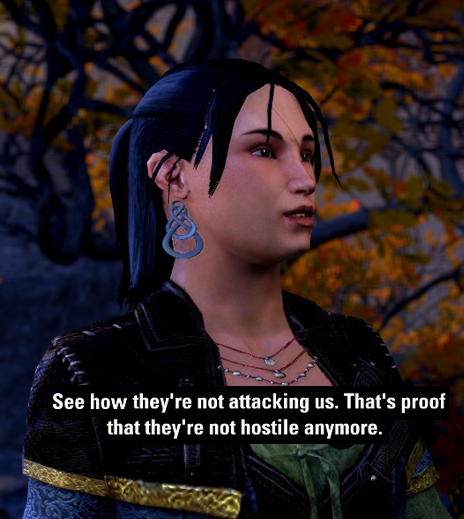
This is real dialogue from a quest in Gold Road. I'm still baffled, did nobody proof read any of this?
I played this game for 7,5k hours since 2016, had done all solo PvE quest content, got Beast and Worm Wizard unlocked (among with many skins and titles from dungeons), got the Inkslayer title (duo run, I tanked on my now obsolete tankblade), had 99% of all available motifs collected (at the time in May 2025)... And in the end I packed my bags. I'm not sure if I'll come back, but I will be watching, like I've done since May.
(Edit to add how long I had played.)Edited by Juomuuri on December 30, 2025 2:44PMPC-EU (Steam) - CP 2300 - I was a tankblade main...7 -
 Gold25Dog✭✭The current mystery gifting mechanic has effectively ruined the game for me - I log in I get daily gift I log out. I have started a petition to hopefully capture some attention to how ridiculous the 'we can't tell you what the criteria to gift is - just keep playing the game' response to asking for access to this part of the game.
I sincerely hope someone with any sense at all will read this and consider if not for the experience for your players but from the money aspect of it - you are literally walking away from purchases in the store that I and other players would make.
I know I am not plugged into whatever fraud/abuse you are attempting to subvert but please for the love of the game find another solution.
Adam0 -
Gold25Dog✭✭Apparently petitions are not allowed on this site - I think that speaks to any sense of accountability or maybe more appropriately the lack there of....
Why do y'all even have threads like this if you don't really care about what your players are asking after ?
2 -
 virtus753✭✭✭✭✭
✭✭✭✭✭Apparently petitions are not allowed on this site - I think that speaks to any sense of accountability or maybe more appropriately the lack there of....
Why do y'all even have threads like this if you don't really care about what your players are asking after ?
I wouldn’t conflate petition the format with petition the act of asking for something. The mods certainly don’t use that equivocation in moderating.
Plenty of people posting on the forums have asked for plenty of things from the devs. Using the term or format of “petition” is against the rules, at least in part because it encourages others to write simply “signed” rather than adding anything in the way of actual discussion. Petitions also by design tend to eschew discussion and lean closer to demands. The rule against those terms or models shouldn’t stop anyone from asking for things or making requests, especially with an eye towards soliciting substantive input from other players. I’ve seen whole threads left intact by the mods except for the word “petition” removed from the title, typically when the content was framed as requests or suggestions and led to discussion.0 -
Gold25Dog✭✭Apparently petitions are not allowed on this site - I think that speaks to any sense of accountability or maybe more appropriately the lack there of....
Why do y'all even have threads like this if you don't really care about what your players are asking after ?
I wouldn’t conflate petition the format with petition the act of asking for something. The mods certainly don’t use that equivocation in moderating.
Plenty of people posting on the forums have asked for plenty of things from the devs. Using the term or format of “petition” is against the rules, at least in part because it encourages others to write simply “signed” rather than adding anything in the way of actual discussion. Petitions also by design tend to eschew discussion and lean closer to demands. The rule against those terms or models shouldn’t stop anyone from asking for things or making requests, especially with an eye towards soliciting substantive input from other players. I’ve seen whole threads left intact by the mods except for the word “petition” removed from the title, typically when the content was framed as requests or suggestions and led to discussion.
See this is where I deviate from the interpretation - the whole point of a 'petition' is to bring awareness that something needs to change - not everyone is like me where they want to be verbose - they may just want to say ' yeah I agree' - that is a form of communication that by saying petitions are not allowed is silencing the people that would attest but without anything to add.
The volume of the issue is then not visible to the people it should be visible to because the format to express that volume has been truncated. That said - I don't honestly believe it would make a difference if the volume was known <reasons redacted as I think I may have violated the community guidelines in sharing my opinion>Edited by Gold25Dog on January 2, 2026 11:40AM2
