Maintenance for the week of March 23:
• PC/Mac: No maintenance – March 23
• PC/Mac: No maintenance – March 23
Class Identity Refresh - possible wrong directions

danko355
✭✭✭✭
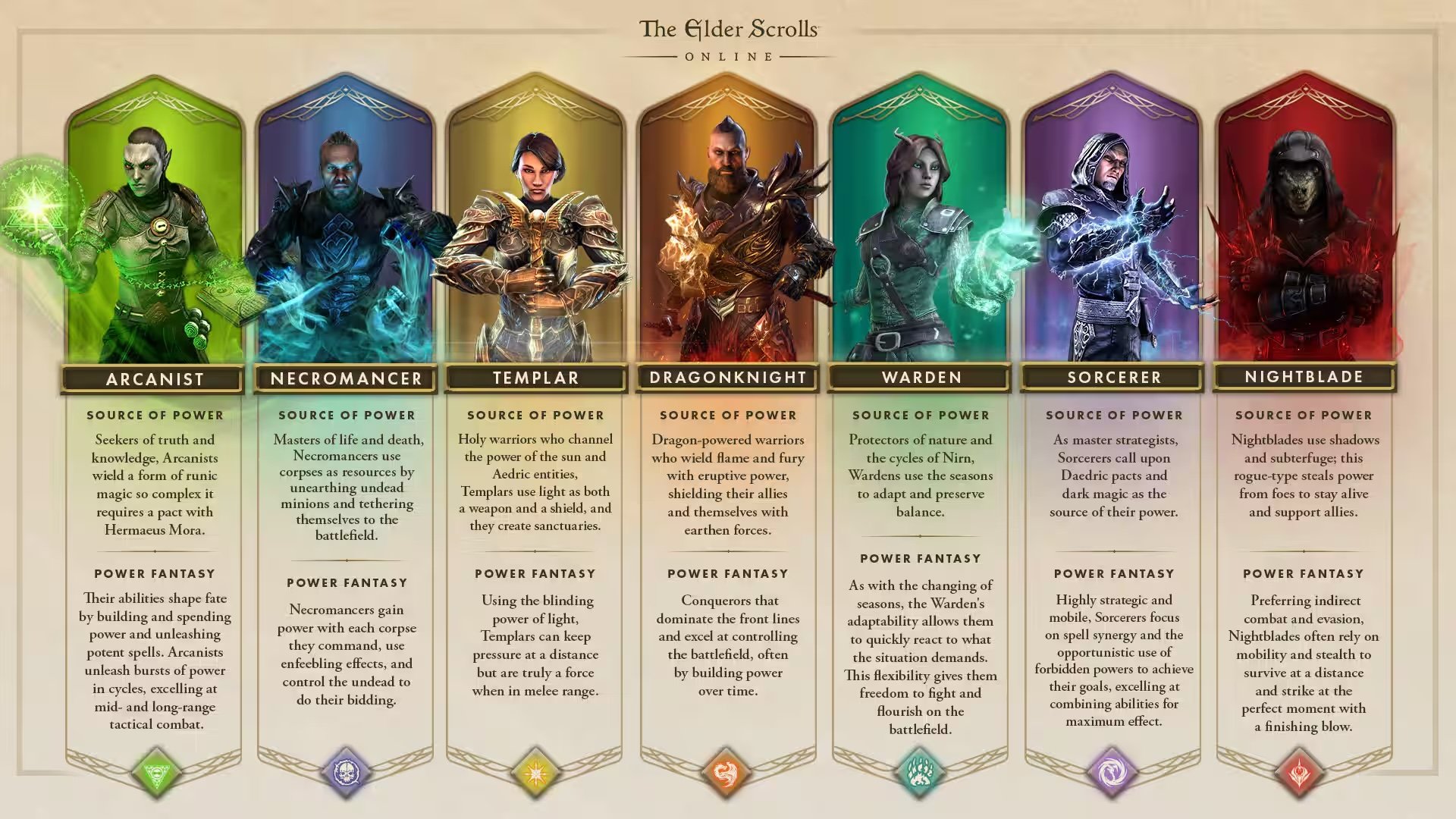
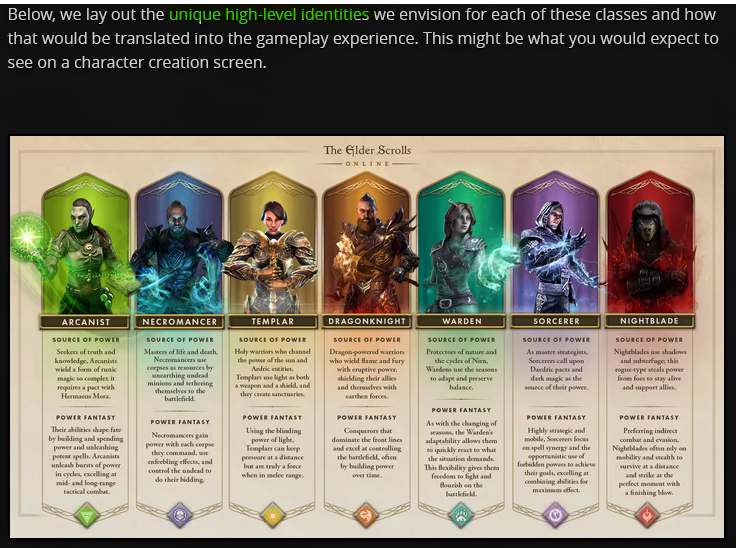
With the recent Class Identity article and image from the Combat Team, I wanted to start a focused discussion about where ESO’s class fantasy might be heading and where, in my opinion, it risks going in the wrong direction.
The article explains that class identity is built on two pillars:
Source of power - lore origin of a class’s power, what makes them different from a normal citizen.
Power fantasy - how that power is expressed in gameplay (how it feels to play that class).
I like this framework a lot in theory. The problem I see is how it’s actually being applied in the image, with Nightblade and Sorcerer taken as an example.
1. Nightblade – reduced to “rogue-type”
The Nightblade panel reads:
Source of Power
“Nightblades use shadows and subterfuge; this rogue-type steals power from foes to stay alive and support allies.”
Power Fantasy
“Preferring indirect combat and evasion, Nightblades often rely on mobility and stealth to survive at a distance and strike at the perfect moment with a finishing blow.”
This is basically a textbook MMO Rogue description: stealth, evasion, mobility, finishing blow. That might fit one popular playstyle (stamblade / gankblade), but it ignores a huge part of what Nightblade has always been:
Nightblade has three class lines:
- Assassination - yes, classic assassin/rogue flavor.
- Shadow - shadow magic, reality manipulation, self-empowerment.
- Siphoning - blood magic / life draining / battlefield control.
Many players (myself included) originally gravitated to Magicka Nightblade specifically because it felt like a Shadow Mage / Blood Mage, not “just another rogue”.
In TES lore, Shadow Magic https://en.uesp.net/wiki/Lore:Shadow_Magic is incredibly powerful and goes way beyond “go invisible”:
it’s about manipulating reality, creating clones, empowering yourself, traversing or bending shadow, etc. Nightblades in ESO do use this, they don’t only sneak behind someone with dual daggers.
By calling Nightblade explicitly a “rogue-type” and then doubling down on stealth + evasion + mobility in the power fantasy, the identity text:
- Overemphasizes one third of the kit (Assassination).
- Underrepresents Shadow and Siphoning as full, standalone magical identities.
- Pushes Nightblade toward a very generic MMO archetype instead of the unique TES “dark mage of shadow and blood” fantasy many of us built our characters around.
If class identity is supposed to be “what makes a class unique and different from other classes”, then defining Nightblade primarily as a rogue feels like shrinking its identity rather than strengthening it.
2. Sorcerer – pushed toward Daedric pet warlock
The Sorcerer panel reads:
Source of Power
“As master strategists, Sorcerers call upon Daedric pacts and dark magic as the source of their power.”
Power Fantasy
“Highly strategic and mobile, Sorcerers focus on spell synergy and the opportunistic use of forbidden powers to achieve their goals, excelling at combining abilities for maximum effect.”
On paper this sounds cool, but again it leans heavily into the Daedric pact / forbidden powers / warlock angle. In practice, though, a lot of players:
- Pick Sorcerer because ESO doesn’t have a generic “Mage/Wizard” class.
- Play Sorc for lightning, spell slinging and the “classic mage” fantasy, not for pets.
- Find pets clunky and unfun.
Yet the very first words of their “source of power” are Daedric pacts and dark magic, not storms, lightning, or raw arcane power. Storm Calling is the line that carries the “I’m a mage throwing lightning around” identity, but that’s not what’s being highlighted as the core fantasy.
Just like Nightblade gets compressed into “rogue”, Sorcerer gets compressed into “pet warlock that uses forbidden Daedric power”, when in reality:
- Daedric Summoning is one line.
- Storm Calling is the de facto “mage” or "elementalist" line for a huge part of the playerbase.
- Dark Magic is… currently pretty bad and could absolutely be the place where a strong, non-pet “arcane mage / battle mage” identity could be reinforced.
3. Identity vs subclassing – why this matters for the future
The article says:
They want to “strengthen the unique identities of each class”.
They want both pure classing and subclassing to be viable.
They are going to reorganize class skill lines and add more incentives to staying in your class’s core lines.
If this is the foundation on which those future changes are built, then the way they frame the class now really matters. If Nightblade is canonically “the rogue class” and Sorcerer is “the Daedric pact warlock”, then:
- Will Nightblade’s Shadow/Siphoning mage aspects be further sidelined in favor of stealth and ganking?
- Will Sorcerers who want to be lightning mages without pets keep getting design scraps while the “pet + forbidden Daedric powers” theme gets reinforced?
I’d really like the Combat Team to consider that many players’ lived class fantasy is:
Nightblade: a dark mage that uses shadow and blood to dominate the battlefield, not just a rogue who goes invisible and backstabs.
Sorcerer: a lightning / arcane mage first, Daedric pet master second (or not at all).
I’m genuinely excited that they are finally doing a long-term class pass and thinking about identity seriously. I just hope the starting point for that process doesn’t lock classes into narrow MMO stereotypes that fail to reflect the broader fantasies many of us have been playing for years.
20
-
 MasterSpatula✭✭✭✭✭
✭✭✭✭✭As a sorc main who really doesn't like pets, my first response to this graphic was basically "uh oh."
For years, my tippity top wish for this game was for Shock/Dark Magic Sorc to be on par with pet sorc. Instead, they moved everything good off of Dark Magic onto Daedric Summoning. I would absolutely beg ZOS, literally get down on my knees, not to overlook Storm Calling (in PVE) and Dark Magic as damage sources if I thought it would do any good."A probable impossibility is preferable to an improbable possibility." - Aristotle19 -
 moderatelyfatman✭✭✭✭✭
✭✭Everything I see here looks like a word salad. I really don't think the devs play this game enough to understand class identity.
Given the track record, we'll probably get this some time after they finish Hybridisation.7 -
 ZhuJiuyin✭✭✭✭✭
✭My first character was a Sorc. The primary reason for choosing Sorc was Dark Magic, followed by Storm Calling. Daedric Summoning was the aspect I cared about least. However, in actual gameplay (for a pure Sorc in PvE), Daedric Summoning accounts for nearly half of the damage, followed by Dark Magic (although only Crystal is included) at 15-20%, with the remainder being general skills like Wall of Elements. Storm Calling, on the other hand, accounts for less than 10% or even less.
Therefore, I welcome a reduction in the proportion of Daedric Summoning in DPS. Furthermore, pets are a huge burden for Sorc. Every time you die, you need to consume a lot of resources and time to resummon your pet, otherwise you'll lose a significant amount of DPS. Pets also lack AoE damage, occupy skill slots, and their attacks don't trigger many common proc sets, making many players dislike pet-sorcerers.
If the new Sorc, as the image suggests, will focus more on Dark Magick's damage output, I'd welcome it. But if it goes back to the old approach of welding Pet and Sorc together... "是燭九陰,是燭龍。"──by "The Classic of Mountains and Seas "English is not my first language,If something is ambiguous, rude due to context and translation issues, etc., please remind me, thanks.4
 -
 Yudo✭✭✭✭✭My guess is they just put a description to somewhat resonate with current state, rather than a solid vision. Would have to ask the person who defined the classes 10y ago
Picked sorcerer as the closes thing to mage archetype. The fantasy power sources for me is types of magic (lightning/dark), not some deadric/dark pact summoner. I don't even use pets. Would hope they do not push more in that direction.7 -
 Gabriel_H✭✭✭✭✭
✭✭
i.e. it's a fantasy blurb. I wouldn't read too much into it.PC EU
Never get involved in a land war in Asia - it's one of the classic blunders!5 -
 Turtle_Bot✭✭✭✭✭
✭✭✭My first (and main) character is also a Sorc, so my initial reaction upon reading that post was the same sense of dread about ZOS forcing even further into the pets. It was such a strange feeling reading that image, because the words in the description go completely against the picture they used for the class and the class icon itself, where the words effectively describe a warlock, but the image used and class icon show a destruction magic mage specializing in lightning magic with a dark/daedric sub-theme to it.
The reason I picked Sorc was the ability to mix the 3 elements of Destro magic (primarily lightning and Ice, but a little bit of flame as well) and since there was no Ice class at the time, I chose Sorcerer for the Lightning theme, and paired ice + flame staff with it to have all 3 elements.
I had little interest in the pets, although I did use them a little bit, they were never the focus of my character, more like assistants for my Sorcerer that help when needed, but never the focus.
Over the years, my main has seen every fun or unique aspect regarding Lightning be gutted or outright removed from the class, so much so that there's barely anything left of her initial lightning theme that made her fun to play.- Overload 3rd bar (this killed the old sorc across all content and the class has never truly recovered from this with its abilities still keeping their design based around having that 3rd bar available to fill out the build properly)
- Old Lightning proc passive in storm calling (allowed crit surge to actually be a reliable HoT despite not actually having one in the class skills, due to allowing multiple instances of damage each second the chance to proc surge heal).
- Mages fury (powercrept over time and never updated to reflect modern execute damage standards, then gutted for literally no real reason despite being the worst execute in the game when it got nerfed)
- Boundless storm (the U35 tick rate adjustment and the later melee attack range increase killed this morphs viability)
- Ball of Lightning projectile absorption (this used to absorb all projectiles within the 2 second window, allowing sorcerer to actually have a chance to escape and reset the fight)
- Even her last hurrah as a PvE lightning mage with the heavy attack build got nerfed into the ground to make way for Arcanist beam, which has just as low APM as HA builds, but even better damage, cleave and survivability than HA builds had at the time.
Nowadays I still run a HA build on her for PvE, sub-classed of course with Assassination and HotT for the crit buffs, status buffs, flail debuff, etc. mostly out of being to lazy to bother farming for Velothi's for beam. I've kept daedric summoning over storm calling because outside of hurricane specifically, there's nothing worth using (in terms of active skills) from storm calling for PvE DPS and at least daedric summoning allows me to use atro for group support in pug groups and daedric summoning also allows me to queue as a healer for random dungeons without switching my build around since matriarch is a good heal and slotting undaunted heal orb + scribing pet class script is a really strong heal over time combo for PvE with additional synergy for the tank, all while keeping most of the damage from my full DPS loadout).
I really hope that ZOS does listen to feedback as they say they will, and re-evaluate their perception of Sorcerer (and the lightning theme in general) to better match how players see the class. I.e. let the class theme go back to focusing more on being a mage (ESO's Lightning/arcane mage specifically) first and foremost, with pets/pacts as a secondary sub-theme.
Considering the massive numbers of complaint threads about matriarch and pets in general over the years, it surprises me that ZOS continues to force this sub-theme onto the class instead of focusing more on the other 2 themes.Trying to not go conspiracy here, but the way sorcerer has been treated over the years, really just gives the feeling that it's being done on purpose, almost spiteful, at this point. Like "how dare the players want to play/have fun roleplaying as a mage when we think they should be playing as summoners instead."
Note: This isn't to bash on anyone, but this really is the feeling I get, looking at what has been done to the Sorcerer class over the past 8 or so years, comparing what it has been made into, to what it was when I first started playing ESO.6 -
Turtle_Bot✭✭✭✭✭
✭✭✭
i.e. it's a fantasy blurb. I wouldn't read too much into it.
I would agree with you, but considering how much ZOS has pushed/forced Sorcerer into Daedric Summoning to the complete abandonment of the other 2 sub-themes over the past 8 years, says that this blurb is closer to how ZOS sees the class rather than just being a fantasy blurb.
Especially since this blurb goes against what a large number of players see this class as (and what most old school Sorc mains will remember the class actually being like back in the day).
Given the sheer volume of recurring complaints over the years about the pets and matriarch specifically for various differing reasons, it's likely the majority of players see the class more as a mage instead of as a summoner despite how much ZOS has tried to push the class into being a summoner over the years.4 -
 noblecron✭✭✭✭✭I hate how much of a summoner sorc is. Give me traditional mage with elemental magic. I liteally subclassed one of my sorcs just to feel that way and gunna subclass the other to throw nb stuff on her. Some friends and I were talking and just wish ZOS would divide sorc into two classes. Summoner and mage
Honeslty when I first heard of subclassing I thought that's what they were going to do.
Nightblade on the one hand I do agree. On the other hand, even the older games had nightblades as rogues that use magics not shadow mages and blood mages. I do love magblade for the shadow and blood mage aspects and do rp that but I get what theyr'e going for.
Nightblade description in Morrowind.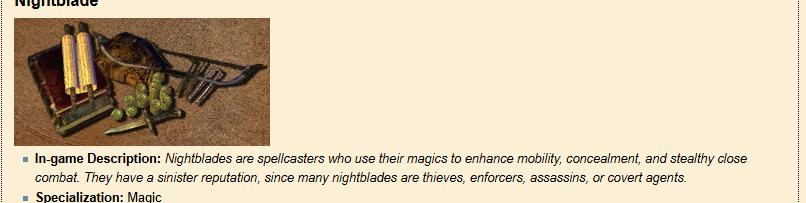
I'm curious how they're going to make warden seasoned themedEdited by noblecron on December 4, 2025 12:40PM1 -
 TX12001rwb17_ESO✭✭✭✭✭
✭✭✭✭Isn't that literally going against the philosophy of "Play however you want" any class can do any role.
How is this not going to force people to subclass? just make all classes like Arcanist so they have access to pretty much every buff there is instead of nerfing them.3 -
 Toanis✭✭✭✭✭All the talk about class identity is not about shoehorning the class into one playstyle like other mmos. We don't want Dragon Knights to be reduced to S&B melee control neither do we want Sorcerers to be the pet class.
If we wanted that, we'd play WoW or SWTOR. FFXIV would give us easy class switching, while BDO and Neverwinter have considerably better action combat with animations perfectly fitting the limited class fantasy.
The complaints are about some options of subclassing being so superior to the classes actual abilities, that in any game mode where min-maxing is a neccessity everyone plays the same, with a minor flavour of the one mandatory original class skill line. Subclassing should add a new flavour to the class, not override the playstyle with that of another class.
Swapping one skill line for Bone Tyrant to gain some undeath flavoured toughness is fine. Adding Herald of the Tome to any class will change that character into an Arcanist. So the skill lines available for subclassing should be weighed for impact.
Maybe make the style defining dps skill lines exclusive, so there's no doubling down on dps passives? Heck, when you switch to a style defining skill line, change the character's actual class. So class identity would be preserved by allowing us actual class switching. And then we could address why even long before subclassing was ever a thing, the PVE meta was basically "Bring an Arcanist".
Edited by Toanis on December 4, 2025 2:58PM1 -
 AzuraFan✭✭✭✭✭
✭✭✭✭My concern is for the warden. They mention the power of the seasons and nothing about animals. If they lean heavily into frost and such, and remove animal companions, that'll be it for me.
Rather than changing something so fundamental that's been in the game for 11 years, maybe they can fix the mess that is subclassing, instead. It seems they introduced a problem and then decide to fix it by going nuclear and blowing away what people have been using for a while.
I'm okay with them taking another look at classes as long as each class isn't forced into being only one thing, like necromancers being sneaky, or wardens using frost.
Edited by AzuraFan on December 4, 2025 2:25PM1 -
ShutUpitsRed✭✭✭✭If that's the "power fantasy" for Templars they sure didn't build them that way lol. PotL and Radiant Oppression are incredible and sweeps feels like a noodle. Lol.0
-
Spearblade✭✭✭✭Ya'll are impossible to please and reading into things WAY too much. These aren't patch notes, it's a fantasy blurb like somebody else said.
When Dragonknight notes get released, we'll have a better idea of how they're approaching things. I suspect each skill line will have DPS/Healing/Tank aspects, just different flavors of a collective whole. Mixing skill lines up (role wise) should also help with balancing Subclassing, as it's not strictly cherry picking the best DPS or Tank skill lines and calling it a day. Some classes already have skill lines like that to an extent, where they don't really excel at anything, but offer great utility (like Storm Calling, or all of Sorcerer really)
But again, wait and see.
1 -
danko355✭✭✭✭Spearblade wrote: »Ya'll are impossible to please and reading into things WAY too much. These aren't patch notes, it's a fantasy blurb like somebody else said.
When Dragonknight notes get released, we'll have a better idea of how they're approaching things. I suspect each skill line will have DPS/Healing/Tank aspects, just different flavors of a collective whole. Mixing skill lines up (role wise) should also help with balancing Subclassing, as it's not strictly cherry picking the best DPS or Tank skill lines and calling it a day. Some classes already have skill lines like that to an extent, where they don't really excel at anything, but offer great utility (like Storm Calling, or all of Sorcerer really)
But again, wait and see.
I don’t think this is just a blurb, and that’s precisely the concern many of us have been raising.
If it were simply marketing text or a beginner-friendly summary, nobody would be alarmed. The issue is that, in the article itself, the devs explain that “source of power” and “power fantasy” are the core pillars they use internally when defining what a class can do, should do, and will do going forward. These descriptions aren’t decoration, they’re the design templates that guide future buffs, nerfs, reworks, and the entire class refresh process.
And this isn’t theoretical. We’ve already seen years of this direction:- Sorcerers have repeatedly given feedback asking for non-pet viability, more lightning/arcane emphasis, better Storm Calling identity, etc.
- Instead, the design keeps pushing pets, pushing Daedric themes, and shaping the kit around those assumptions, even when most players don’t enjoy that fantasy.
- This is exactly why people are reacting strongly: if the foundational identity is defined narrowly, then the actual gameplay options shrink around that narrow definition.
13 -
 Ezhh✭✭✭✭✭
✭As a sorc main who feels unable to take a sorc into any serious content I can only echo the concerns here. I don't want to be a summoner. The flap flap flap of the tormentor actually makes me queasy and I can't run it at all without using an addon to hide it (which means hiding everyone else too - would it kill you so much ZoS to add an addon API call to hide pets?).
I very much dislike the main arcanist gameplay of beeeeeeaaaaammmm for 4 seconds at a time because I don't like slow gameplay. So I'm also worried the goal will be to give every class the equivalent of arc beam and call it a day. Plar is already beaming for around this. What next? DK fire breathing for 4 seconds? Sorc with a channeled lightning strike for 4 seconds? NB with a channel life drain ability for 4 seconds? I don't know...
There are so many knowledgeable players who have been trying to explain the real issues for such a long time now. I wish ZoS would stop and listen. A better approach to subclassing would have been a way to branch into specific parts of a class identity in more meaningful ways, so sorc could support both those who want to be summoners and those who want to command storms... But here we are.10 -
MasterSpatula✭✭✭✭✭
✭✭✭✭✭Spearblade wrote: »Ya'll are impossible to please and reading into things WAY too much. These aren't patch notes, it's a fantasy blurb like somebody else said.
When Dragonknight notes get released, we'll have a better idea of how they're approaching things. I suspect each skill line will have DPS/Healing/Tank aspects, just different flavors of a collective whole. Mixing skill lines up (role wise) should also help with balancing Subclassing, as it's not strictly cherry picking the best DPS or Tank skill lines and calling it a day. Some classes already have skill lines like that to an extent, where they don't really excel at anything, but offer great utility (like Storm Calling, or all of Sorcerer really)
But again, wait and see.
Zos has consistently made the mistake of pushing Sorc into being a pet class. We have consistently asked them not to do that. They have consistently doubled down on this mistake, actively doing the opposite of what we've asked for and of what they should be doing. We've called this out to no avail.
Now this graphic indicates that they plan to lean in heavily on this same fundamental and willful error.
Plainly, a "wait and see" attitude is unwise if you actually want them to do what they should have been doing all along.Edited by MasterSpatula on December 5, 2025 1:42AM"A probable impossibility is preferable to an improbable possibility." - Aristotle7 -
 katanagirl1✭✭✭✭✭
✭✭✭✭✭I had concerns when I saw this graphic on the official thread and noted a few things there.
My first character ten years ago was a stamblade. If anything, the vision of the class they have proposed in my opinion has always been the magicka version. I haven’t looked lately, but when I made my build there just weren’t stamina class skills, I used weapon skills instead. I haven’t changed her since then, I’m used to it now. I love hitting from the shadows as a solo player, it is the most fun out of all of the characters for me. However, the vision also needs to work for group play. Nightblade should not just be delegated to Dark Brotherhood assassin. The class use to excel at group dungeon and trial play but was gutted some time ago.
My second character was a sorcerer. I used some pets back when I was leveling her up, but having a permanent summons that does the fighting for you is boring. I struggle with a PvP no pet sorc negate now because I want to do the fighting myself. Casting spells and using your staff to fight things makes you feel powerful while playing your character, going afk while being a zookeeper and having them fight for you does not.
Khajiit Stamblade main
Dark Elf Magsorc
Redguard Stamina Dragonknight
Orc Stamplar PVP
Breton Magsorc PVP
Dark Elf Necromancer
Dark Elf Magden
Khajiit Stamblade
Khajiit Stamina Arcanist
PS5 NA1 -
 Recent✭✭✭✭✭
✭Hybridisation would mean that both stamina and magicka would work equally but alas it does not, instead we have stamina being the meta right now.
When I was talking about us losing class identity with subclassing i meant that a rogue nightblade using necromancer skills aswell as warden skills becomes a mutt. What is a mutt? A mutt is a dog of mixed breeds so not a pure bred.
Class identity needs to be about what class you chose your character to be when you created it. Nightblade with herald of the tome skills from arcanist should have shadowy coloured beam ratgervthan green beam. It should be cosmetic to the class they are. A warden with hearald of the tome using beam could have a nature theme beam, maybe fletcher flies or icy blue beam something like that.0 -
danko355✭✭✭✭Hybridisation would mean that both stamina and magicka would work equally but alas it does not, instead we have stamina being the meta right now.
When I was talking about us losing class identity with subclassing i meant that a rogue nightblade using necromancer skills aswell as warden skills becomes a mutt. What is a mutt? A mutt is a dog of mixed breeds so not a pure bred.
Class identity needs to be about what class you chose your character to be when you created it. Nightblade with herald of the tome skills from arcanist should have shadowy coloured beam ratgervthan green beam. It should be cosmetic to the class they are. A warden with hearald of the tome using beam could have a nature theme beam, maybe fletcher flies or icy blue beam something like that.
I would love to have a Bear beam for my Warden!0 -
 Marto✭✭✭✭✭
✭What the blurb says about Dragonknight:Source of Power:
Dragon-Powered warriors who wield flame and fury with eruptive power, shielding their allies and themselves with earthern forces.
Power Fantasy:
Conquerors that dominate the front lines and excel at controlling the battlefield, often by building power over time.
What the article says about Dragonknight:A great way to better understand what we’ve discussed is through examples. As mentioned above, we’ll be starting with Dragonknight, which is already underway internally with high-level adjustments to abilities, visuals, and animations.
Below we’ll cover some of the larger adjustments broken out as the refinements versus reconfigurations we mentioned above to give some insight into the design process and how it fits into our vision.
Refinement
Dragonknights are attrition warriors. There will be many adjustments that help reforge this experience, including unique damage over time parameters like shorter durations, higher damage per tick, and ramping effects that let them build their power over the course of a fight. Another area this is improved is with the new Avalanche passive in Earthen Heart, which allows you to slowly build up momentum with a stacking damage bonus while in combat that can be lost if you fail to keep up the pressure.
Reconfiguring
Dragonknights’ flames are ravenous and demand fuel. Dragonknights are designed to require careful resource management, creating the feeling that their flame always needs fuel. This also helps balance the class, preventing them from dominating long battles simply by outlasting their opponents. While we still believe in this design philosophy, we’ve also tried to build more satisfying methods of solving those problems inside their class kit, like reworked Inhale—which has moved to Ardent Flame and now briefly restores a percent of your missing resources over time before unleashing its classic explosion.
And I'd expect every reworked skill to come with at least a paragraph of dev commentary when we actually get the patch notes.
I think you're reading way too much into a tiny simplified blurb. It's not supposed to be ZOS' entire strategy condensed into 2 sentences, because you simply can't condense it that much."According to the calculations of the sages of the Cult of the Ancestor Moth, the batam guar is the cutest creature in all Tamriel"1 -
 Faltasë✭✭✭✭As far as fantasy blurb goes, I will say they made the most basic cliche fantasy role descriptions with pretty much zero flair.
XBOX 2015-2019
PC-NA 2019-2022, 2025-present
Please keep fixing the combat. It's good to fix the combat.
Auri-El is the one true God.0 -
PeacefulAnarchy✭✭✭✭✭
✭
When DK notes are released it'll be too late to have any meaningful input.Spearblade wrote: »Ya'll are impossible to please and reading into things WAY too much. These aren't patch notes, it's a fantasy blurb like somebody else said.
When Dragonknight notes get released, we'll have a better idea of how they're approaching things. I suspect each skill line will have DPS/Healing/Tank aspects, just different flavors of a collective whole. Mixing skill lines up (role wise) should also help with balancing Subclassing, as it's not strictly cherry picking the best DPS or Tank skill lines and calling it a day. Some classes already have skill lines like that to an extent, where they don't really excel at anything, but offer great utility (like Storm Calling, or all of Sorcerer really)
But again, wait and see.
You're right that people are reading too much into things, and I think some people's specific fears are unlikely to come true, but we have no idea and ZOS seems intent on not letting us know. In that context I think it's good that people share their hopes and fears because maybe some of those concerns will have an effect on the currently in progress development. If nothing else maybe ZOS will adress those fears. While yesterdays livestream was light on details it did show that at least some forum concerns were heard and are being taken into account.
2 -
 FullMax✭✭✭Sorcerers should be given the ability to summon Frost, Fire, and Storm Atronachs, depending on the transformation you choose.
Necromancers should be given the ability to summon Flesh Atronachs (Flesh Atronachs can taunt enemies and absorb damage), Plague Zombies (zombies can be used to inflict debuffs, such as disease), and Spectres (Spectres currently only act as healers, which is absurd to me.)
In the solo games of the series, Spectres drained energy (you can transform them to absorb health or mana) and dealt frost damage.
Regarding Wardens: there's a suggestion to remove their Frost skill tree and add the Earth skill tree from the Dragon Knight. I don't think that's a good solution.
It's true that Druids aren't particularly suited to the Frost element. But maybe Water would suit them better?
The Water skill tree can be both healing and combat-oriented. Hydrobolt, and all that.
I understand that the element of water has never been in any part of the series, but it's still an option.Edited by FullMax on December 5, 2025 10:39PM❝A seed is invisible in the ground, but only from it grows a huge tree. Just as invisible is a thought, but only from a thought grow the greatest events of human life.❞Achievement points 50.455
Champion points 24642 -
katanagirl1✭✭✭✭✭
✭✭✭✭✭It just occurred to me that classes used to have unique skills or buffs that they brought to the group when running in dungeons and trials. This should be part of the vision that the devs are going with the source of power and power fantasy thing they are pushing, not just a vision for solo players.
Give each class something that gives something to the group so that group composition will be diverse and not just the best all-out dps class anymore. The buff does not stack either, so more than one of each class does not benefit, just each class contributing to the whole.
Khajiit Stamblade main
Dark Elf Magsorc
Redguard Stamina Dragonknight
Orc Stamplar PVP
Breton Magsorc PVP
Dark Elf Necromancer
Dark Elf Magden
Khajiit Stamblade
Khajiit Stamina Arcanist
PS5 NA3 -
 Radiate77✭✭✭✭✭
✭katanagirl1 wrote: »It just occurred to me that classes used to have unique skills or buffs that they brought to the group when running in dungeons and trials. This should be part of the vision that the devs are going with the source of power and power fantasy thing they are pushing, not just a vision for solo players.
Give each class something that gives something to the group so that group composition will be diverse and not just the best all-out dps class anymore. The buff does not stack either, so more than one of each class does not benefit, just each class contributing to the whole.
From the accidental DK preview we got in German, it looks like this is the case.Dragon Priest [Restoring Light, Draconic Power, Grave Lord]
Death Knight [Grave Lord, Winter’s Embrace, Siphoning]
Pyromancer [Ardent Flame, Dawn’s Wrath, Earthen Heart]
Summoner [Living Death, Grave Lord, Daedric Summoning]
Ranger [Animal Companions, Green Balance, Shadow]
Druid [Earthen Heart, Animal Companions, Stormcalling]
Elementalist [Stormcalling, Winter’s Embrace, Ardent Flame]
Dawnguard [Dawn’s Wrath, Restoring Light, Ardent Flame]2 -
 ESO_player123✭✭✭✭✭
✭✭Sorcerers should be given the ability to summon Frost, Fire, and Storm Atronachs, depending on the transformation you choose.
Necromancers should be given the ability to summon Flesh Atronachs (Flesh Atronachs can taunt enemies and absorb damage), Plague Zombies (zombies can be used to inflict debuffs, such as disease), and Spectres (Spectres currently only act as healers, which is absurd to me.)
In the solo games of the series, Spectres drained energy (you can transform them to absorb health or mana) and dealt frost damage.
Regarding Wardens: there's a suggestion to remove their Frost skill tree and add the Earth skill tree from the Dragon Knight. I don't think that's a good solution.
It's true that Druids aren't particularly suited to the Frost element. But maybe Water would suit them better?
The Water skill tree can be both healing and combat-oriented. Hydrobolt, and all that.
I understand that the element of water has never been in any part of the series, but it's still an option.
@FullMax Wait a second. Whose suggestion is this? What about the players (myself included) that have a Warden toon themed around Frost? Should these toons just be discarded? I personally would be very upset about it.
1 -
katanagirl1✭✭✭✭✭
✭✭✭✭✭katanagirl1 wrote: »It just occurred to me that classes used to have unique skills or buffs that they brought to the group when running in dungeons and trials. This should be part of the vision that the devs are going with the source of power and power fantasy thing they are pushing, not just a vision for solo players.
Give each class something that gives something to the group so that group composition will be diverse and not just the best all-out dps class anymore. The buff does not stack either, so more than one of each class does not benefit, just each class contributing to the whole.
From the accidental DK preview we got in German, it looks like this is the case.
Ah, that’s good news. I hope it’s a skill or other buff and does not require the use of certain sets that hurt your dps, for instance. I ran an EC necro for a while and though it felt good that I was helping the team, it sucked that I couldn’t use better gear.
Khajiit Stamblade main
Dark Elf Magsorc
Redguard Stamina Dragonknight
Orc Stamplar PVP
Breton Magsorc PVP
Dark Elf Necromancer
Dark Elf Magden
Khajiit Stamblade
Khajiit Stamina Arcanist
PS5 NA0 -
Radiate77✭✭✭✭✭
✭katanagirl1 wrote: »katanagirl1 wrote: »It just occurred to me that classes used to have unique skills or buffs that they brought to the group when running in dungeons and trials. This should be part of the vision that the devs are going with the source of power and power fantasy thing they are pushing, not just a vision for solo players.
Give each class something that gives something to the group so that group composition will be diverse and not just the best all-out dps class anymore. The buff does not stack either, so more than one of each class does not benefit, just each class contributing to the whole.
From the accidental DK preview we got in German, it looks like this is the case.
Ah, that’s good news. I hope it’s a skill or other buff and does not require the use of certain sets that hurt your dps, for instance. I ran an EC necro for a while and though it felt good that I was helping the team, it sucked that I couldn’t use better gear.
Here’s the video. https://youtu.be/B786lPU0nlA?si=c2XU0F7oKhaXM8Aa
Here’s a summary of the changes by @ZhuJiuyinThis is a summary I compiled using AI. Due to placeholders and translation errors in the German version, it may not be entirely accurate.
1. Engulfing Flames' 6% bonus fire damage has been changed to 6% bonus damage.
2. Flames of Oblivion now deal area damage every 5 seconds instead of just damaging 3 targets, and each hit has a chance to deal bonus damage.
3. Volatile Armor now provides bonus damage based on resistances.
4. Dragon Blood now heals once and then once based on missing health.
5. Take Flight now provides a bonus damage buff.
6. Stone Giant now adjusts damage based on the target's maximum health (similar to Black Gem Foundry's Monster Helm Sets).
7. Molten Armaments now deal bonus damage on your light and heavy attacks (I'm uneasy about this because it could completely replace Sorc's Overload).
8. Mountain's Blessing now provides a damage buff when you deal damage, and it stacks. One stack is lost when no damage is dealt.
9. Helping Hands: A fully charged heavy attack will cause the target to lose balance and restore your maximum resources.
10. Inhale: Now restores both maximum resources and health simultaneously.
If these changes are implemented, I'm really looking forward to the upcoming class reworks. However, I have to complain that, based on the current pace, completing all the class reworks will take at least 2-3 years, which is far too long.
I don’t see the group buff in there, but it’s in the video, and it looks great. Also keep in mind, we might not get these, but it shows the headspace ZOS are in with these changes, and they look really good.Edited by Radiate77 on December 7, 2025 9:06PMDragon Priest [Restoring Light, Draconic Power, Grave Lord]
Death Knight [Grave Lord, Winter’s Embrace, Siphoning]
Pyromancer [Ardent Flame, Dawn’s Wrath, Earthen Heart]
Summoner [Living Death, Grave Lord, Daedric Summoning]
Ranger [Animal Companions, Green Balance, Shadow]
Druid [Earthen Heart, Animal Companions, Stormcalling]
Elementalist [Stormcalling, Winter’s Embrace, Ardent Flame]
Dawnguard [Dawn’s Wrath, Restoring Light, Ardent Flame]1